

Top reasons to invest in Dubai property: 2026 guide
TL;DR:
- Dubai offers high rental yields of 6-8% with zero taxes, outperforming many global cities.
- The Golden Visa program provides a 10-year renewable residency with property investments of AED 2 million or more.
- Market stability in 2026 is driven by strong liquidity, global demand, and comprehensive legal protections.
Global property markets in 2026 are defined by uncertainty: rising taxes, compressed yields, and tightening regulations in traditional hubs like London and New York. Against this backdrop, Dubai stands out as a global investment powerhouse, offering zero taxes on rental income and capital gains, strong legal protections, and lifestyle benefits that few cities can match. Whether you are allocating capital for the first time or rebalancing an existing international portfolio, this guide gives you the data, frameworks, and expert perspective to make a confident, well-informed decision about Dubai property in 2026.
Table of Contents
- Exceptional rental yields and zero taxes
- 10-year Golden Visa and residency advantages
- Global demand, liquidity, and robust regulations
- Moderating price growth, supply dynamics, and risk
- A contrarian perspective: What most investors miss in Dubai’s 2026 boom
- Ready to invest with confidence? Work with Dubai’s trusted experts
- Frequently asked questions
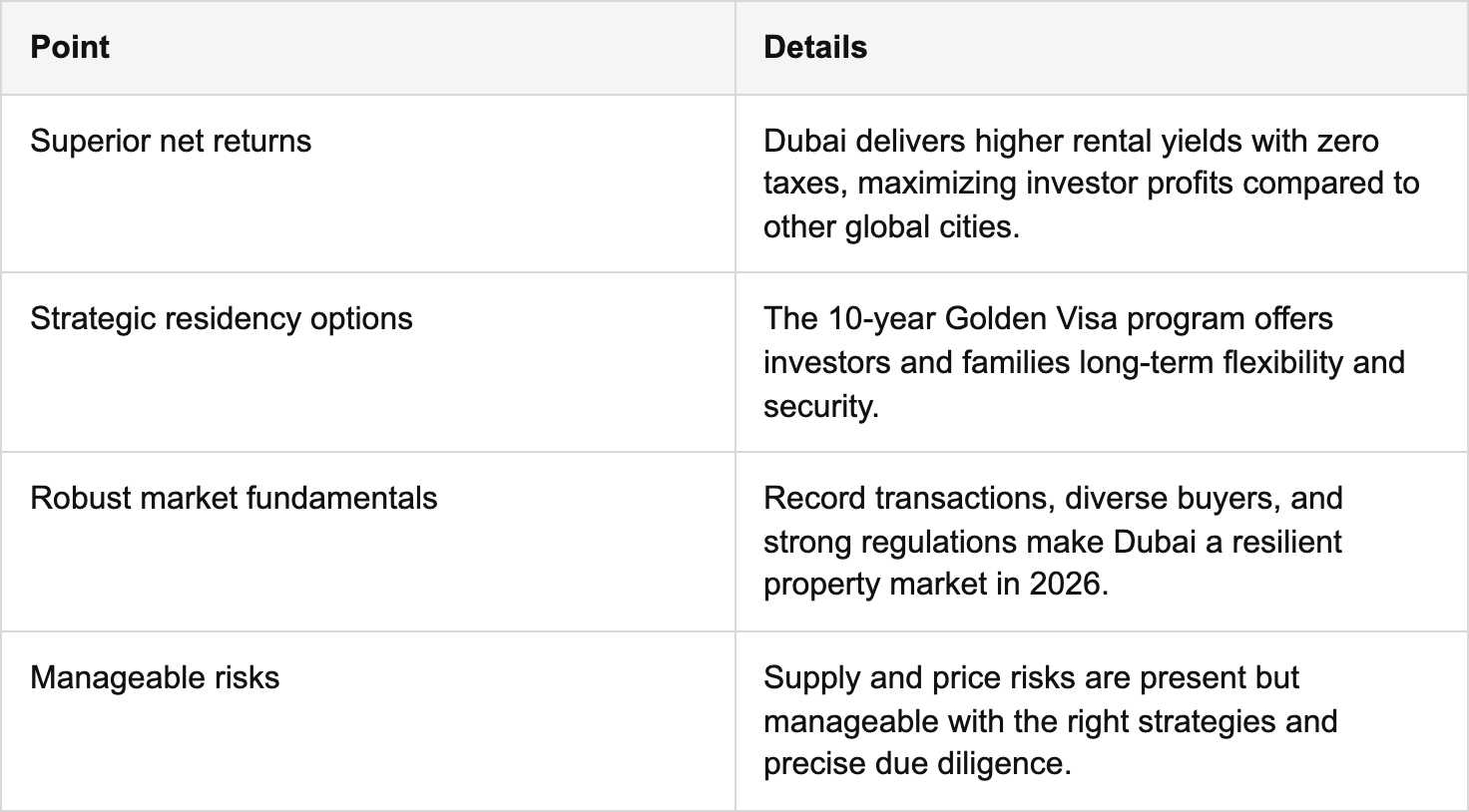
Key Takeaways
Exceptional rental yields and zero taxes
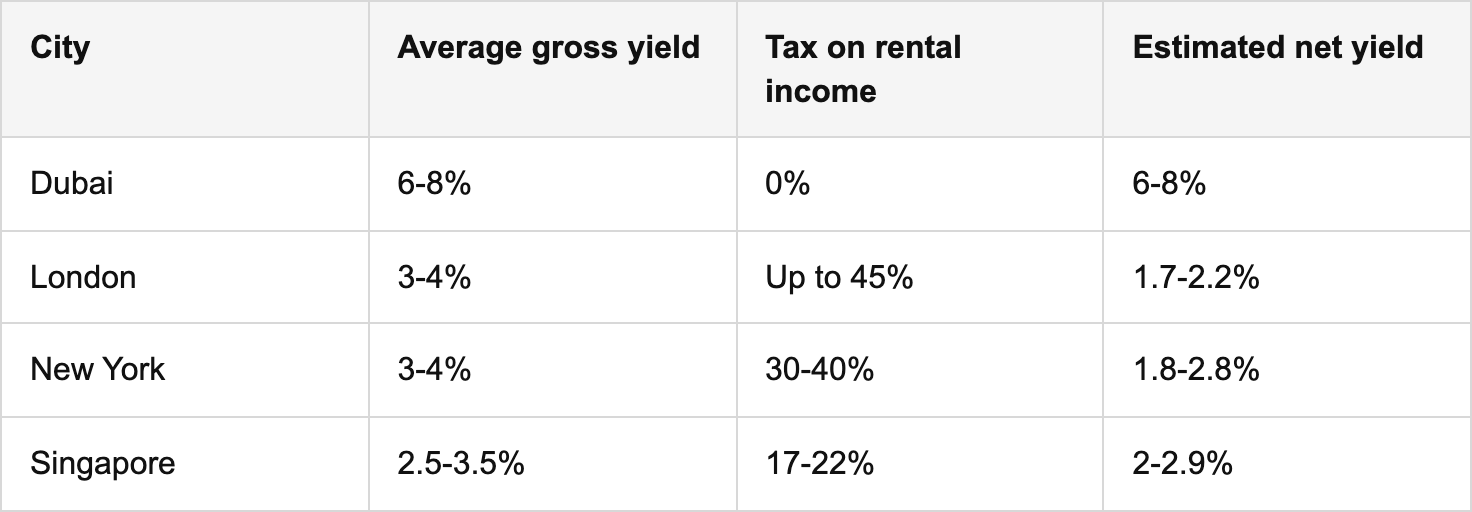
Start where it matters most: your bottom line. Dubai’s property market consistently delivers rental yields of 6-8% on average, a figure that already outpaces most established global cities. But the real advantage becomes clear when you factor in taxation. In London, rental income is subject to income tax rates of up to 45%, and capital gains tax applies on disposal. In New York, combined federal and state taxes can reduce your net rental income by 30-40%. Dubai, by contrast, imposes zero property taxes on rental income, capital gains, or inheritance.
Consider a straightforward example. If your Dubai property generates AED 100,000 in annual rental income, you retain the full amount. The same income earned from a comparable London property could leave you with AED 55,000 to 70,000 after tax. That gap compounds significantly over a five or ten-year holding period. Understanding Dubai rental yields in context means recognizing that the headline percentage is only part of the story.
The advantages of owning Dubai property extend further when you consider the absence of stamp duty equivalents at the purchase stage and no annual property tax levied by the municipality on residential holdings. Global investor trends confirm that tax efficiency is one of the top three reasons high-net-worth individuals are redirecting capital toward Dubai.
Rental yield and tax comparison: Dubai vs. global peers
Key tax advantages for Dubai investors:
- No income tax on rental earnings
- No capital gains tax on property disposal
- No inheritance tax on real estate assets
- No annual municipal property tax on residential holdings
- No wealth tax applicable to property portfolios
Pro Tip: Always calculate net yield, not gross yield, when comparing markets. Dubai’s 0% tax rate means your gross and net yields are identical, which is a structural advantage that rarely appears in other global markets. Review Dubai property taxes carefully to understand the full cost structure before committing capital.
10-year Golden Visa and residency advantages
Beyond pure numbers, Dubai offers long-term security for global families. The UAE’s Golden Visa program grants 10-year renewable residency to qualifying property investors, making it one of the most strategically valuable residency-by-investment programs available today. To qualify, your property must be valued at AED 2 million or more, and it can be a single asset or a combination of properties meeting that threshold.
The benefits extend well beyond a residency stamp:
- Family inclusion: Spouse, children, and in some cases parents can be sponsored under your Golden Visa.
- Business setup rights: Residency enables you to establish UAE-based companies, open corporate bank accounts, and operate locally.
- No minimum stay requirement: Unlike many residency programs globally, the Golden Visa does not require you to spend a fixed number of days per year in the UAE.
- Education access: Children gain access to UAE schools and universities under the same visa.
- Healthcare eligibility: Full access to UAE’s private and public healthcare systems.
- Visa-free travel: UAE passport holders and long-term residents benefit from one of the world’s most respected travel documents.
Demand for the program is substantial. Over 100,000 Golden Visas have been issued to date, and navigating residency alongside property acquisition has become a standard strategy for internationally mobile families. Industry data shows that 22-32% of high-value property transactions in Dubai are directly linked to Golden Visa applications.
“The Golden Visa transforms a real estate transaction into a long-term lifestyle and business platform. For high-net-worth families, it is not just an investment in property, it is an investment in optionality.”
Understanding the Dubai investor residency rules before you purchase is essential, as property structure and ownership type affect eligibility. You can also review the Golden Visa processing guide to understand timelines, which typically run between 12 and 25 business days.
Pro Tip: Pair your Golden Visa application with a prime-location property purchase from day one. Choosing a well-located asset in a freehold zone not only satisfies the AED 2M threshold but also positions you for stronger capital appreciation and easier family relocation logistics.
Global demand, liquidity, and robust regulations
Sustainable investments require strong underlying fundamentals, and Dubai’s market delivers on all three: broad buyer demand, high transaction liquidity, and investor-grade legal protections.
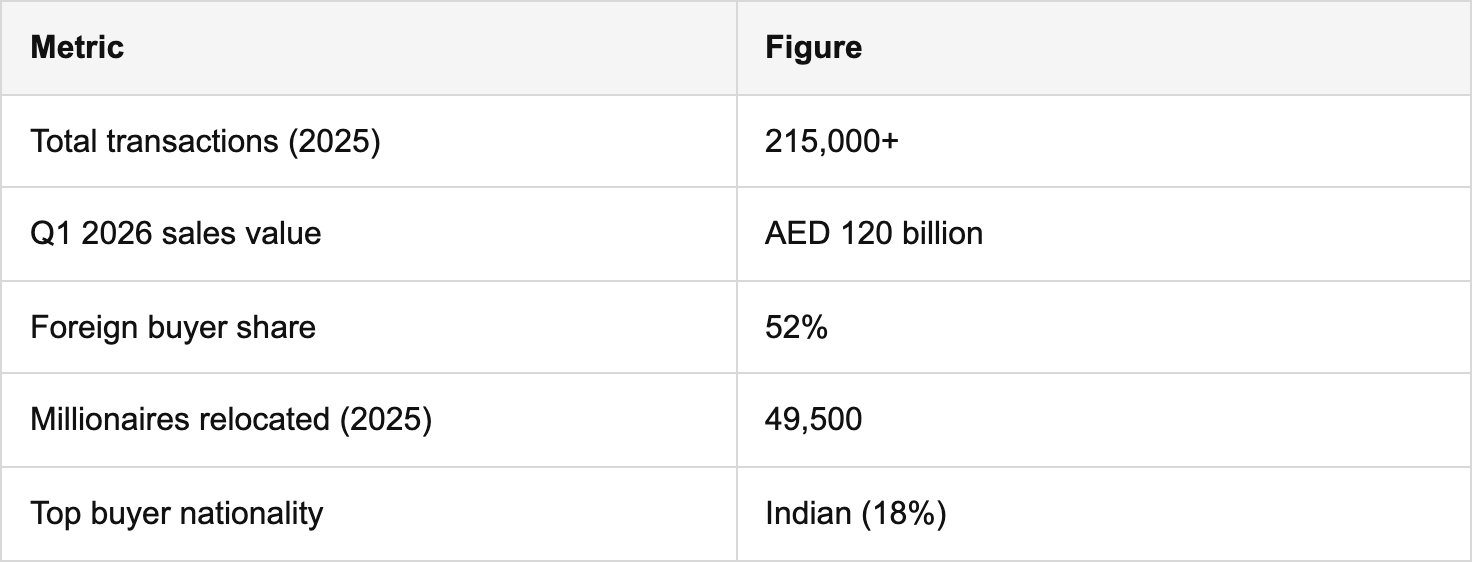
The buyer base is genuinely global. Indian nationals represent approximately 18% of buyers, Russian nationals around 9%, with significant volumes from the UK, EU, China, and GCC countries. Overall, 52% of buyers are foreign nationals, reflecting the city’s appeal as a neutral, internationally accessible market. Dubai attracted 49,500 millionaires in 2025 according to millionaire migration data, reinforcing the depth of the high-net-worth buyer pool.

Transaction volumes confirm this demand. The market recorded over 215,000 transactions in 2025, and Q1 2026 alone generated AED 120 billion in sales value. This level of activity means you can enter and exit positions with relative confidence, a critical factor for portfolio management.
Dubai property market: Key metrics
Regulatory protections are equally strong. Dubai’s legal framework includes:
- 100% freehold ownership available to foreign nationals in designated zones
- RERA (Real Estate Regulatory Authority) oversight of all transactions and developer conduct
- DLD (Dubai Land Department) title registration, ensuring transparent ownership records
- Escrow account requirements for off-plan developers, protecting buyer deposits
- Strata law governing jointly owned property and owners’ association rights
These protections give you a clear legal roadmap for 2026 real estate trends and make Dubai’s framework comparable to the most investor-friendly markets globally. Understanding how Dubai fits your broader Dubai portfolio impact is straightforward when the legal structure is this transparent.
Moderating price growth, supply dynamics, and risk
Even in the world’s most dynamic markets, a savvy investor asks: what has changed, and what are the risks? Dubai’s market in 2026 is fundamentally different from the 2020 to 2023 surge, and understanding that shift is essential for sound decision-making.
Price growth for 2026 is forecast at a sustainable 2-10%, a significant moderation from the 20%+ annual surges seen in prior years. This is not a warning sign. It is a sign of market maturation, which historically creates more stable, compounding returns for long-term holders.
That said, risks are real and should be factored into your strategy:
- Oversupply pressure: Approximately 167,000 units are expected to enter the market through 2026 and 2027, which could compress yields in certain sub-markets.
- Yield compression in prime segments: High demand for premium addresses has pushed entry prices up, narrowing gross yields in some areas.
- Speculative sub-markets: Certain off-plan communities with weaker fundamentals carry short-term loss potential if developer timelines slip or demand softens.
- Geopolitical sensitivity: While Dubai is positioned as a neutral hub, broader regional developments can affect buyer sentiment.
Practical risk management steps:
- Focus on established, liquid communities with proven rental demand.
- Prioritize developer quality and track record over headline payment plans.
- Conduct thorough due diligence on supply pipelines in your target area.
- Avoid speculative flipping in oversupplied sub-markets.
“The investors who will outperform in 2026 are those who treat Dubai as a long-term income asset, not a short-term trade. The risk-adjusted returns in mature, serviced communities remain among the best globally.”
Pro Tip: Distressed sales in over-leveraged sub-markets are currently available at 20-35% below market value. These represent genuine bargain entries for disciplined buyers who understand navigating Dubai market risks and can move quickly with clean financing. Watch for market bubble signs in specific corridors before committing.
A contrarian perspective: What most investors miss in Dubai’s 2026 boom
Before you finalize any investment decision, it is critical to look deeper than headline numbers. The most common mistake we see from globally sophisticated investors is treating Dubai like a 2021 trade: buy anything off-plan, wait for handover, sell at a profit. That playbook is largely exhausted.
2026 rewards discipline, not volume. The investors who are quietly outperforming are not chasing the highest advertised yield or the flashiest off-plan launch. They are buying in mature, serviced communities with strong rental infrastructure, established tenant demand, and clear exit liquidity. They are also looking at insights on Dubai’s market cycles to time their entry with precision rather than urgency.
Many high-net-worth individuals also overlook distressed inventory. When over-leveraged investors exit quickly, they create below-market opportunities that rarely appear in headline data. The prime segment, meanwhile, is more resilient than most external analysts suggest, driven by genuine end-user demand from the millionaire migration wave. The real edge in 2026 is local knowledge, patience, and a focus on compounding income over speculative capital gains.
Ready to invest with confidence? Work with Dubai’s trusted experts
Dubai’s 2026 property market offers a rare combination of high yields, zero taxes, legal security, and lifestyle benefits. But capturing that advantage requires more than data. It requires active market navigation, developer relationships, and precise timing.

Anthony Joseph’s award-winning team specializes in exactly this. From identifying prime-location assets and off-plan opportunities to managing your Golden Visa application and portfolio structuring, the guidance is tailored to your specific investment goals. If you are ready to move from research to action, work with Anthony Joseph to request a portfolio assessment or explore curated property options matched to your capital objectives and residency strategy.
Frequently asked questions
What are the main risks when investing in Dubai property in 2026?
Oversupply of 167,000 units, yield compression in prime segments, and cycle volatility are the primary risks. Focused due diligence on location, developer quality, and supply pipelines is the most effective mitigation strategy.
How does Dubai compare to London or New York for property investment returns?
Dubai delivers rental yields of 6-8% with zero tax on income or capital gains, while London and New York yields are reduced by 30-40% in taxes, making Dubai’s net return structurally superior.
Is the Dubai Golden Visa available for all property investors?
The Golden Visa requires AED 2M+ in qualifying property investment and grants 10-year renewable residency, including family sponsorship and business setup rights, but not all property types or ownership structures qualify.
What is the outlook for Dubai property prices in 2026?
Price appreciation of 2-10% is forecast for 2026, representing a healthy moderation from the 20%+ annual growth seen in prior years and signaling a more sustainable, long-term investment environment.


