

Why Invest in Dubai Real Estate: Global Portfolio Impact
Wealth preservation and growth rarely come easy, especially for high-net-worth European and Asian investors navigating mature property markets. Dubai’s real estate sector stands out by offering a potent mix of robust legal protections, minimal income tax, and diverse opportunities across residential, commercial, and mixed-use segments. With Dubai recording property transactions exceeding AED 917 billion in 2025, this market delivers substantial depth and liquidity for investors seeking tangible assets and geographic diversification in a global portfolio.
Table of Contents
Dubai Real Estate Investment Defined
Dubai real estate investment represents a strategic approach to acquiring, holding, and generating returns from property assets within the Emirates’ dynamic property market. At its core, this investment category encompasses residential, commercial, and mixed-use properties, ranging from residential apartments and villas to office spaces, retail outlets, and hospitality assets. Unlike traditional stock or bond investments, real estate in Dubai offers a tangible asset with physical value, providing investors with both income generation through rental yields and capital appreciation potential. The definition extends beyond simple property ownership to include a comprehensive investment strategy that factors in market cycles, regulatory frameworks, and global economic influences affecting property values.
What distinguishes Dubai real estate as an investment vehicle is the emirate’s unique position as a global business hub with minimal income tax, transparent regulatory frameworks, and a diversified economy. Investors typically engage through multiple entry points: direct property purchase (whether freehold in designated areas or leasehold arrangements), off-plan investments in emerging developments, real estate investment trusts, or fractional ownership models. The market’s sophistication reflects its maturity, with property transactions consistently demonstrating resilience. For context, Dubai’s property market recorded transactions exceeding AED 917 billion in 2025, underscoring the scale and depth of investment opportunities available to international capital.
For high-net-worth investors from Europe and Asia, Dubai real estate investment functions as a diversification mechanism within a broader global portfolio. It addresses several investor objectives simultaneously: generating consistent rental income through high-occupancy rates, accessing capital appreciation in a property market with established historical growth patterns, and establishing a tangible asset base in a jurisdiction with robust property rights protections and transparent title registration. The investment framework operates within clear legal structures, regulated by the Real Estate Regulatory Agency, which ensures transparency and protects investor interests. A trained real estate professional can guide you through structuring your investment to align with your specific objectives, whether prioritizing immediate cash flow, long-term appreciation, or portfolio diversification across geographic regions.
Understanding this definition also means recognizing the supporting infrastructure that makes Dubai real estate attractive. The emirate’s commitment to professional development in the real estate sector reflects this strategic importance. The introduction of formal educational pathways, including specialized training programs in real estate management and investment strategy, demonstrates Dubai’s focus on ensuring a knowledgeable market with qualified professionals who understand both investor needs and market dynamics. This educational ecosystem supports your investment journey by ensuring access to informed advisors who can navigate complex transactions and market conditions.
Pro tip: Begin your Dubai real estate investment journey by clearly defining whether your primary objective is monthly rental income, long-term capital growth, or portfolio diversification, as this distinction fundamentally shapes which property types, locations, and investment structures will deliver optimal returns aligned with your financial goals.
Major Property Types and Segments
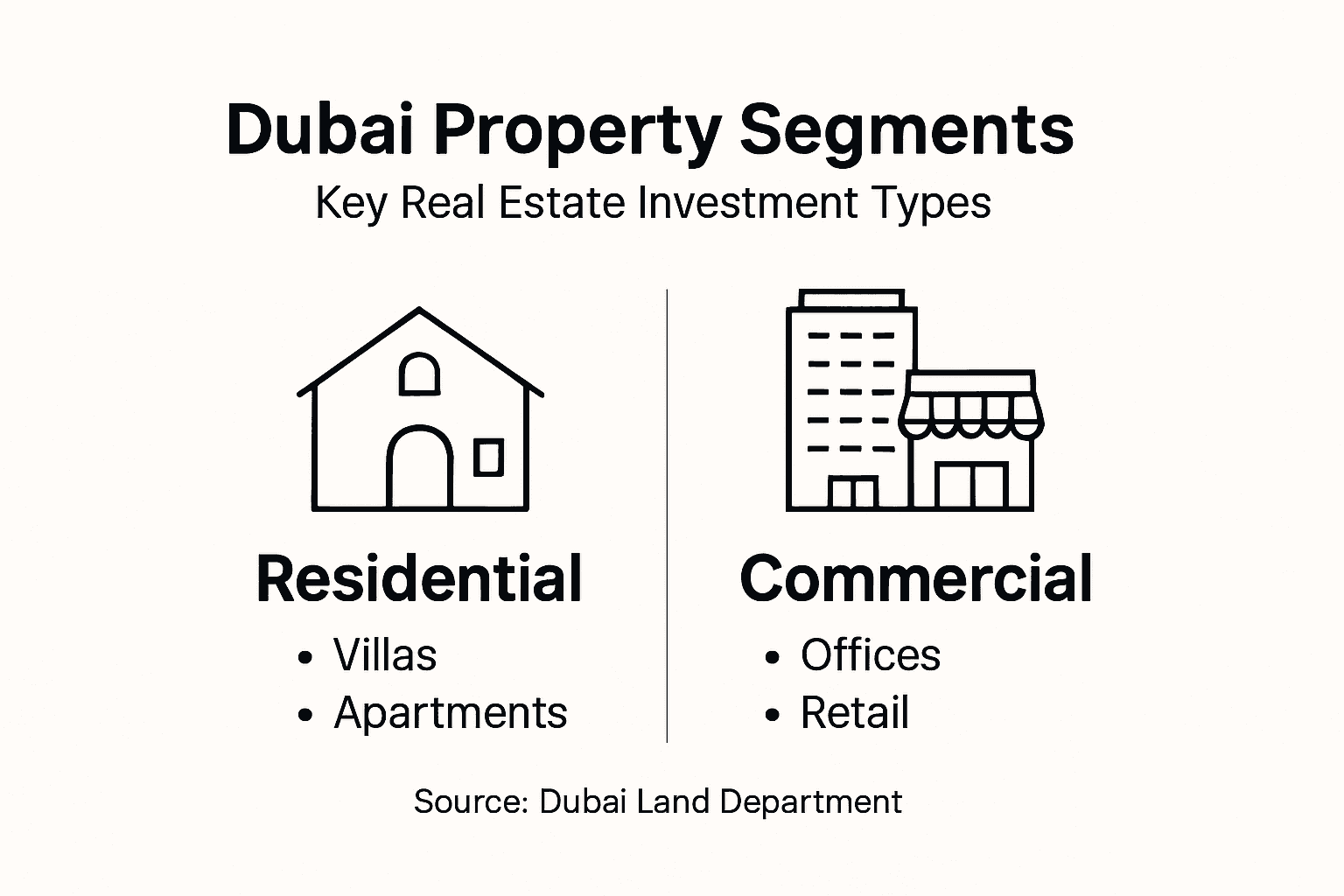
Dubai’s real estate market divides into distinct property categories, each serving different investor profiles and generating different return profiles. The primary segments are residential properties (villas and apartments), commercial real estate (offices and retail), and mixed-use developments that combine multiple functions. Understanding these segments is critical because each operates under different market dynamics, attracts different tenant demographics, and responds differently to economic cycles. For European and Asian investors building globally diversified portfolios, recognizing these distinctions allows you to allocate capital strategically based on your income generation timeline and risk tolerance.
Residential Properties: Villas and Apartments
Residential real estate dominates Dubai’s investment landscape and splits into two primary subcategories with distinctly different characteristics. Villas represent single-family dwellings, typically offering higher price points per unit but commanding premium rental rates from families and expatriate executives. These properties appeal to investors seeking stable, long-term tenancy with professional occupants who value privacy and space. Apartments and flats, conversely, provide lower entry points and attract a broader tenant base including young professionals, couples, and corporate housing seekers. According to Dubai’s 2024 real estate performance analysis, villas experienced particularly strong price appreciation, reflecting investor confidence in this segment’s capital growth potential. The villa segment appeals especially to investors prioritizing both rental income and significant appreciation over five to ten year holding periods.
Apartment investments offer different advantages. They typically generate faster tenant turnover, allowing portfolio adjustments more rapidly than villa segments. Studio and one bedroom apartments remain consistently in high demand from young professionals and first-time renters, while two and three bedroom units attract families requiring longer lease terms. The lower capital requirement per unit also enables portfolio diversification, allowing investors to spread capital across multiple properties and locations rather than concentrating investments in single large assets.
Commercial Properties: Offices and Retail
Commercial real estate encompasses office spaces and retail units, each serving distinct business functions and investor strategies. Office properties range from small individual units in business parks to large floor plates in premium downtown locations. These spaces attract multinational corporations, professional services firms, and regional headquarters operations, generally offering longer lease terms (three to five years minimum) with corporate-grade tenants providing predictable income. Retail units include ground-floor shopfronts, mall spaces, and standalone commercial establishments. The retail segment has experienced transformation following pandemic impacts, but premium locations in high-traffic areas maintain strong performance, particularly in hospitality-adjacent properties.
Commercial investments typically deliver lower gross rental yields compared to residential properties but offer superior tenant stability and longer lease commitments. Office properties particularly appeal to investors seeking passive income with minimal turnover management. However, commercial segments show greater sensitivity to economic cycles and business confidence indicators. An international investor deploying capital across both residential and commercial segments can balance short-term income stability with longer-term appreciation potential across market cycles.
Mixed-Use and Specialized Developments
Mixed-use developments combine residential, commercial, and hospitality components within single projects. These modern developments often include apartments, retail spaces, restaurants, gyms, and co-working facilities, creating vibrant communities that attract diverse tenant pools. Investors in mixed-use projects benefit from multiple revenue streams and reduced vacancy risk through varied tenant demographics. Specialized properties including student housing, serviced apartments, and hospitality investments represent smaller segments but increasingly attract institutional capital seeking alternative income models.
Dubai’s investor base has expanded globally, with growing interest from European, Asian, and Middle Eastern capital seeking exposure to these varied segments. The diversity of property types allows investors to construct tailored portfolios aligned with specific objectives. Some investors focus exclusively on residential for steady monthly returns, while others combine residential income properties with commercial assets for diversification or add mixed-use developments for enhanced capital appreciation potential.
Here’s a concise comparison of major Dubai property types to highlight their core differences for investors:

Pro tip: Start by identifying your primary investment objective—monthly cash flow, long-term appreciation, or portfolio diversification—then focus your property selection within segments that historically deliver that outcome, as villa investments typically outperform apartments for appreciation while apartment portfolios generate more consistent monthly returns.
Key Market Features for Investors
Dubai’s real estate market operates within a framework of structural advantages that distinguish it from competing international markets. The combination of regulatory transparency, high transaction volumes, and consistent price growth creates an environment where international investors can deploy capital with confidence. These market features directly impact your investment returns, risk profile, and portfolio performance. Understanding what makes Dubai’s market unique helps you evaluate whether this market aligns with your broader investment strategy and financial objectives.
Regulatory Transparency and Investor Protection
The regulatory environment forms the bedrock of Dubai real estate investment confidence. The Real Estate Regulatory Agency (RERA) enforces strict compliance standards, maintains transparent property registries, and protects investor capital through escrow requirements for off-plan purchases. This regulatory framework eliminates the opacity that characterizes less mature markets, allowing you to conduct due diligence with access to verified, accurate property records and transaction history. The transparency isn’t merely administrative; it fundamentally reduces your transaction risk and provides legal recourse if disputes arise.

Dubai’s freehold property ownership system in designated areas grants actual ownership rights equivalent to property rights in developed Western jurisdictions. This differs significantly from leasehold structures in some international markets, where you hold use rights rather than actual property ownership. For European investors familiar with property ownership in London or Amsterdam, this distinction matters considerably. The clarity of ownership rights protects your capital and ensures that property appreciation accrues directly to you rather than to development authorities or ground-lease holders.
Transaction Volume and Market Liquidity
The sheer scale of Dubai’s real estate activity creates genuine market liquidity. Dubai’s market demonstrates significant transaction volumes and balanced off-plan and ready property availability, ensuring you can execute buy and sell transactions without artificial market constraints. High transaction velocity means properties move quickly in both rising and declining markets, reducing the risk of capital becoming trapped in illiquid positions.
This liquidity becomes increasingly valuable during portfolio rebalancing or when market conditions suggest transitioning from one property type to another. An investor holding commercial real estate in a slowing economy might efficiently redeploy capital into residential segments without enduring extended holding periods. The alternative in less liquid markets forces investors to wait months or years to execute strategic changes, sacrificing timing advantages and capital efficiency.
Price Growth and Capital Appreciation
Historical price performance across Dubai’s property segments, particularly in premium residential categories, demonstrates consistent capital appreciation over medium-term holding periods. This growth reflects genuine supply-demand dynamics rather than speculative bubbles. Population growth, expanding corporate presence, and increasing ultra-high-net-worth resident concentration drive sustained demand for premium properties. For investors from Europe and Asia seeking geographic diversification, Dubai’s price trajectory offers returns that compete favorably with developed Western markets while providing exposure to an emerging premium market.
Price growth patterns vary by segment and location. Villa segments have demonstrated particularly strong appreciation, while apartment segments often deliver more stable but moderate growth. Understanding these differential growth rates allows you to weight portfolio allocation toward segments aligned with your appreciation expectations. An investor prioritizing capital growth over rental income might allocate more heavily to villa segments, while an investor needing monthly cash flow emphasizes apartment portfolios despite potentially slower appreciation.
Diverse Global Investor Base
Dubai’s investor composition has expanded substantially beyond traditional Middle Eastern capital. The market now attracts European investors fleeing restrictive property regulations, Asian investors seeking Western-standard legal protections, and international fund managers deploying institutional capital. This diversified investor base creates competitive market dynamics while reducing concentration risk associated with single-source capital dependence. You’re investing alongside sophisticated institutional investors who conduct rigorous due diligence, validating market opportunities and reducing the likelihood of asset-level misrepresentation or market mispricing.
The international investor presence also supports professional services infrastructure. Real estate advisors, property managers, legal specialists, and wealth planners serving international clients maintain high professional standards to compete for sophisticated clientele. This competitive service environment works directly in your favor, ensuring access to qualified professionals who understand both Dubai’s local market and your home jurisdiction’s tax and regulatory requirements.
Pro tip: Before committing capital, request detailed transaction history and rental performance data for specific properties you’re considering, as this concrete performance data reveals actual market dynamics far more accurately than developer projections or marketing materials.
Legal Framework and Ownership Rights
Dubai’s legal structure governing real estate ownership differs fundamentally from many Western jurisdictions, requiring careful attention before deploying capital. The framework accommodates multiple ownership models, each with distinct rights, responsibilities, and long-term implications for your investment returns and capital security. As a high-net-worth investor from Europe or Asia, understanding these distinctions prevents costly mistakes and ensures your property investment aligns with your overall tax and wealth planning strategy. The legal clarity that characterizes Dubai’s system works in your favor, providing certainty about ownership rights that many emerging markets cannot match.
Freehold Ownership and Leasehold Structures
Freehold and leasehold ownership structures accommodate diverse investor needs within Dubai’s regulatory framework. Freehold ownership grants you complete control over land and the structures built upon it, with indefinite ownership duration. This ownership model operates similarly to property ownership in London, Toronto, or Sydney, where you hold the title outright and retain all appreciation benefits. Freehold properties exist in designated freehold zones throughout Dubai, primarily in areas like Downtown Dubai, Dubai Hills Estate, Palm Jumeirah, and Arabian Ranches. These zones were specifically established to accommodate expatriate investors, meaning foreign nationals can acquire freehold properties without restrictions.
Leasehold ownership, conversely, grants you temporary use rights over a property for a specified duration, typically ranging from 99 years down to shorter periods. During the lease term, you hold actual occupancy and use rights, and you can generate rental income from tenants. However, the underlying land ownership remains with the ground-lease holder, typically a government entity or development authority. At lease expiration, your ownership rights terminate and revert to the ground-lease holder. For long-term investors, leasehold terms of 99 years present minimal practical concerns given investment timelines. However, shorter leasehold periods of 30 or 50 years require careful analysis regarding residual value and refinancing implications as lease expiration approaches.
Regulatory Compliance and Property Registration
Property registration occurs through the Dubai Land Department, which maintains comprehensive ownership records accessible for due diligence verification. Every property transaction requires Dubai Land Department registration, creating a transparent title registry that protects both buyers and existing owners. This registration system eliminates the title disputes and ownership ambiguities that plague less developed markets. When you purchase a property, you receive an official title document confirming your ownership rights, duration, and any encumbrances or restrictions.
The registration process involves several critical steps. Your transaction passes through RERA (Real Estate Regulatory Agency) compliance verification, ensuring the property meets legal standards and the transaction complies with regulatory requirements. For off-plan purchases, RERA escrow requirements protect your capital during the development period, ensuring funds cannot be diverted from construction. This regulatory oversight distinguishes Dubai from jurisdictions where developer fraud or capital misappropriation represents genuine risk. Understanding these protections provides confidence that your capital deployment follows established legal procedures.
Ownership Rights and Capital Appreciation
Freehold ownership rights in designated zones grant you direct benefit from property appreciation. Any increase in property value accrues entirely to you as the owner. This differs from some alternative market structures where appreciation benefits flow to development authorities or ground-lease holders rather than individual property owners. For investors prioritizing long-term capital growth, freehold ownership ensures your investment thesis depends on genuine property market performance rather than structural arrangements that fragment appreciation benefits.
Leasehold ownership complicates appreciation calculations. As lease expiration approaches, property value typically declines as remaining lease duration shortens. A property with 99 years remaining leasehold holds near full value, but the same property with 30 years remaining leasehold trades at substantial discount reflecting limited remaining tenure. This dynamic particularly affects long-term investment planning. An investor purchasing a 40-year leasehold property at age 50 might reasonably expect to hold the property for 20 to 30 years, accepting lease expiration risk. Conversely, an investor at age 40 with 40-year remaining leasehold faces lease expiration within their lifetime, requiring explicit consideration of refinancing, lease extension possibilities, or eventual property relinquishment.
Restrictions and Considerations for International Investors
Foreign nationals can freely purchase freehold properties in designated zones without nationality restrictions or foreign ownership caps. This unrestricted access distinguishes Dubai from many developed markets where foreign ownership faces limitations, percentage caps, or higher taxation. However, non-residents cannot purchase leasehold properties outside specific zones, and certain sectors restrict foreign participation. Investment property purchases don’t trigger additional taxation specific to foreign buyers, eliminating a common barrier in competing markets.
Your obligations as a property owner include maintaining adequate property insurance, paying annual fees for leasehold properties (which cover maintenance and administration), and ensuring tenancy compliance with Dubai’s rental law framework. These obligations are straightforward and comparable to property ownership responsibilities in any developed jurisdiction.
Pro tip: When evaluating Dubai property purchases, always verify remaining lease duration and confirm freehold status through the Dubai Land Department registry before committing capital, as this single verification prevents structural ownership complications that could diminish future marketability or refinancing flexibility.
Tax-Free Benefits and Golden Visa
The United Arab Emirates offers a fiscal environment fundamentally different from most developed markets, with zero personal income tax creating substantial wealth preservation advantages for international investors. This tax structure, combined with the Golden Visa residency program, creates a compelling incentive framework that extends beyond pure property investment returns. For European investors managing significant wealth across multiple jurisdictions and Asian investors seeking tax-efficient wealth deployment, Dubai’s tax regime represents a material financial advantage that compounds significantly over decades of investment holding periods.
Tax-Free Income and Wealth Preservation
The UAE imposes no personal income tax on rental income generated from real estate investments, capital gains, or investment returns. This contrasts sharply with most developed jurisdictions where property investors face marginal income tax rates ranging from 20 percent to 45 percent on rental income depending on domicile and tax bracket. For a European investor generating 100,000 euros annually from Dubai property rentals, the absence of income tax preserves approximately 40,000 to 45,000 euros that would otherwise flow to the tax authority in their home country. Over a 20-year investment horizon, this tax efficiency compounds into millions of euros in additional wealth retention.
Capital gains from property sales are similarly tax-free in the UAE. When you sell a Dubai property at profit, you retain the entire appreciation amount without capital gains taxation. This differs markedly from the United Kingdom (where 20 percent capital gains tax applies), Canada (where 50 percent of gains are taxable), or Singapore (where gains above certain thresholds trigger taxation). The tax-free treatment of capital gains means your investment returns compound more efficiently, accelerating wealth accumulation compared to tax-jurisdictions where gains erode through taxation.
Wealth taxes, inheritance taxes, and property-specific taxes that characterize many developed markets simply do not exist in the UAE. German investors familiar with inheritance taxes approaching 19 to 30 percent find the tax-free wealth transfer environment particularly advantageous. Swiss investors accustomed to wealth taxes appreciate the absence of annual levies on asset values. This tax environment attracts sophisticated wealth management by allowing capital preservation without continuous tax drag.
The following table summarizes the tax and residency benefits that distinguish Dubai real estate for international investors:

Golden Visa and Long-Term Residency
The Golden Visa grants long-term renewable residency for property investors meeting minimum investment thresholds, eliminating traditional sponsor dependencies that characterize most UAE residency options. Property investors who purchase real estate valued at AED 2 million or more automatically qualify for a 10-year renewable residence visa without requiring a local sponsor or employer. This removes a significant friction point in the traditional expatriate residency model, where visa sponsorship typically requires employer dependency or family relationships.
The Golden Visa provides unprecedented stability for investors seeking to establish long-term UAE presence. Rather than managing annual visa renewals or navigating employer transitions that complicate residency status, Golden Visa holders enjoy a decade of residential certainty with straightforward renewal pathways. For investors from Europe and Asia prioritizing stability and long-term UAE presence, this visa independence fundamentally changes the residency calculation.
The visa benefits extend beyond mere residency permission. Golden Visa holders can sponsor immediate family members, work and study in the UAE without employer sponsorship, and enjoy unrestricted travel flexibility that traditional sponsored visas restrict. An investor holding a Golden Visa can restructure employment, launch business ventures, or adjust professional circumstances without visa complications that plague sponsor-dependent residency arrangements. Family members gain the ability to pursue education or employment independent from the primary investor’s circumstances, creating genuinely flexible household arrangements.
Strategic Portfolio Integration
The combination of tax-free real estate returns and Golden Visa residency creates a distinctive investment framework unavailable in competing jurisdictions. An investor can deploy capital into Dubai property generating substantial rental income completely tax-free, simultaneously securing long-term residency that provides flexibility for broader lifestyle and business objectives. This combination proves particularly attractive to European investors from high-tax jurisdictions seeking geographic diversification while optimizing overall tax positioning.
Golden Visa qualification at the AED 2 million threshold aligns conveniently with meaningful Dubai real estate investment positions. A 2 million AED property (approximately 544,000 USD) represents a legitimate entry point into Dubai’s premium residential market, allowing investors to build meaningful property portfolios while simultaneously qualifying for residency advantages. Investors deploying larger capital amounts can acquire multiple properties and benefit from proportional visa advantages across their investment portfolio.
The visa’s renewable structure means long-term investors can sustain residency indefinitely through simple visa renewal processes. Rather than navigating changing employment circumstances or building business entities to maintain residency status, property investors with Golden Visas maintain stable residency through straightforward administrative renewal procedures tied directly to property ownership.
Pro tip: When structuring Dubai real estate investments above AED 2 million, explicitly plan for Golden Visa application timing alongside property acquisition to maximize the residency benefit, as this integration creates tax-efficient wealth preservation while establishing long-term UAE lifestyle flexibility that compounds across decades of property ownership.
Risks, Common Pitfalls, and Exit Strategies
Dubai real estate investment delivers compelling returns, but like any asset class, it carries identifiable risks and pitfalls that careless investors encounter repeatedly. Understanding these challenges before deploying capital allows you to structure investments defensively, implement protective mechanisms, and develop exit strategies that preserve capital when market conditions shift. European and Asian investors accustomed to mature Western markets sometimes underestimate Dubai-specific risks, particularly around tenant management, market cyclicality, and liquidity constraints during downturns. A realistic assessment of potential obstacles combined with pragmatic exit planning distinguishes successful investors from those who encounter unexpected challenges.
Market Cyclicality and Price Volatility
Dubai’s property market demonstrates cyclical behavior, with periods of rapid appreciation followed by correction phases where values decline materially. The 2008 financial crisis saw Dubai property values fall 50 to 60 percent from peak valuations, creating significant losses for investors who purchased at market peaks without exit strategies. While the market has matured substantially since 2008, cyclicality remains inherent to Dubai’s dynamics as an emerging premium market. Investors projecting indefinite appreciation without acknowledging correction possibilities underestimate downside exposure.
Price volatility affects different property segments differently. Luxury villa markets demonstrate greater volatility than mid-market apartment segments, which maintain more stable valuations through consistent international demand. An investor allocating heavily to ultra-premium properties faces greater drawdown risk during corrections compared to diversified portfolios spanning multiple segments. Volatility also extends to rental rates. During economic downturns, tenant demand weakens and rental rates decline before property prices stabilize. An investor dependent on rental income can face reduced cash flow during correction phases even if property values eventually recover.
Managing cyclical risk requires disciplined portfolio structuring. Rather than concentrating capital in single properties or premium segments, diversifying across villa and apartment investments, multiple locations, and varying price points dampens cyclical impact. Investors adopting long-term holding horizons of 7 to 10 years can typically absorb correction phases and benefit from subsequent appreciation cycles. Conversely, investors with short time horizons face genuine risk of selling during downturns at depressed valuations.
Tenant Management and Vacancy Risk
Dubai attracts substantial expatriate populations, creating reliable tenant demand but also generating tenant turnover dynamics that complicate cash flow forecasting. International tenants relocate frequently due to employment transfers, expat assignments concluding, or lifestyle changes. While this creates opportunities to reset rental rates to market levels, it also generates periods of vacancy between tenants and costs associated with property maintenance and marketing between leases.
Tenant quality varies substantially. Professional corporate tenants with employer support typically maintain lease obligations reliably, while individual tenants sometimes face financial difficulties that complicate collections. A single tenant default can eliminate rental income for months while pursuing legal recovery through Dubai courts. Larger portfolios with multiple tenants diversify this risk, but single-property investors face concentration risk if their sole tenant defaults or departs unexpectedly.
Property management becomes critical in managing tenant relationships and minimizing vacancy periods. Owners managing properties directly sometimes lack expertise in tenant screening, lease enforcement, and maintenance coordination. Professional property management companies charge 5 to 10 percent of rental income but provide systematic tenant management, maintenance coordination, and legal compliance that reduce owner headaches and minimize income disruption.
Liquidity Constraints and Market Timing
While Dubai’s property market offers superior liquidity compared to many emerging markets, genuine liquidity constraints emerge during economic downturns or crisis periods. During severe corrections, buyer demand evaporates and selling properties requires substantial price concessions to attract bidders. An investor needing to liquidate during a downturn may face forced sales at depressed valuations, crystallizing losses rather than waiting for recovery.
Off-plan property purchases create liquidity complications. Selling off-plan properties before completion requires finding alternative buyers willing to assume the purchase contract, often requiring price concessions. Once properties complete, resale becomes more straightforward, but the development period creates illiquidity where capital remains locked in incomplete projects for years.
Currency Risk and Exchange Rate Exposure
Property purchases typically involve currency conversion from your home currency to AED. If you’re a European investor purchasing with euros or an Asian investor using Singapore dollars, exchange rate movements affect your effective investment cost. AED is pegged to the US dollar, but your home currency may appreciate or depreciate against the dollar, changing your investment’s cost in home currency terms. Currency depreciation against the AED increases your effective investment cost, while appreciation works in your favor.
Rental income received in AED requires conversion to your home currency for personal use, exposing you to ongoing exchange rate risk. If your home currency weakens against the AED, your converted rental income decreases. Hedging strategies exist through forward contracts or multi-currency accounts, but they add complexity and costs.
Developing Effective Exit Strategies
Successful investors establish exit criteria before acquiring properties, defining specific circumstances triggering portfolio adjustments or complete exits. Common exit triggers include achieving target appreciation percentages (selling villa investments after 30 percent appreciation), reaching holding period targets (exiting properties after 10-year ownership regardless of market conditions), or portfolio rebalancing when segment performance diverges significantly from expectations.
Diversified exit timing prevents forced sales during simultaneous market downturns. Rather than holding identical holding periods for all properties, stagger holding periods so portfolio exits occur across different market cycles. This prevents a situation where multiple properties become eligible for sale simultaneously during unfavorable market conditions.
Maintaining liquidity reserves ensures you’re not forced into distressed sales if unexpected circumstances require capital. Investors with 12 to 24 months of holding costs, including property taxes, maintenance, and utilities, can weather temporary vacancy periods or market challenges without needing immediate liquidity from property sales.
Pro tip: Establish written investment exit criteria before purchasing Dubai properties, specifying target returns or holding periods that trigger portfolio adjustments, and maintain sufficient liquidity reserves to prevent forced sales during market downturns that could crystallize losses instead of waiting for recovery cycles.
Unlock Strategic Advantages with Anthony Joseph in Dubai Real Estate
Navigating Dubai’s real estate market requires an expert who understands the complex regulatory landscape, market cycles, and investment segments like villas, apartments, and commercial properties. The challenges of cyclical price volatility, tenant management, and structuring investments for long-term capital growth or rental income demand tailored guidance to optimize your portfolio’s impact. Anthony Joseph offers you personalized solutions including property sales, off-plan investments, and professional property management designed to align with your unique investment objectives mentioned in the article such as securing tax-free returns and capitalizing on Dubai’s Golden Visa benefits.

Take confident steps today by partnering with a highly awarded Dubai real estate broker who provides detailed insights and actionable strategies on https://anthonyjosephaj.com. Explore comprehensive property sales and rentals, and leverage expert advice on investment structuring and portfolio diversification. Don’t leave your Dubai real estate investment to chance. Visit the platform now and ensure your global portfolio gains the edge it deserves.
Frequently Asked Questions
What are the main types of real estate investments available in Dubai?
Dubai offers several types of real estate investments, including residential properties (like villas and apartments), commercial properties (like office spaces and retail units), and mixed-use developments. Each segment has distinct characteristics and caters to different investor goals.
How does Dubai’s regulatory framework benefit real estate investors?
Dubai’s regulatory framework is characterized by transparency and investor protection through the Real Estate Regulatory Agency (RERA). It enforces strict compliance standards and ensures that property transactions are secure, thus reducing risks for investors.
What potential returns can investors expect from Dubai real estate?
Investors can expect a combination of rental income and capital appreciation. While rental yields can vary, many investors in Dubai benefit from consistent cash flow, especially in high-demand areas, with property values historically showing growth over time.
What tax advantages do investors gain from purchasing property in Dubai?
Investors in Dubai enjoy a tax-free environment, meaning there are no personal income taxes on rental income or capital gains. This tax structure significantly enhances overall wealth preservation and investment returns compared to markets with high taxation.


