
Leverage Dubai real estate trends for smarter investment decisions
TL;DR:
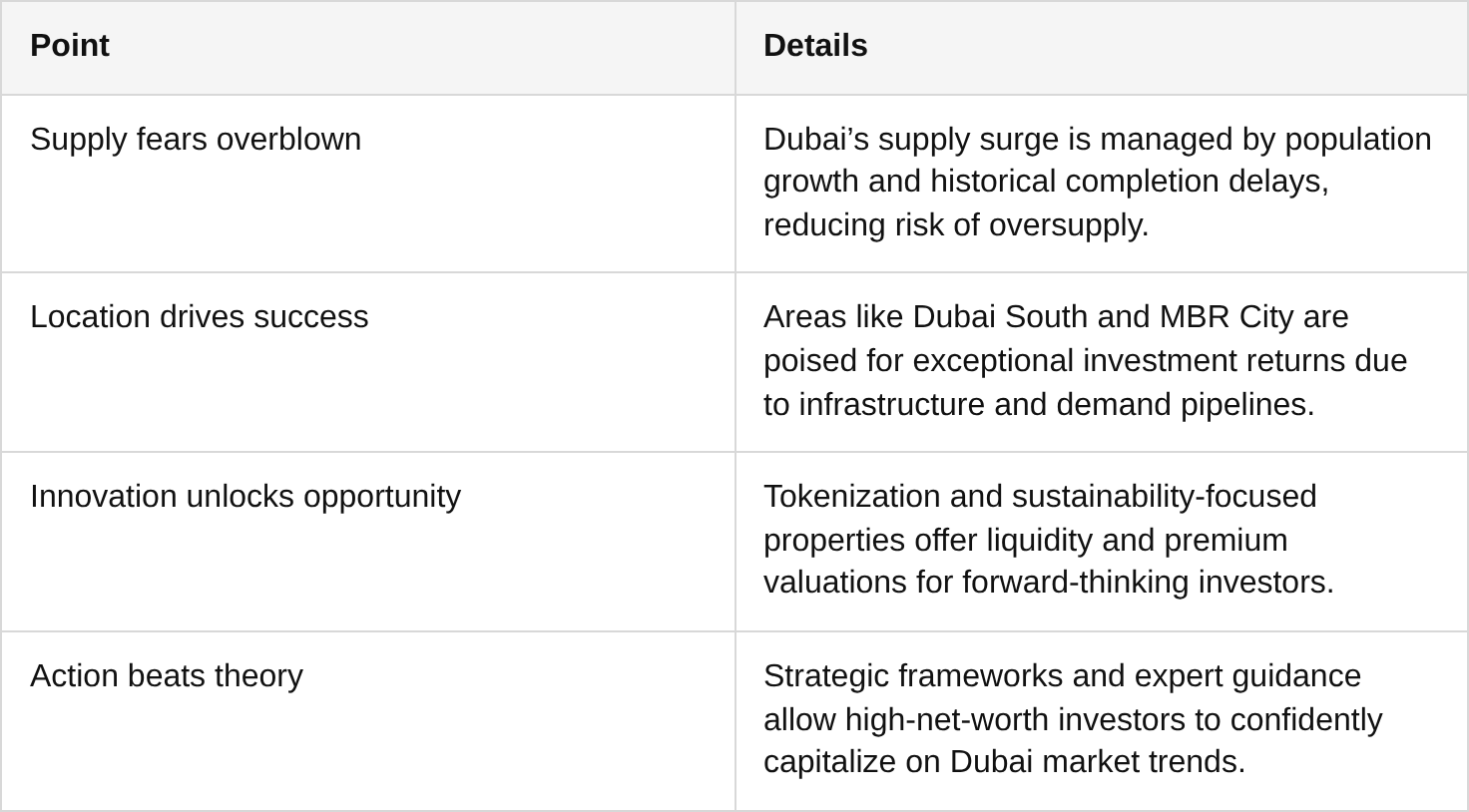
- Dubai’s population growth and delayed project completions prevent real market oversupply in 2026.
- Key growth areas like Dubai South and MBR City benefit from infrastructure upgrades, offering high upside potential.
- Tokenization and sustainability certifications are reshaping investment liquidity and valuation premiums in Dubai real estate.
With up to 160,000 new residential units projected to enter Dubai’s market in 2026, many investors assume a supply glut is inevitable. That assumption is wrong, and acting on it could cost you significant returns. Dubai’s population continues to grow at a pace that absorbs new inventory faster than most markets worldwide, and historical completion delays consistently reduce actual delivery rates well below planned figures. This guide cuts through the noise, walking you through the real supply and demand picture, the neighborhoods commanding the strongest growth, emerging innovations reshaping liquidity, and the actionable frameworks that position high-net-worth investors for maximum returns in 2026.
Table of Contents
- Analyzing Dubai supply and demand drivers for 2026
- Strategic locations and growth corridors in Dubai
- Innovations: Tokenization and sustainability in Dubai real estate
- Actionable strategies for Dubai property investors in 2026
- Our take: What most investors miss about Dubai market dynamics
- Partner with expert guidance for optimal Dubai property results
- Frequently asked questions
Key Takeaways
Analyzing Dubai supply and demand drivers for 2026
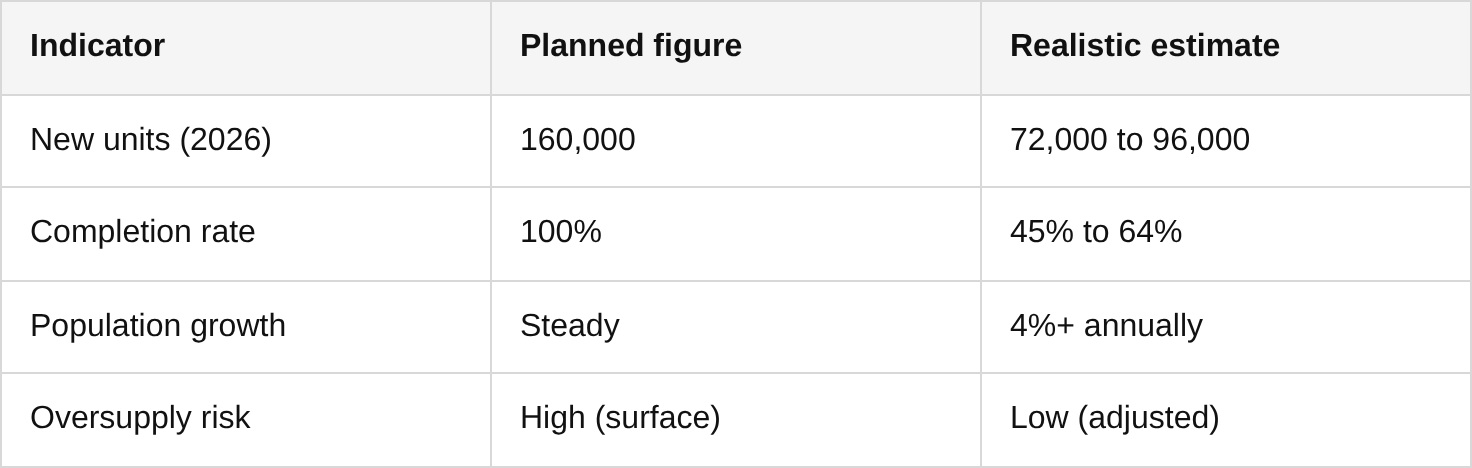
The headline number of 100,000 to 160,000 units planned for 2026 sounds alarming at first glance. But context transforms that figure entirely. Dubai’s population has surpassed 4 million residents, and sustained net migration keeps demand elevated year after year. When you factor in that historical completion rates in Dubai consistently land between 45% and 64% of planned supply, the actual number of units hitting the market is far lower than projections suggest.
Consider this: if 160,000 units are planned but only 60% are completed, roughly 96,000 units actually enter the market. That figure, measured against a growing population and rising household formation, does not produce oversupply. It produces a balanced or even undersupplied market in premium segments.
Key supply and demand indicators for 2026:
- Planned new units: 100,000 to 160,000
- Historical completion rate: 45% to 64% of planned supply
- Population growth: 4+ million residents with continued net migration
- Absorption rate: Strong in mid-market and luxury segments
- Off-plan delivery risk: Concentrated in outer districts, not prime corridors
Understanding Dubai real estate trends through this adjusted lens is what separates reactive investors from strategic ones. Applying sound portfolio management strategies means you account for actual delivery, not planned delivery, when modeling your exposure.
Now that you understand why the supply outlook is not as simple as it seems, let’s examine what strategic locations and emerging trends are poised to drive outsized returns.
Strategic locations and growth corridors in Dubai
Not all Dubai neighborhoods respond equally to market shifts. In 2026, micro-location analysis is your most powerful tool. Two districts stand out above the rest: Dubai South and Mohammed Bin Rashid City (MBR City). Both benefit from major infrastructure investments and demand pipelines that insulate them from broader market fluctuations.

Dubai South and MBR City are positioned to deliver significant upside because new infrastructure catalysts, including the expansion of Al Maktoum International Airport and the continued buildout of Expo City, drive sustained occupier demand. Infrastructure triggers like these create value uplifts that precede broader price appreciation, giving early-positioned investors a meaningful advantage.
What to evaluate when assessing a growth corridor:
- Proximity to confirmed infrastructure projects (metro lines, airports, commercial hubs)
- Current versus planned supply in that specific micro-location
- Rental yield trajectory over the past 12 to 24 months
- Developer reputation and historical delivery performance
- Freehold versus leasehold status and its effect on resale liquidity
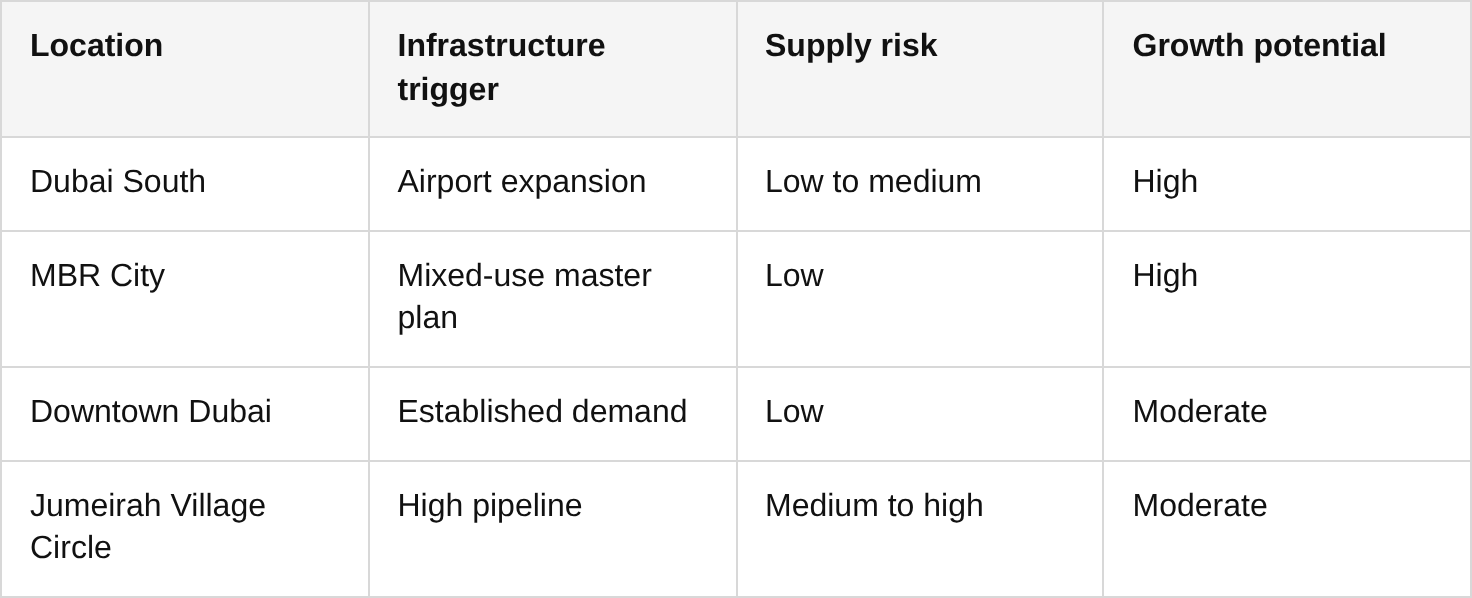
Pipeline risk is real in outer districts where developer concentration is high and end-user demand is less proven. Reviewing top Dubai investment areas with a granular supply map helps you avoid pockets of oversupply while capturing growth in corridors with genuine demand foundations.
Pro Tip: Before committing capital to any Dubai neighborhood, request a micro-location supply report covering a 1 to 2 kilometer radius. Aggregate city data masks the stark differences between adjacent districts.
With location-specific insights clarified, it is vital to understand how emerging market innovations are reshaping access and liquidity for Dubai investors.
Innovations: Tokenization and sustainability in Dubai real estate
Two forces are quietly redefining how sophisticated investors approach Dubai property: tokenization and sustainability-driven premiums. Neither is speculative anymore. Both are producing measurable effects on valuations and transaction structures in 2026.
Tokenization increases liquidity by converting property ownership into digital tokens on a blockchain, enabling fractional ownership and faster secondary market transactions. For high-net-worth investors, this means you can allocate to Dubai real estate with greater precision, rebalancing exposure without the friction of traditional property sales. The Dubai Land Department has been actively developing the regulatory framework to support this, signaling institutional backing for the model.
Sustainability and wellness features now command measurable price premiums in Dubai. Properties certified under LEED (Leadership in Energy and Environmental Design) or featuring biophilic design, air quality systems, and wellness amenities attract both premium tenants and capital appreciation above market averages. This is not a lifestyle trend. It is a valuation driver.
How to assess tokenization and sustainability in your investment decisions:
- Verify whether the development is registered under Dubai’s digital asset framework
- Check for third-party sustainability certifications (LEED, WELL, Estidama)
- Analyze rental premium data for wellness-certified buildings versus standard stock
- Evaluate secondary market liquidity for tokenized assets before entry
- Confirm that the developer has a track record in delivering certified projects
“The investors who outperform in 2026 will be those who treat tokenization and sustainability not as optional features but as core investment criteria, embedded in their due diligence from day one.”
When evaluating Dubai real estate, these two factors should sit alongside traditional metrics like rental yield and capital gains potential. Reviewing essential investment tips that incorporate innovation criteria will sharpen your decision-making framework considerably.
Pro Tip: When comparing two otherwise equal properties, a LEED-certified unit in a wellness-focused development can command 10% to 20% higher rental yields, making sustainability a direct financial metric, not just an ethical preference.
Armed with knowledge of market innovations, the next step is mapping these trends into actionable investment strategies for the upcoming year.
Actionable strategies for Dubai property investors in 2026
Market knowledge only creates returns when paired with disciplined execution. The strategic edges available in 2026 include pipeline analysis, micro-location focus, tokenization adoption, and wellness-driven investments. Here is how to operationalize them.
-
Conduct pipeline analysis before any acquisition. Pull supply data for your target district, apply the 45% to 64% completion rate adjustment, and model absorption against local population growth. This gives you a realistic demand-supply picture rather than a headline-driven one.
-
Prioritize micro-location over macro trends. A neighborhood within 500 meters of a new metro station or commercial anchor can outperform the broader market by 15% to 25% in capital appreciation. Granular location research is non-negotiable.
-
Allocate a portion of your portfolio to tokenized assets. Even a 10% to 15% allocation to tokenized Dubai property improves liquidity and allows faster rebalancing as market conditions evolve.
-
Screen for sustainability certifications as a baseline. Exclude properties that lack third-party environmental or wellness certification from your primary consideration set. The rental yield premium and resale value advantage justify this filter.
-
Time your entry around infrastructure milestones. The strongest capital appreciation windows typically open 12 to 18 months before a major infrastructure project completes. Position early in growth corridors like Dubai South before the airport expansion reaches full operational capacity.
-
Diversify across asset classes within Dubai. Residential, commercial, and hospitality real estate respond differently to economic cycles. A balanced allocation reduces concentration risk while maintaining exposure to Dubai’s overall growth trajectory.
Pro Tip: Review your portfolio growth strategies annually against updated pipeline data. Markets shift, and a strategy built on 2025 data may underperform by 2027 without recalibration.
Exploring Dubai investment strategies that integrate these frameworks positions you ahead of investors relying on surface-level market commentary.
With these practical strategies in hand, let’s take a step back for a fresh perspective on where the Dubai real estate market is truly headed and what most investors overlook.
Our take: What most investors miss about Dubai market dynamics
Most investors read the supply headline and either panic or dismiss Dubai entirely. Both reactions are wrong. The real opportunity in 2026 lies in understanding that completion delays and population growth have consistently stabilized Dubai’s supply-demand equation through every market cycle, rewarding investors who stay informed and patient.
What the data rarely shows is the role of timing patience as a strategic asset. Investors who entered Dubai South or MBR City before infrastructure milestones were priced in captured returns that late-movers simply could not replicate. The same dynamic is playing out again in 2026.
Sustainability and tokenization are not fringe concepts. They are becoming the new baseline for institutional-grade property in Dubai. Investors who treat these as optional extras will find themselves holding assets that underperform against certified, innovation-forward developments within three to five years.
The comprehensive investment guide we recommend goes beyond market timing. It builds a durable framework that accounts for innovation cycles, demographic shifts, and regulatory evolution, which is where lasting wealth in Dubai real estate is actually created.
Partner with expert guidance for optimal Dubai property results
Understanding market trends is one thing. Translating them into precise, high-performing investments requires experience, local intelligence, and a network that most investors simply do not have on their own.
Anthony Joseph and the team at anthonyjosephaj.com provide award-winning advisory services tailored to high-net-worth investors navigating Dubai’s evolving property landscape. From off-plan acquisitions in growth corridors to tokenized asset evaluation and sustainability-certified property sourcing, the guidance you receive is built on deep market expertise and a proven track record. Connect today to align your 2026 investment strategy with Dubai’s most promising opportunities.
Frequently asked questions
Does the planned supply increase in Dubai mean property values will fall in 2026?
No. Only 45% to 64% of planned units are completed each year, and robust population growth absorbs new supply, preventing a market crash.
Which Dubai neighborhoods offer the biggest upside for investors in 2026?
Dubai South and MBR City lead the field, driven by major infrastructure projects and strong demand pipelines that support sustained capital appreciation.
How does tokenization change real estate investing in Dubai?
Tokenization increases liquidity by enabling fractional ownership and faster secondary market transactions, giving investors more flexibility in managing their property exposure.
What risk management tactics should Dubai property investors use in 2026?
Focus on pipeline analysis, micro-location research, and portfolio diversification across asset classes to build resilience against localized supply and demand fluctuations.


