

Dubai Property Taxes: 4% Transfer Fee & 0% Annual Taxes
Many international investors believe Dubai property comes with zero taxes or costs. The reality is more nuanced. While Dubai offers unmatched tax advantages like no annual property tax and zero capital gains tax for individuals, specific fees apply. These include a 4% transfer fee from Dubai Land Department, municipality charges, and corporate tax on business profits. Understanding these costs is essential for making informed investment decisions and maximizing returns in Dubai’s dynamic real estate market.
Table of Contents
- How To Choose The Right Property Tax Strategy In Dubai
- Zero Annual Property Tax And Capital Gains Tax Advantages
- Dubai Land Department (DLD) Transfer Fee And Additional Closing Costs
- Rental Income, Municipality Housing Fees, And Corporate Tax Implications
- Value Added Tax (VAT) On New Property Purchases And Summary Comparison
- Situational Recommendations: Choosing The Best Tax-Savvy Investment Path
- Explore Dubai Real Estate Investment Opportunities With Expert Guidance
Key Takeaways
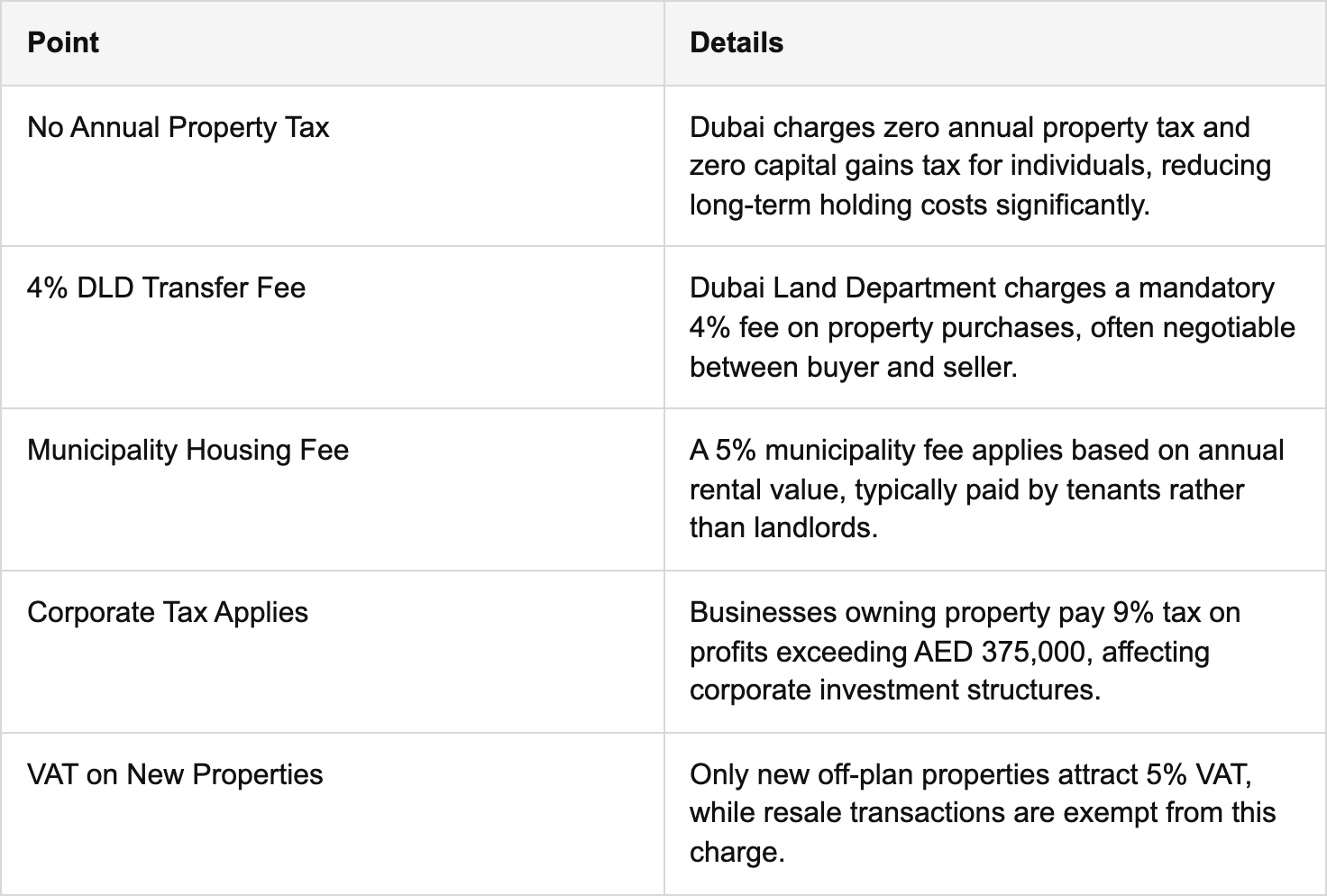
How to Choose the Right Property Tax Strategy in Dubai
Approaching Dubai property investment requires understanding the difference between zero annual taxes and transactional fees. This distinction shapes your total cost of ownership and influences which investment structure delivers optimal returns.
Start by evaluating ownership options. Individual ownership means tax-free rental income and no capital gains tax on sales. Corporate ownership suits investors managing multiple properties but triggers 9% corporate tax on profits above AED 375,000.
Key considerations when planning your tax strategy:
- Budget for the 4% DLD transfer fee plus closing costs totaling 5% to 9% of purchase price
- Factor in 5% VAT when purchasing new off-plan developments
- Include municipality fees of 5% when calculating rental yields
- Negotiate transfer fee splits with sellers to reduce your acquisition costs
Pro Tip: Review your investment horizon before choosing ownership structure. Short-term flippers benefit from individual ownership’s zero capital gains tax, while long-term portfolio builders might justify corporate structures for asset protection despite the 9% profit tax.
Understanding these components enables you to structure investments that align with your financial goals. The right approach depends on whether you prioritize immediate tax savings, long-term portfolio growth, or asset protection. Dubai property investment strategies vary significantly based on these factors.
Zero Annual Property Tax and Capital Gains Tax Advantages
Dubai’s zero annual property tax policy stands as one of its strongest investment advantages. Unlike most global markets where property owners face recurring annual taxes, Dubai eliminates this ongoing cost entirely for individual owners.
This benefit compounds over time. A property held for 10 years avoids thousands or tens of thousands in taxes that would erode returns in markets like London, New York, or Singapore. Your holding costs remain limited to maintenance, service charges, and optional property management fees.
Individuals pay zero tax on rental income earned from Dubai properties, making rental income fully tax-free for private investors. This creates powerful cash flow advantages. A property generating AED 100,000 in annual rent delivers the full amount to your pocket, unlike jurisdictions where income taxes claim 20% to 50% of rental earnings.
Key tax-free benefits for individual property owners:
- No annual property tax reduces long-term holding costs by thousands annually
- Zero capital gains tax on property sales means you keep 100% of appreciation
- Tax-free rental income maximizes cash flow and IRR calculations
- No inheritance tax on property transfers preserves family wealth across generations
The capital gains advantage deserves emphasis. When you sell a property that appreciated AED 500,000, you receive the entire gain. Markets imposing 15% to 30% capital gains taxes would extract AED 75,000 to AED 150,000 from that profit. This difference fundamentally alters investment math and exit strategies.
For Dubai real estate tax facts, the individual ownership structure delivers unmatched advantages. These benefits make Dubai particularly attractive for high-net-worth investors seeking to preserve and compound wealth without government taxation eroding returns.
Dubai Land Department (DLD) Transfer Fee and Additional Closing Costs
The DLD transfer fee represents your largest transactional cost when purchasing Dubai property. This mandatory 4% charge applies to the property’s purchase price and goes directly to Dubai Land Department for title registration and transfer services.

Understanding who pays this fee matters significantly. By default, buyers bear the full 4% cost. However, negotiating the DLD fee split with the seller can reduce buyer costs, often lowering the buyer’s share from 4% to 2% in resale transactions. This negotiation point can save you tens of thousands on a single purchase.
Beyond the DLD fee, several additional costs affect your total acquisition price:
- Real estate agent commissions typically 2% of purchase price, usually paid by buyers
- Mortgage registration fees of approximately 0.25% if financing the purchase
- Legal and conveyancing fees ranging from AED 5,000 to AED 15,000
- Property valuation fees of AED 2,500 to AED 3,500 for mortgaged purchases
Total buyer closing costs in Dubai typically range from 5% to 9% of the purchase price including DLD fee, agent commissions, mortgage registration, and professional fees. This total impacts how much capital you need beyond your down payment.
Pro Tip: Always request detailed closing cost breakdowns before signing purchase agreements. Sellers sometimes agree to cover certain fees like agent commissions or split the DLD fee 50/50. These negotiations can reduce your upfront investment by 2% to 4% of purchase price.
For detailed guidance on DLD transfer fee details and navigating the complete property purchase process in Dubai, understanding these transactional costs ensures accurate budgeting. Calculate total acquisition costs at 105% to 109% of listing price to avoid surprises.
Rental Income, Municipality Housing Fees, and Corporate Tax Implications
Rental income treatment varies dramatically based on ownership structure. Individual property owners enjoy completely tax-free rental income, keeping 100% of what tenants pay. This advantage makes Dubai rental yields among the most attractive globally when compared on an after-tax basis.
Municipality housing fee in Dubai is charged at 5% of annual rental value and is usually paid by tenants as a fee for municipality services. Landlords typically don’t bear this cost directly. The fee appears on DEWA utility bills and covers waste management, infrastructure maintenance, and community services.
Corporate ownership introduces different tax considerations. The UAE introduced a 9% corporate tax on business profits exceeding AED 375,000, affecting property income held by corporate entities. This fundamentally changes the return profile for properties held in corporate structures.
Key points on rental income and recurring fees:
- Individual owners pay 0% tax on all rental income regardless of amount
- Tenants typically pay the 5% municipality housing fee, not landlords
- Corporate entities face 9% tax on net property profits above AED 375,000
- Ownership structure determines whether you pay corporate tax on property operations
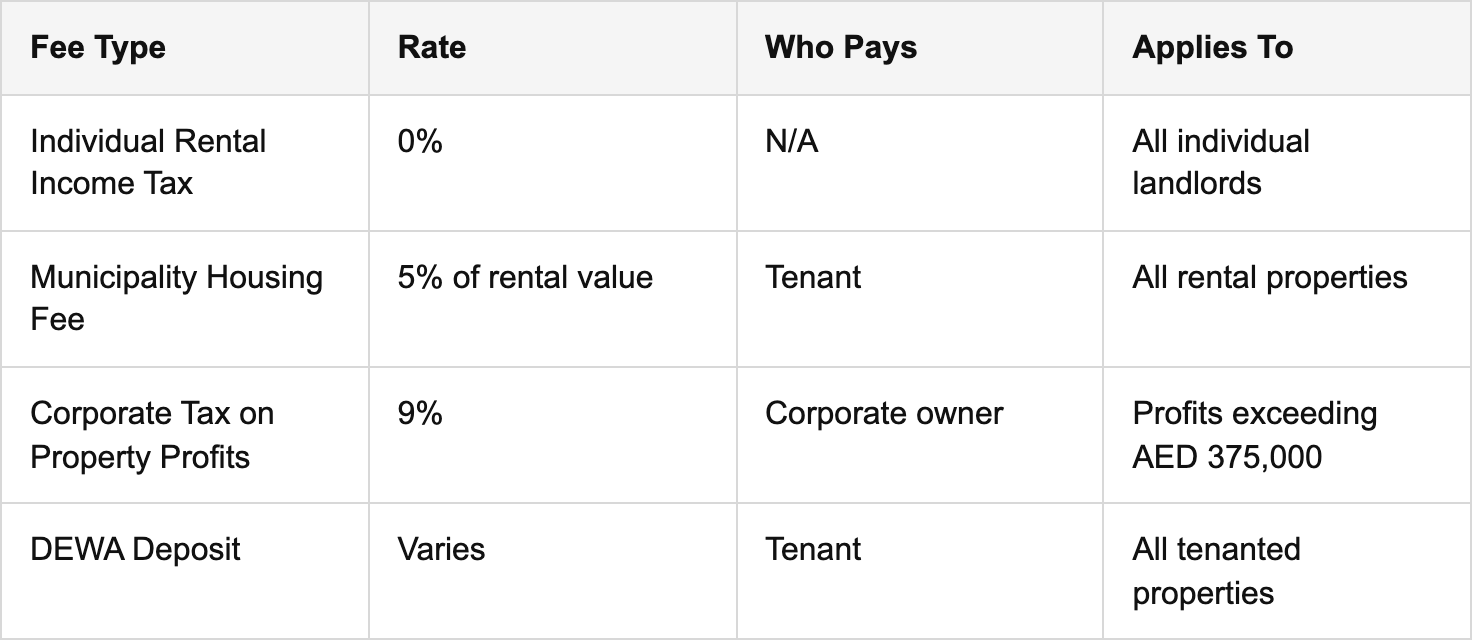
The corporate tax threshold matters significantly. A company owning properties generating AED 500,000 in annual profit pays 9% only on the amount exceeding AED 375,000. The first AED 375,000 remains tax-free. This results in AED 11,250 in corporate tax rather than AED 45,000 if the full amount were taxed.
For investors managing multiple properties or seeking asset protection, corporate structures offer benefits despite the tax cost. However, individual ownership remains optimal purely from a tax perspective. Understanding corporate tax and regulations helps you choose the structure that best serves your overall investment strategy.
Value Added Tax (VAT) on New Property Purchases and Summary Comparison
VAT application in Dubai property follows a specific rule. Only new off-plan properties purchased directly from developers attract 5% VAT. This means if you buy a brand new apartment for AED 1,000,000, you pay an additional AED 50,000 in VAT, bringing your total to AED 1,050,000.
Resale properties and secondary market transfers are completely exempt from VAT. When you purchase an existing property from another owner, no VAT applies regardless of the property’s age or value. This exemption makes resale properties 5% cheaper in terms of transactional costs compared to new developments.
The VAT rule creates interesting strategic considerations. New off-plan properties often offer payment plans and developer incentives that can offset the 5% VAT cost. Meanwhile, resale properties avoid VAT but may require immediate full payment or traditional mortgage financing.
Here’s a comprehensive comparison of all Dubai property taxes and fees:
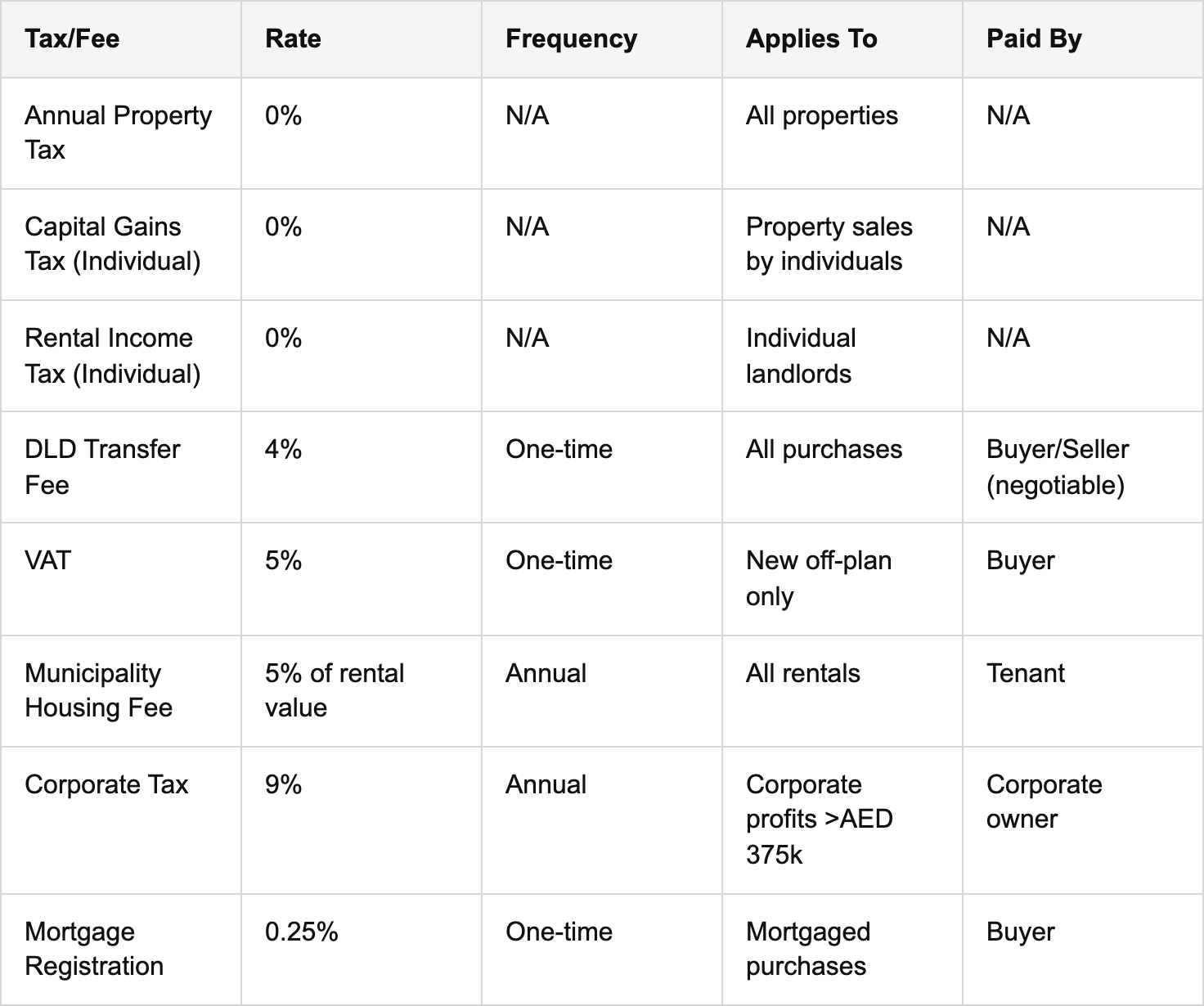
This table clarifies why Dubai attracts global investors. The absence of annual taxes, capital gains tax, and rental income tax for individuals creates exceptional return potential. Transactional fees remain reasonable compared to total investment value.
For detailed information on VAT on off-plan properties and a complete summary of Dubai property taxes and fees, these resources provide additional context for your investment decisions.
Situational Recommendations: Choosing the Best Tax-Savvy Investment Path
Applying Dubai’s tax structure to your specific situation requires matching your investor profile with the optimal ownership and acquisition strategy. Different goals demand different approaches.
For most individual investors, personal ownership delivers maximum tax efficiency. You capture tax-free rental income, avoid capital gains tax on sales, and eliminate ongoing annual property taxes. This structure works best for investors owning one to three properties focused on capital appreciation and passive income.
Follow these recommendations based on your investment scenario:
-
Single property investors: Choose individual ownership for complete tax exemption on rental income and capital gains. Budget 7% to 9% for closing costs including the 4% DLD fee.
-
Multiple property portfolios: Consider corporate ownership if managing five or more properties, accepting the 9% corporate tax for benefits like liability protection and easier estate planning.
-
Off-plan buyers: Include 5% VAT in your total budget and compare the all-in cost against resale properties that avoid VAT but may lack developer payment plans.
-
Rental income focus: Prioritize individual ownership to keep 100% of rental income. Remember tenants typically pay the 5% municipality fee, not you.
-
Quick flippers: Individual ownership eliminates capital gains tax on sales, maximizing profit on short-term appreciation plays.
Pro Tip: Negotiate the DLD fee split aggressively in buyer’s markets. Sellers motivated to close quickly often agree to pay 2% to 3% of the 4% total transfer fee, reducing your acquisition cost substantially.
The municipality housing fee deserves careful attention in rental yield calculations. Although tenants usually pay this 5% charge, you must account for it in your property’s total cost structure. Some tenant negotiations involve landlords absorbing part or all of this fee to secure long-term leases.
For comprehensive tax-savvy investment strategies tailored to your goals, professional guidance helps you structure investments that maximize after-tax returns while maintaining flexibility for future portfolio adjustments.
Explore Dubai Real Estate Investment Opportunities with Expert Guidance
Understanding Dubai’s property tax landscape gives you a foundation for smart investment decisions. Taking the next step means accessing comprehensive market data, investment analysis, and expert insights that turn knowledge into action.

Dubai’s real estate market offers exceptional opportunities for investors who understand the tax advantages and fee structures. Whether you’re exploring your first Dubai property purchase or expanding an existing portfolio, having access to detailed market analysis and professional guidance makes the difference between average and exceptional returns.
Our platform provides everything you need to make confident decisions. Explore the Complete guide to Dubai real estate investment for comprehensive insights into market trends, investment strategies, and property selection. Stay current with Dubai real estate trends 2026 to identify emerging opportunities before they become mainstream. Discover Off-plan property investment opportunities that offer developer incentives and payment flexibility.
Frequently Asked Questions
How are Dubai property purchases taxed for international investors?
International investors pay the same 4% DLD transfer fee as UAE residents when purchasing property. No additional taxes apply based on nationality. Buyers face total closing costs of 5% to 9% including the DLD fee, agent commissions, and legal fees.
Do I pay annual property tax on Dubai real estate?
No annual property tax exists in Dubai for any property owner. Individual owners also pay zero tax on rental income and capital gains. Corporate entities pay 9% tax only on property-related profits exceeding AED 375,000 annually.
What is the municipality housing fee and who pays it?
The municipality housing fee equals 5% of annual rental value and covers waste management and community services. Tenants typically pay this fee through their DEWA utility bills. Landlords rarely bear this cost unless specifically negotiated in the lease agreement.
Does VAT apply to all Dubai property transactions?
VAT at 5% applies only to new off-plan properties purchased directly from developers. Resale properties and secondary market transactions are completely exempt from VAT regardless of property value or type.
Can I negotiate the DLD transfer fee with the seller?
Yes, the 4% DLD transfer fee split is negotiable between buyer and seller. In many resale transactions, parties agree to split the fee equally at 2% each. Motivated sellers sometimes agree to pay 3% or even the full 4% to facilitate the sale.
How does corporate ownership affect property taxes in Dubai?
Corporate entities owning property pay 9% corporate tax on annual profits exceeding AED 375,000. The first AED 375,000 remains tax-free. Individual ownership avoids this tax entirely, keeping rental income and capital gains completely tax-free.
Recommended
- Real Estate Tax in Dubai – Key Facts for Investors
- Dubai Property Laws Explained: Risks, Rights, and Returns
- Dubai Commercial Property: What Investors Must Know
- Dubai Real Estate Terms Explained for Investors
- Video : Expatriate Taxes
- Dubai Anchors Real Estate Tokenization On XRP Ledger As Token Climbs 2% / Naijatipsland


