

Legal requirements for Dubai investors: 2026 guide
Dubai’s real estate and business markets present exceptional opportunities for international investors, yet navigating the legal framework remains a critical challenge. Understanding ownership rights, registration procedures, visa pathways, and corporate setup regulations determines investment success and long-term residency eligibility. This comprehensive guide breaks down the essential legal criteria, processes, fees, and strategic considerations that high-net-worth individuals and foreign investors must master to capitalize on Dubai’s dynamic market in 2026.
Table of Contents
- Understanding Legal Criteria For Property Investment In Dubai
- The Property Purchase Process And Fees Every Investor Should Know
- Key Legal Requirements For Obtaining Dubai’s Golden Visa Through Real Estate
- Legal Framework For Business Setup And Foreign Ownership In Dubai
- Legal Nuances, Exceptions, And Important Considerations For Investors
- Explore Expert Legal Assistance For Your Dubai Investments
Key takeaways
1. Understanding legal criteria for property investment in Dubai
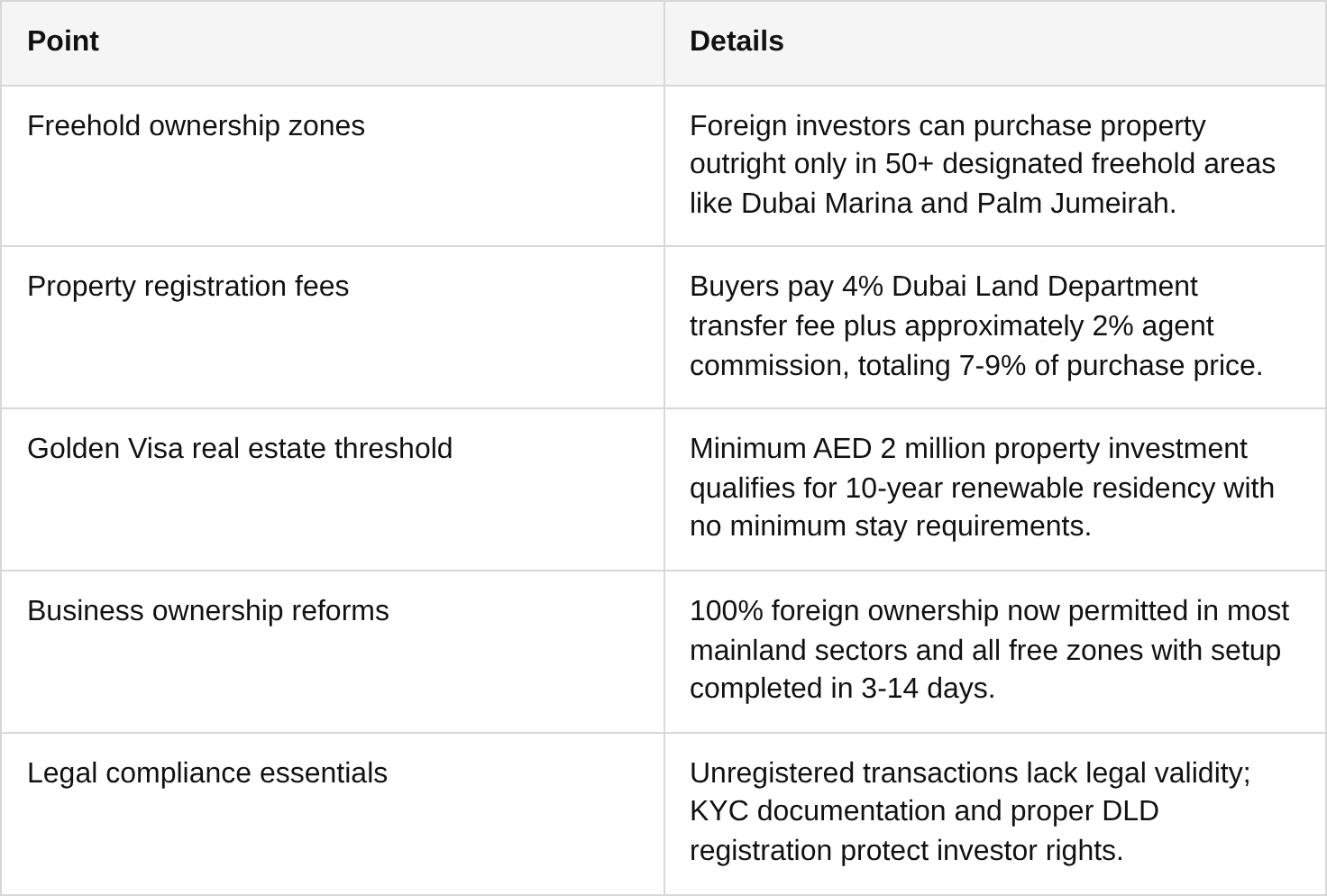
Dubai’s property investment landscape operates under a clear yet nuanced legal framework that foreign investors must understand before committing capital. The foundation rests on freehold ownership rights limited to designated zones, which Law No. 7 of 2006 established to attract international investment while maintaining regulatory control. This legislation opened more than 50 specific areas where foreigners can acquire full ownership, including prestigious locations such as Dubai Marina, Downtown Dubai, Palm Jumeirah, and Dubai Hills Estate.
Outside these freehold zones, international investors face different ownership structures. Usufruct rights grant long-term usage and rental income for up to 99 years without transferring actual ownership. Leasehold arrangements provide similar benefits but typically span shorter durations of 10 to 50 years. Some investors choose partnership structures with UAE nationals to access properties in non-freehold areas, though this approach introduces complexity and shared decision-making requirements.
The Dubai Land Department (DLD) serves as the primary regulatory authority overseeing all property transactions and maintaining the official registry. The Real Estate Regulatory Agency (RERA) complements this role by licensing developers, brokers, and property managers while enforcing consumer protection standards. Together, these entities ensure transparency and legal compliance across the market.
Key ownership considerations for foreign investors include:
- Verification that target properties fall within officially designated freehold zones
- Confirmation of developer registration and project approval status with RERA
- Review of master community regulations that may impose additional restrictions
- Assessment of service charge obligations and homeowner association requirements
- Understanding inheritance laws that apply to foreign-owned real estate
Pro Tip: Always verify property ownership types in Dubai through official DLD channels before signing any preliminary agreements to avoid legal complications that could delay or invalidate your investment.
2. The property purchase process and fees every investor should know
The property acquisition process in Dubai follows a structured sequence designed to protect both buyers and sellers while ensuring government oversight. Understanding each step and associated costs prevents surprises and enables accurate budget planning. The property purchase process involves signing agreements and obtaining developer approvals within specific timeframes that investors must respect.
The complete purchase journey unfolds through these essential stages:
- Property selection and initial reservation with refundable deposit (typically AED 5,000 to 20,000)
- Sales and Purchase Agreement (SPA) execution with developer or seller, including payment schedule
- No Objection Certificate (NOC) acquisition from developer confirming clearance for transfer
- DLD trustee office appointment for title deed transfer registration within 60 days of agreement
- Final payment completion and official title deed issuance in buyer’s name
Financial obligations extend beyond the purchase price itself. The Dubai Land Department imposes a mandatory 4% transfer fee on the property value, split equally between buyer and seller unless otherwise negotiated. Real estate agent commissions typically add 2% plus VAT, though this varies by transaction type and market conditions. Additional costs include mortgage registration fees (0.25% of loan value if financing), trustee fees (approximately AED 4,000), and various administrative charges.
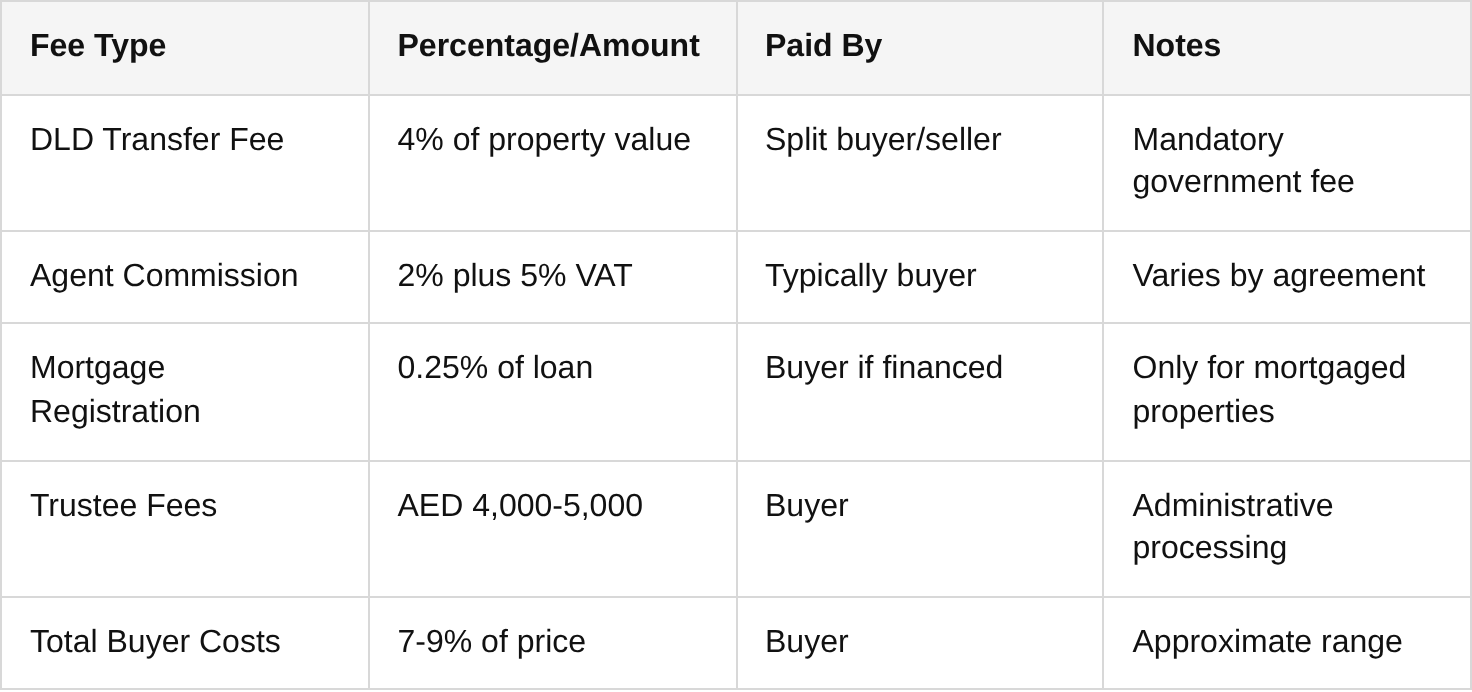
Smart investors budget 7% to 9% above the purchase price to cover all transaction expenses. This conservative approach accounts for potential variations in negotiated terms and unexpected administrative requirements. Foreign buyers should also factor in currency exchange costs and international wire transfer fees when moving funds into UAE bank accounts.
Pro Tip: Download the Dubai REST (Real Estate Self Transaction) mobile app to expedite developer NOC requests and track your transaction status in real time, potentially reducing processing delays by several days.
Exploring the complete steps to buying property in Dubai and understanding real estate tax facts Dubai provides investors with comprehensive knowledge to navigate transactions confidently.
3. Key legal requirements for obtaining Dubai’s Golden Visa through real estate
Dubai’s Golden Visa program revolutionized residency options for property investors by offering long-term stability without the traditional employment or sponsorship constraints. The real estate pathway has become increasingly popular, with 65% of Golden Visa applicants qualifying through property investments in recent years. This trend reflects both the program’s attractiveness and Dubai’s strategic positioning as a global investment hub.
The primary real estate route requires a minimum investment of AED 2 million in property, which can be a single unit or multiple properties combined to meet the threshold. Crucially, mortgaged properties qualify as long as the equity portion reaches AED 2 million, making the program accessible to investors using leverage. Off-plan properties from approved developers also count toward the requirement, though investors must obtain proper documentation confirming the investment value and project legitimacy.
Golden Visa benefits through real estate investment include:
- Ten-year residency renewable indefinitely as long as property ownership continues
- No minimum stay requirements or physical presence obligations in the UAE
- Freedom to work, study, or conduct business without separate employment visa
- Ability to sponsor immediate family members including spouse, children, and parents
- Access to UAE banking, healthcare, and education systems on par with residents
For investors not ready to commit AED 2 million, Dubai introduced a two-year renewable visa option for properties valued at AED 750,000 or above. While less comprehensive than the Golden Visa, this pathway still provides meaningful residency benefits and serves as a stepping stone for those building their UAE presence gradually.
“The Golden Visa through real estate has transformed Dubai’s appeal to international investors. We’re seeing unprecedented demand from high-net-worth individuals who value the combination of property appreciation potential and long-term residency security without the bureaucratic complexity common in other jurisdictions.”
Application processing typically takes 30 to 60 days once all documentation is submitted. Required materials include valid passport copies, property title deeds or sale agreements, proof of investment value, and biometric data collected during the application process. Investors should work with authorized typing centers or legal advisors familiar with current requirements to avoid delays or rejections.
The Dubai Golden Visa application process has been streamlined significantly, and understanding Golden Visa UAE benefits helps investors maximize the value of their residency status.
4. Legal framework for business setup and foreign ownership in Dubai
Dubai’s business environment underwent dramatic transformation with legal reforms permitting 100% foreign ownership across most sectors, eliminating the previous requirement for 51% UAE national partnership in mainland companies. This change positioned Dubai as one of the world’s most accessible markets for international entrepreneurs and corporate entities seeking Middle East presence.
Establishing a business in Dubai follows a systematic process:
- Trade name reservation through Department of Economic Development (DED) or relevant free zone authority
- Initial approval application with business activity selection and location confirmation
- Memorandum of Association (MOA) drafting and notarization for mainland companies
- Office space lease agreement (Ejari registration) meeting minimum requirements for chosen license type
- Final license issuance and additional approvals from sector-specific regulators if required
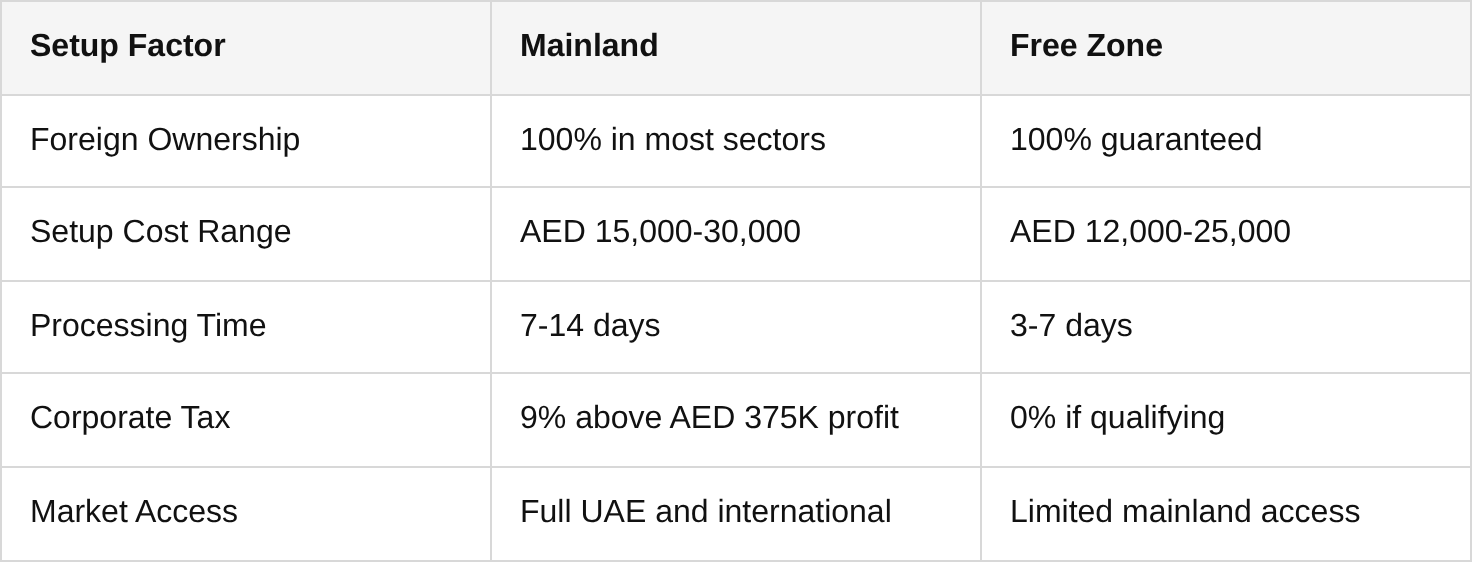
Investors face a fundamental choice between mainland and free zone establishment, each offering distinct advantages. Mainland companies can conduct business anywhere in the UAE and internationally without restrictions, making them ideal for operations requiring local market access or government contracts. Free zones provide 100% foreign ownership guarantees, simplified setup procedures, and favorable tax treatment, but typically restrict direct business within the UAE mainland without a local distributor.

Corporate tax considerations became critical in 2023 when the UAE introduced a 9% federal corporate tax on profits exceeding AED 375,000. However, qualifying free zone companies meeting specific conditions continue enjoying 0% corporate tax rates, creating significant planning opportunities for investors structuring their operations strategically.
Certain strategic sectors still require local sponsorship or partnership, including oil and gas, banking, insurance, and telecommunications. Security and defense-related activities also maintain ownership restrictions. Investors should verify current regulations for their specific industry before committing to a particular structure.
Pro Tip: Choose free zone establishment if your business model focuses on international trade, e-commerce, consulting, or services delivered remotely, as the zero corporate tax benefit and streamlined setup outweigh mainland advantages for these activities.
Investors interested in commercial real estate should review the Dubai commercial property process guide for comprehensive insights into acquiring business premises.
5. Legal nuances, exceptions, and important considerations for investors
Successful Dubai investment requires awareness of subtle legal requirements and exceptions that can significantly impact transaction validity and long-term outcomes. Many investors overlook these details until complications arise, making proactive understanding essential.
Unregistered property transactions carry no legal weight in Dubai’s system. Verbal agreements, preliminary contracts, or sales concluded outside official DLD channels provide zero protection if disputes emerge. Only properly registered title deeds confer enforceable ownership rights. This strict approach protects the market’s integrity but demands that investors complete formal registration regardless of personal trust relationships with sellers or developers.
Know Your Customer (KYC) requirements apply universally to property and business transactions. Foreign investors must present valid passports, proof of address, and source of funds documentation. Enhanced due diligence applies to high-value transactions or investors from certain jurisdictions. While no age restrictions limit property ownership, minors cannot directly hold title, requiring trust or guardian arrangements until they reach legal age.
Vacant land purchases face additional restrictions. Most freehold zones permit only completed or under-construction property acquisitions, reserving land sales for UAE nationals or GCC citizens. Exceptions exist in specific developments where master developers received special permissions, but investors should verify eligibility before pursuing land opportunities.
Corporate ownership structures introduce notification requirements. Companies holding UAE property must inform the DLD of any shareholder changes exceeding 50% ownership within 30 days. Failure to comply can result in penalties and complications during future transactions. This rule aims to maintain transparency and prevent ownership obscurity that could facilitate money laundering or other illicit activities.
Golden Visa applications face specific exclusions. Properties purchased entirely through cryptocurrency lack eligibility, as do investments financed solely by loans without substantial equity contribution. The government seeks genuine investment commitment rather than purely leveraged speculation. Properties under construction qualify only when developers provide proper completion guarantees and timeline documentation.
High-net-worth investors managing real estate investment funds exceeding AED 180 million benefit from reduced government fees and expedited approvals under Decree No. 22 of 2022 governing investment funds. This framework encourages institutional capital deployment while maintaining regulatory oversight.
Common legal traps investors should avoid:
- Signing preliminary agreements without lawyer review of terms and conditions
- Assuming verbal developer promises carry legal weight without written confirmation
- Neglecting to verify actual freehold status through official DLD property records
- Overlooking community fee obligations that can accumulate into substantial debt
- Failing to update visa and Emirates ID information after property acquisition
- Ignoring inheritance law implications for estate planning across jurisdictions
Staying informed about Dubai real estate regulations investors must follow ensures compliance and protects long-term investment value.
Explore expert legal assistance for your Dubai investments
Navigating Dubai’s legal requirements for property and business investment demands specialized knowledge and current market expertise. While this guide provides comprehensive foundational understanding, each investor’s situation presents unique considerations requiring tailored advice. Professional guidance ensures you maximize opportunities while avoiding costly mistakes that could jeopardize your investment timeline or residency goals.

Whether you’re pursuing Golden Visa eligibility through strategic property acquisition, establishing corporate presence in optimal free zones, or structuring complex multi-asset portfolios, working with experienced advisors streamlines the process significantly. Expert support helps you identify the most advantageous legal structures, negotiate favorable terms, and complete transactions efficiently within Dubai’s regulatory framework. Discover how personalized expert Dubai investment legal assistance can transform your investment journey and accelerate your success in one of the world’s most dynamic markets.
FAQ
What properties can foreign investors legally own in Dubai?
Foreign investors can purchase freehold properties only in 50+ designated zones established under Law No. 7 of 2006, including areas like Dubai Marina, Palm Jumeirah, and Downtown Dubai. Outside these zones, ownership options include usufruct rights for up to 99 years or leasehold arrangements, though these don’t convey full ownership. Partnership with UAE nationals provides another route to access non-freehold properties, but this introduces shared control and complexity.
How long does the property registration process take and what fees apply?
Property registration must occur within 60 days of signing the sales agreement to maintain legal validity. Buyers typically pay a 4% Dubai Land Department transfer fee plus approximately 2% agent commission with VAT, resulting in total transaction costs of 7-9% of the purchase price. Additional expenses include mortgage registration fees if financing and trustee processing charges of around AED 4,000 to 5,000.
What are the real estate investment requirements for Dubai’s Golden Visa?
The Golden Visa requires a minimum AED 2 million property investment, which can include mortgaged properties where equity reaches this threshold or multiple properties combined. Off-plan developments from approved developers qualify with proper documentation. The visa grants 10-year renewable residency with no minimum stay requirements, work authorization, and family sponsorship rights, making it highly attractive for international investors seeking long-term UAE presence.
Can foreigners fully own companies in Dubai and how long does setup take?
Foreign investors can own 100% of companies in most mainland sectors and all free zones following recent legal reforms that eliminated mandatory local partnership requirements. Company setup takes between 3 to 14 days depending on the chosen jurisdiction, with free zones typically processing faster. Certain strategic sectors like banking, oil and gas, and telecommunications still require local sponsorship or partnership arrangements.
Are unregistered property transactions valid and what legal protections exist?
Unregistered property transactions carry no legal validity in Dubai regardless of payment completion or verbal agreements. Only official Dubai Land Department registration with proper title deed issuance provides enforceable ownership rights and legal protection. All investors must complete mandatory KYC procedures with valid passport documentation and proof of funds to ensure transaction legitimacy and protect their investment from future disputes.


