

Dubai rental market: 6-8% yields beat London & New York
TL;DR:
- Dubai’s rental yields of 6-8% outperform major cities like London and New York.
- Structural advantages include zero property tax, clear regulations, and high demand from expatriates.
- Supply influx risks in mid-market apartments require careful neighborhood and timing analysis.
Dubai’s rental market is quietly outperforming some of the world’s most celebrated investment destinations, and most global investors haven’t adjusted their strategies to reflect this reality. While London and New York command prestige, they deliver gross rental yields of just 2-5% compared to Dubai’s city-wide average of 6-8%. This gap isn’t a temporary anomaly. It’s driven by structural advantages: a tax-free environment, pro-investor regulations, and a fast-growing population of high-earning expatriates. If you’re a high-net-worth investor evaluating where your capital works hardest, understanding Dubai’s rental market fundamentals is no longer optional. It’s essential.
Table of Contents
- Understanding Dubai’s rental yields vs. global cities
- Market fundamentals: Supply, demand, and 2026 outlook
- Key advantages driving investor interest
- Investment risks and due diligence for 2026
- Our take: The overlooked playbook for Dubai rental success
- Take the next step in Dubai real estate
- Frequently asked questions
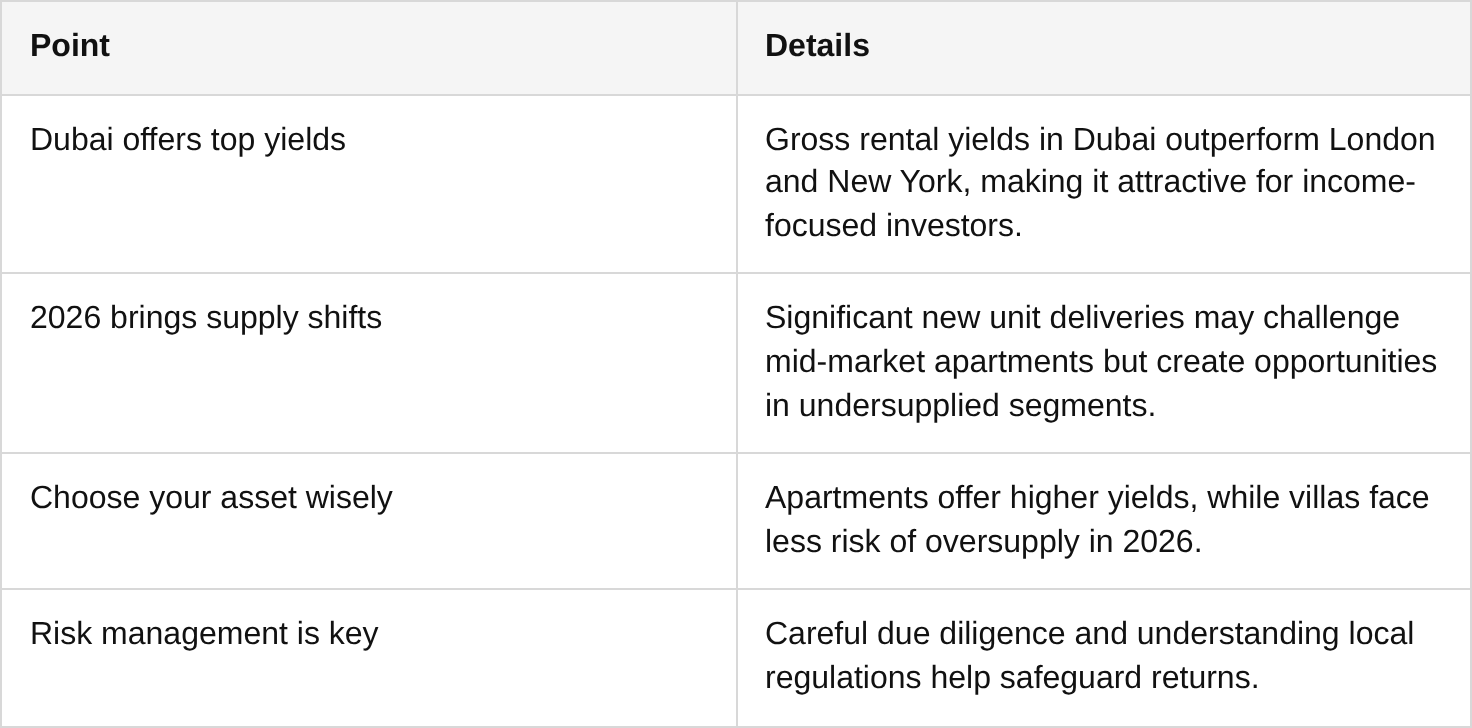
Key Takeaways
Understanding Dubai’s rental yields vs. global cities
Before comparing markets, it helps to define what gross rental yield actually measures. It’s the annual rental income divided by the property’s purchase price, expressed as a percentage. This metric tells you how efficiently a property generates income relative to its cost, making it one of the most direct tools for comparing investment performance across cities.
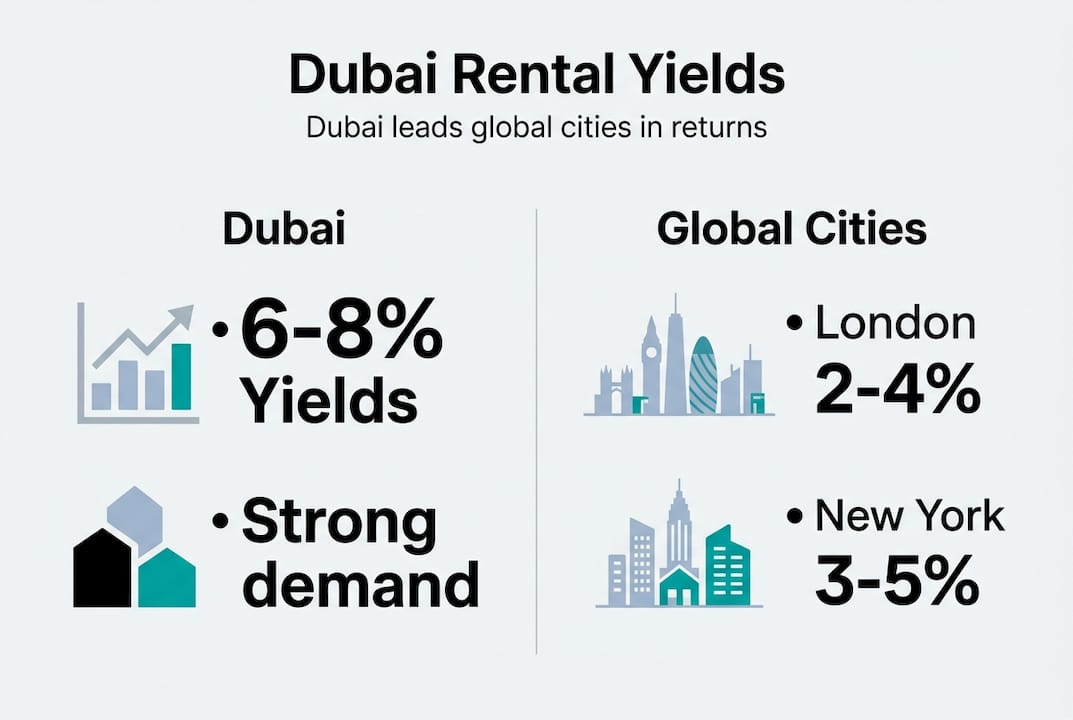
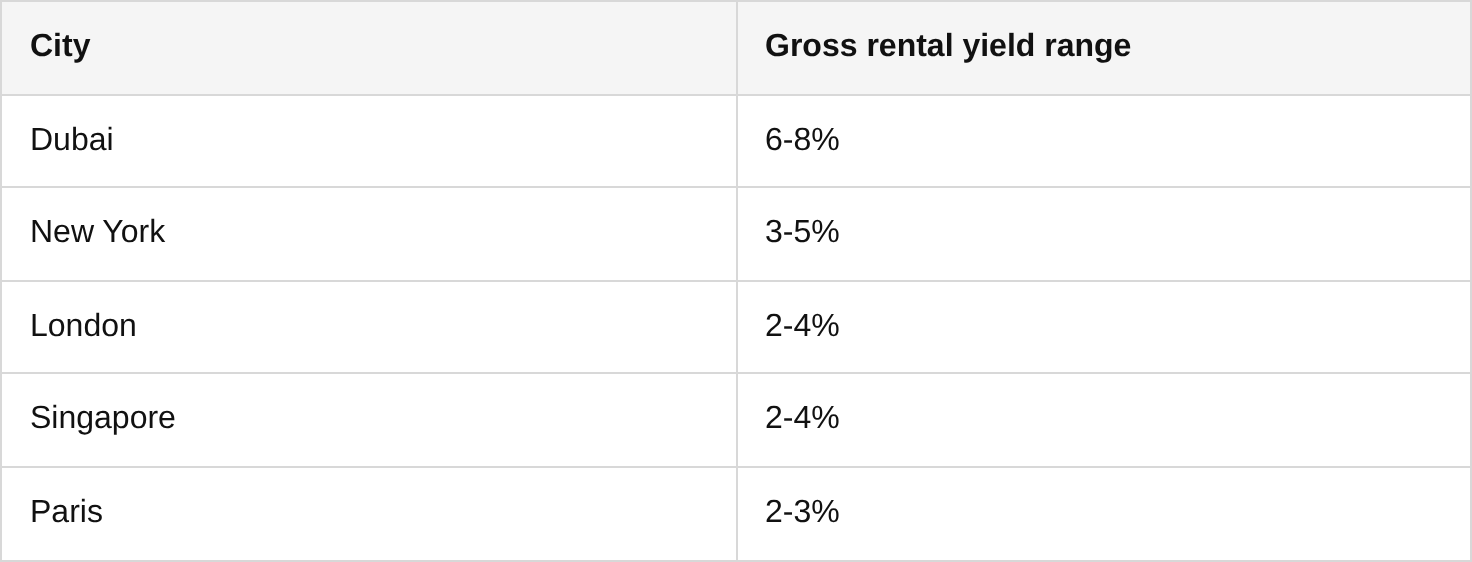
Dubai’s city-wide yields of 6-8% significantly outperform major financial centers. London typically returns 2-4%, New York sits at 3-5%, and cities like Paris and Singapore often fall below 4%. For an investor deploying serious capital, that yield gap compounds meaningfully over time.
Within Dubai, the numbers vary by asset type. Apartments deliver an average yield of approximately 7.07%, while villas average around 4.93%. Districts like Jumeirah Village Circle, Dubai Silicon Oasis, and International City consistently rank among the highest-yielding apartment locations, with some buildings exceeding 9%. These aren’t fringe areas. They attract a large, stable tenant base of working professionals and young families.
For international investors building or diversifying a global portfolio, these numbers represent a genuine structural advantage. Dubai’s property prices remain relatively accessible compared to its yield output, which is the inverse of what you typically find in gateway cities where high prices suppress returns.
Understanding 2026 Dubai real estate trends also reveals that rental demand continues to be fueled by net population growth, tourism infrastructure, and the city’s expanding role as a regional business hub. These aren’t speculative tailwinds. They’re measurable, recurring demand drivers that support rental income stability.
Market fundamentals: Supply, demand, and 2026 outlook
Knowing the rental yields, it’s vital to dig deeper into what’s shaping Dubai’s current and future rental market. The headline numbers are attractive, but the market is not without complexity.

The most significant factor to monitor in 2026 is supply. Projections indicate a delivery of 55,000-120,000 new units entering the market this year, which creates real pressure in certain segments. Mid-market apartments in areas like Jumeirah Village Circle, Business Bay, and Dubai South face the highest risk of localized oversupply. When supply outpaces demand in a specific district, vacancy rates rise and landlords face downward pressure on rents.
However, the risk is not uniform across the market. Two segments remain structurally undersupplied:
- Villas and townhouses in established communities like Arabian Ranches, Emirates Hills, and Palm Jumeirah
- Luxury and ultra-prime apartments in areas like Downtown Dubai, Dubai Marina, and DIFC
These segments benefit from limited land availability, longer construction timelines, and a tenant base that prioritizes quality over cost. Demand here is inelastic, meaning it doesn’t shift dramatically with minor supply increases.
To make smarter investment decisions, focus on these signals when evaluating a neighborhood:
- Current vacancy rates and historical trends
- Pipeline supply data for the next 12-24 months
- Proximity to employment hubs, schools, and transport links
- Tenant demographic stability (working professionals vs. transient population)
- Rental price growth over the past 12 months
Pro Tip: When a large supply wave is incoming, shift focus toward communities with geographic constraints on new development. Waterfront locations, established villa communities, and prime commercial districts rarely see the same oversupply dynamics as suburban apartment clusters.
For a thorough framework, the complete Dubai investment guide walks through how to assess supply risk by district before committing capital.
Key advantages driving investor interest
Apart from the numbers and market mechanics, what else draws international capital to Dubai? The answer lies in a combination of structural and regulatory factors that most global markets simply don’t offer.
Here are the five core advantages that consistently attract high-net-worth investors:
- High rental yields. As established, Dubai’s 6-8% gross yields outperform virtually every comparable global city, offering superior income generation per dollar invested.
- Zero property and income tax. There is no annual property tax and no personal income tax on rental earnings in Dubai. Your gross yield is essentially your net yield, which is a rare advantage in global real estate.
- Regulatory clarity and investor protections. Dubai’s Real Estate Regulatory Authority (RERA) governs landlord-tenant relationships, rental increase limits, and dispute resolution. Foreign investors have the same property rights as residents in designated freehold zones.
- Ease of capital flow. There are no restrictions on repatriating rental income or capital gains. You can move money in and out of Dubai freely, which matters enormously when managing a global portfolio.
- Global connectivity and demand. Dubai’s position as a transit and business hub drives continuous inflow of high-earning expatriates, creating a deep, liquid tenant pool.
Most investors overlook RERA’s Rental Increase Calculator, a publicly available tool that caps how much a landlord can legally raise rent based on current market rates. This regulatory mechanism protects both tenants and investors from volatile rent swings.
Understanding the rental laws explained in full helps you structure leases and pricing strategies that maximize legal income while maintaining strong tenant retention. When you know how to evaluate Dubai property through this regulatory lens, you reduce friction and increase predictability.
Investment risks and due diligence for 2026
Of course, with opportunity comes risk. Investors need to take a clear-eyed look at challenges unique to Dubai’s landscape.
The most pressing concern for 2026 is the supply influx and market imbalances that could suppress rental growth in specific apartment segments. But oversupply is just one layer of risk. Here’s what a thorough due diligence process should cover:
Market and asset risks:
- Oversupply in mid-market apartments in JVC, Business Bay, and Dubai South
- Rental price softening in high-supply corridors
- Off-plan delivery delays affecting projected income timelines
- Market cycle timing, particularly buying at peak valuations
Regulatory and operational risks:
- Changes to visa regulations that affect expatriate tenant demand
- RERA rent cap adjustments that limit income growth
- Service charge increases in managed communities that erode net yields
- Property management quality, which directly affects vacancy rates and tenant retention
Due diligence checklist for high-net-worth investors:
- Verify the developer’s track record and delivery history for off-plan purchases
- Review the community’s historical vacancy rate and average lease renewal rate
- Analyze the pipeline supply data for the specific district over the next 24 months
- Confirm freehold status and title deed clarity through Dubai Land Department records
- Assess service charges as a percentage of gross rental income
- Engage a licensed RERA-registered broker with verifiable transaction history
Avoiding the common mistakes that catch investors off guard requires more than reading market reports. It requires ground-level knowledge of how specific communities perform across cycles. Reviewing Dubai property laws before signing any agreement is a non-negotiable step in protecting your investment.
Our take: The overlooked playbook for Dubai rental success
Having examined the facts and numbers, here’s what most guides won’t tell you about winning in Dubai’s rental market.
Yield alone is not a strategy. We see investors chase high-yield districts without accounting for tenant quality, management complexity, or exit liquidity. A 9% yield in a district with chronic oversupply and high vacancy is not a better investment than a 6.5% yield in a community with 95% occupancy and consistent rent growth.
The investors who perform best in Dubai treat it as a dynamic market, not a passive income machine. They pay close attention to regulatory shifts, supply cycles, and tenant demographic changes. They also recognize that segment selection, specifically choosing between apartments and villas, luxury and mid-market, freehold and leasehold, matters more than any single headline metric.
Our investment tips consistently emphasize one principle: the best returns come from informed positioning, not market timing. Dubai rewards investors who understand its structure deeply and act with precision.
Take the next step in Dubai real estate
Dubai’s rental market offers a rare combination of strong yields, regulatory clarity, and genuine liquidity. But navigating it successfully requires more than reading the data.

Anthony Joseph brings years of on-the-ground expertise in Dubai real estate, helping high-net-worth investors identify the right assets, structures, and strategies for their specific goals. Whether you’re evaluating your first Dubai acquisition or expanding an existing portfolio, personalized guidance makes the difference between average returns and exceptional ones. Explore Dubai investment strategies and connect with Anthony’s team to receive a tailored market analysis built around your investment objectives.
Frequently asked questions
Are Dubai rental yields really higher than in other cities?
Yes, Dubai’s gross rental yields average 6-8%, outperforming cities like London (2-4%) and New York (3-5%), making it one of the highest-yielding major real estate markets globally.
What is the biggest risk to Dubai rental investments in 2026?
The main risk is potential oversupply in mid-market apartments, particularly in districts like JVC, Business Bay, and Dubai South, where the 2026 supply influx of 55,000-120,000 units could suppress rental growth.
Is Dubai’s villa or apartment segment a better investment?
Apartments offer higher average yields at approximately 7.07% vs. 4.93% for villas, but villas face significantly less oversupply risk in 2026, making them a more stable long-term hold for capital preservation.
Are international investors welcome in Dubai’s rental market?
Absolutely. Dubai offers regulatory clarity and strong liquidity for foreign investors, with full property ownership rights in designated freehold zones and no restrictions on repatriating rental income or capital gains.


