
Diversifying Across Emirates: Smarter UAE Real Estate Strategies
TL;DR:
- Diversifying across multiple UAE emirates reduces portfolio risk from localized economic and cyclical shocks.
- Each emirate offers distinct yields, tenant profiles, and growth, benefiting a resilient investment strategy.
- A balanced, multi-emirate portfolio outperforms concentrated holdings by providing income stability and growth opportunities.
Many investors operate under a powerful but flawed assumption: that Dubai is the only emirate worth serious capital allocation. The reality is more nuanced. Concentrating your entire property portfolio in a single emirate, regardless of how attractive that market looks, leaves you exposed to localized cyclical swings, tenant demand shifts, and supply-demand imbalances that no single market can fully insulate itself from. Spreading investments across Dubai, Abu Dhabi, Sharjah, Ajman, and Ras Al Khaimah gives you access to distinct yield profiles, tenant demographics, and capital growth trajectories that, together, create a far more resilient income-generating machine.
Table of Contents
- The risks of over-concentrating property investments
- Distinct investment profiles of Dubai, Abu Dhabi, and other emirates
- How diversified portfolios outperform in volatile UAE markets
- Common mistakes and best practices in emirate diversification
- The uncomfortable truth: Why most investors miss the real value in emirate diversification
- Explore tailored strategies for your UAE portfolio
- Frequently asked questions
Key Takeaways
The risks of over-concentrating property investments
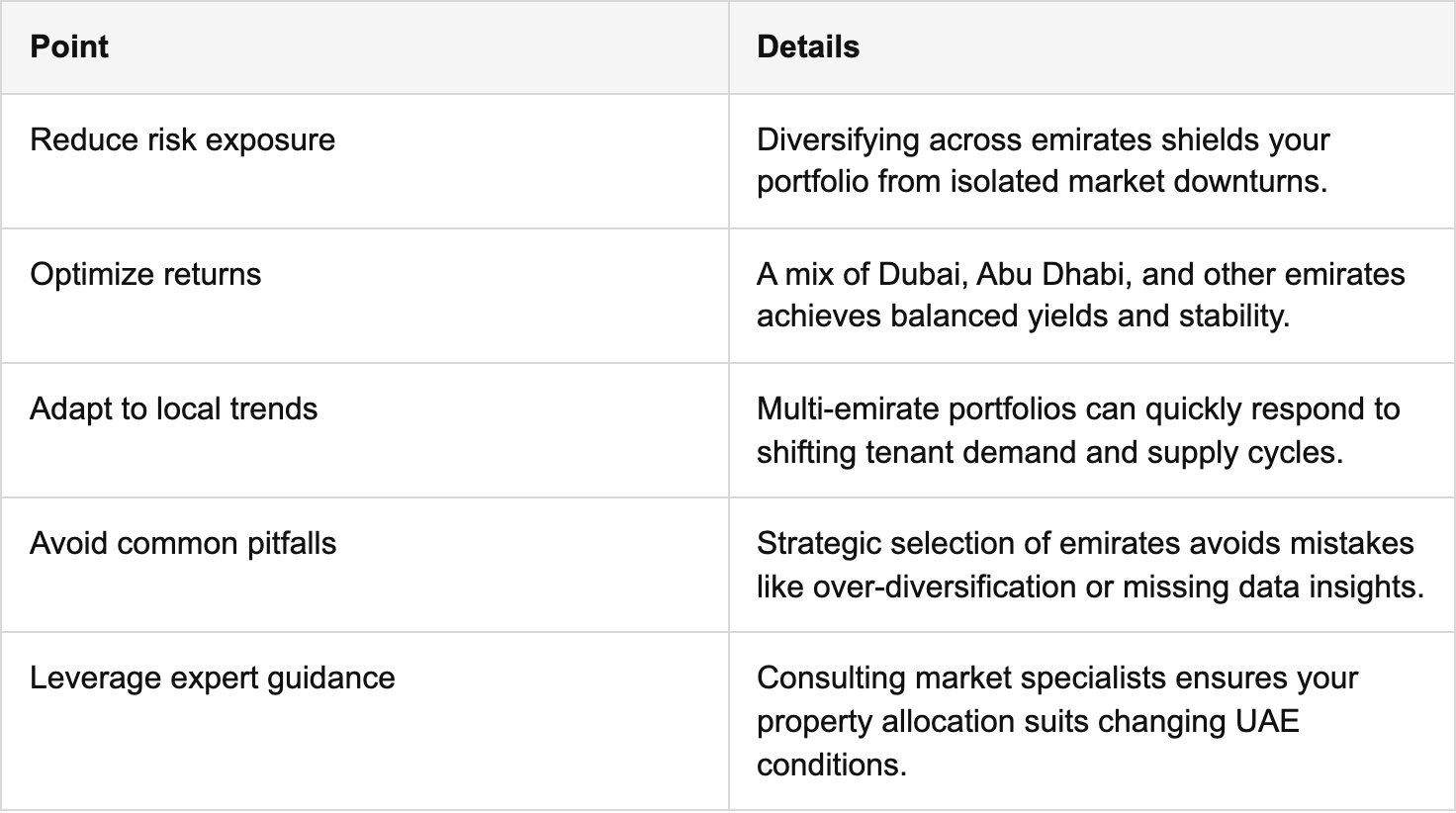
Sticking to a single emirate might feel like the safe, familiar choice. In practice, it often amplifies risk rather than reducing it. Any localized economic shock, an oversupply of units, a shift in corporate relocations, or a government policy change, can ripple through your entire portfolio simultaneously when all your assets sit in one market.
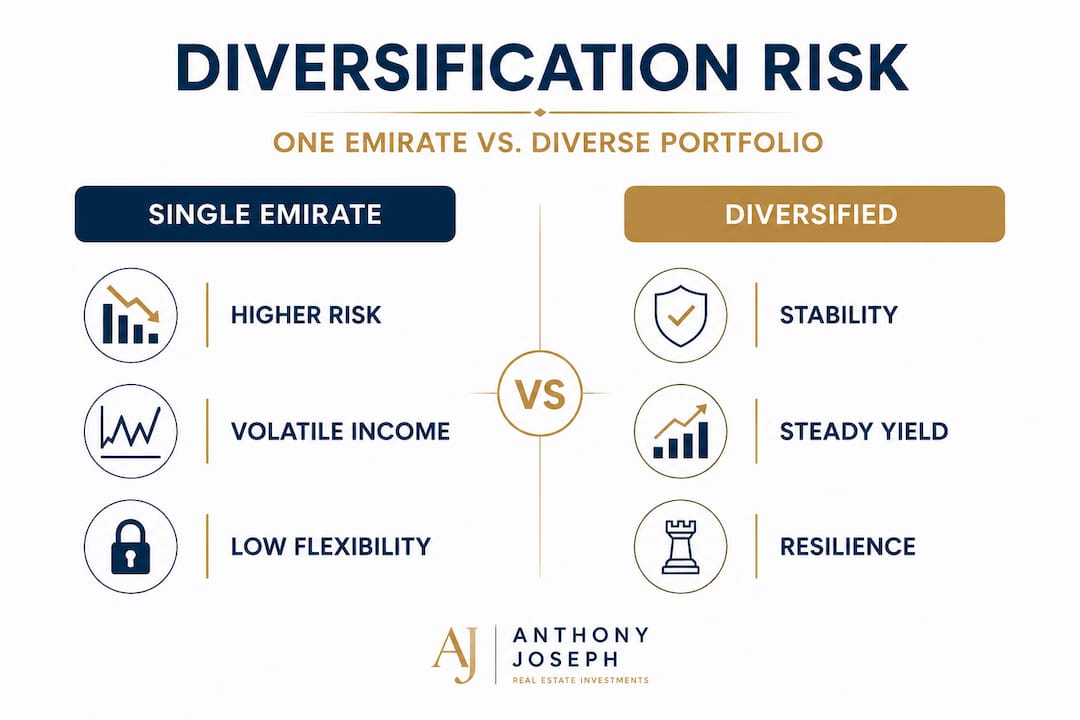
Consider what happens when a specific emirate experiences a supply glut. Vacancy rates climb, landlords compete on price, and rental yields compress. If every asset you own sits in that market, your entire income stream contracts at once. A well-structured real estate portfolio workflow would spread that exposure so that only a portion of your holdings absorbs the impact while assets in other emirates continue generating stable returns.
The risks of single-emirate concentration include:
- Cyclical vulnerability: Every property market moves through expansion, peak, contraction, and recovery. When all your properties track the same cycle, your cash flow and capital values move in lockstep.
- Tenant base dependency: Dubai’s prime residential districts attract a specific expatriate demographic. If corporate hiring slows or a major employer relocates, vacancy rates can spike across multiple properties simultaneously.
- Supply-demand mismatches: Massive off-plan pipeline deliveries are a defining feature of Dubai’s market. A sudden surge in unit completions can temporarily suppress rental rates across entire sub-markets.
- Regulatory concentration risk: Zoning changes, rent cap adjustments, or ownership law revisions affect all properties in a given emirate at the same time.
“Diversifying across emirates is used to reduce portfolio risk by avoiding over-exposure to a single emirate’s localized cycle, tenant base, and supply-demand dynamics.”
Managing Dubai portfolio growth effectively means knowing when to hold concentrated positions and when to re-balance across borders. The data consistently shows that geographically diversified property portfolios outperform concentrated ones over 10-year holding periods, particularly when measured against risk-adjusted returns rather than gross yield alone. Dubai’s appeal as a global investment powerhouse is undeniable, but that strength does not eliminate its cyclical character.
Distinct investment profiles of Dubai, Abu Dhabi, and other emirates
With the risks of single-emirate concentration in mind, understanding the distinctive strengths and weaknesses of each emirate is crucial for constructing a resilient portfolio.
Each emirate in the UAE functions as a distinct sub-market with its own demand drivers, tenant demographics, regulatory environment, and liquidity characteristics. Treating them as interchangeable markets is one of the most expensive mistakes a serious investor can make.
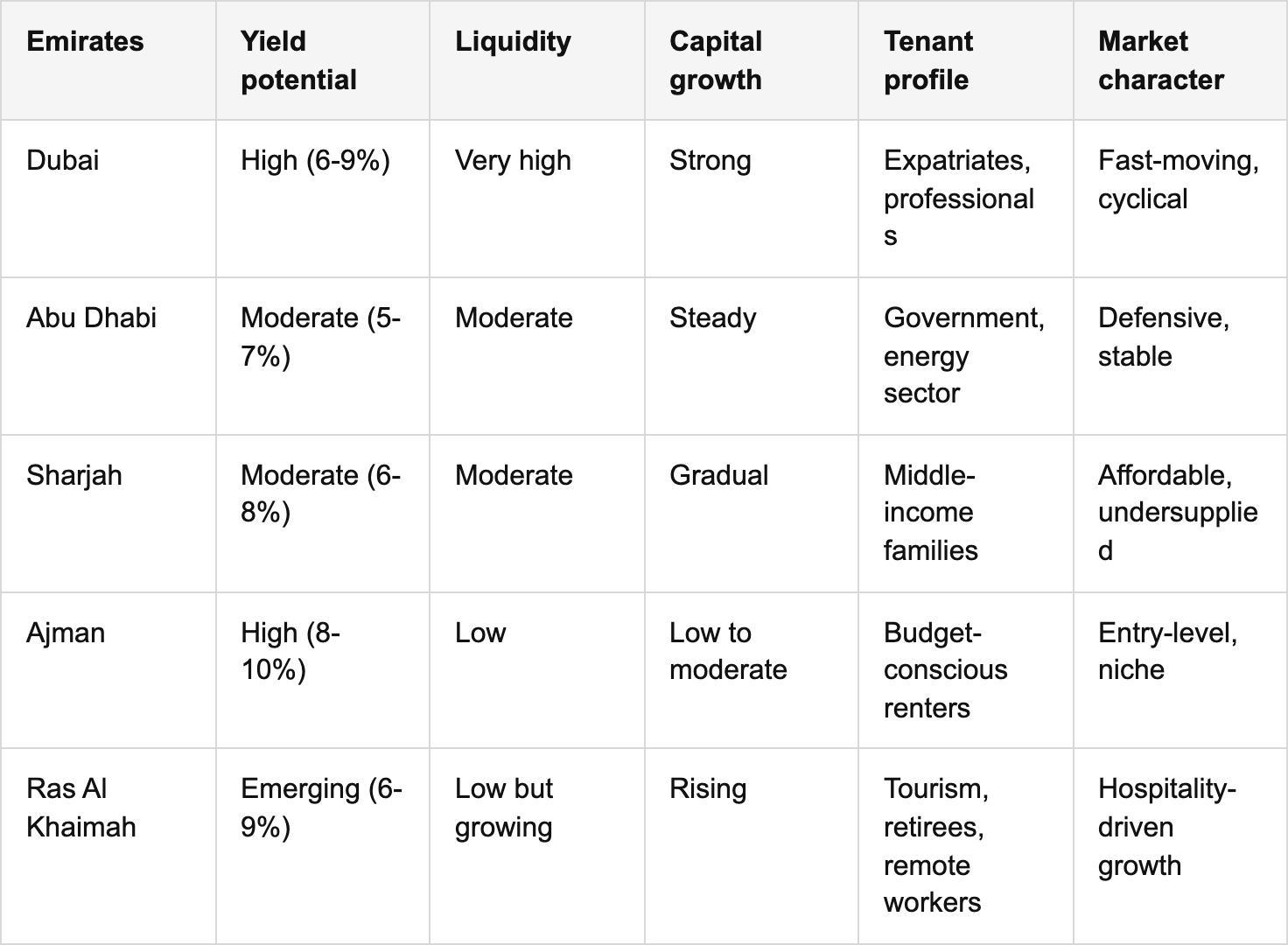
According to Dubai market portfolios, Dubai and Abu Dhabi play different portfolio roles: Dubai tends to provide higher liquidity and cash-flow potential, while Abu Dhabi is positioned more toward defensive stability and long-term holding.
Dubai remains the most liquid residential market in the UAE. Transaction volumes are high, buyer demand is consistent, and rental demand from the expatriate workforce keeps occupancy rates strong across most sub-markets. If you need to exit a position quickly, Dubai offers the clearest path to liquidity. Staying current with Dubai investment trends 2026 is essential for timing entry and exit decisions accurately.
Abu Dhabi offers a different proposition. Government and energy sector employment creates a stable, long-tenure tenant base with lower turnover. Capital appreciation is slower, but so is capital loss during downturns. Abu Dhabi properties tend to hold value more consistently because the supply pipeline is more controlled and demand is less speculative.
Sharjah sits just minutes from Dubai and attracts middle-income families priced out of Dubai’s rental market. The emirate’s rent cap regulations have historically limited yield compression during boom periods but have also protected investors from catastrophic vacancy spikes during slowdowns. Understanding the nuances here requires fluency with Dubai real estate terms and broader UAE market conventions.
Ajman presents the highest gross yields in the UAE but carries the lowest liquidity. Properties here attract a budget-conscious tenant base, which can mean higher turnover and more intensive property management requirements. For investors who can manage those dynamics, the yield premium is real.
Ras Al Khaimah is the most strategically interesting emerging market. Tourism investment, Wynn Resorts’ upcoming casino-resort development, and the emirate’s positioning as a destination for retirees and remote workers are reshaping its demand profile. The Dubai rental yield guide provides comparative data that helps contextualize Ras Al Khaimah’s yields against the broader UAE market.
Pro Tip: Do not allocate capital to any emirate based on gross yield figures alone. Factor in vacancy rates, tenant turnover costs, management intensity, liquidity timelines, and transaction costs before comparing net returns across markets.
How diversified portfolios outperform in volatile UAE markets
Once you grasp the unique traits of each emirate, the next step is seeing how a diversified approach actually protects and grows your wealth during market turbulence.
The performance difference between concentrated and diversified portfolios becomes most visible during cyclical corrections. When Dubai experienced significant price corrections between 2014 and 2020, investors who held positions exclusively in Dubai saw portfolio values and rental income decline simultaneously. Investors with exposure to Abu Dhabi and Sharjah at the same time experienced a partial offset because those markets moved on different timelines with different drivers.
Illustrative portfolio performance comparison (2020 to 2024):
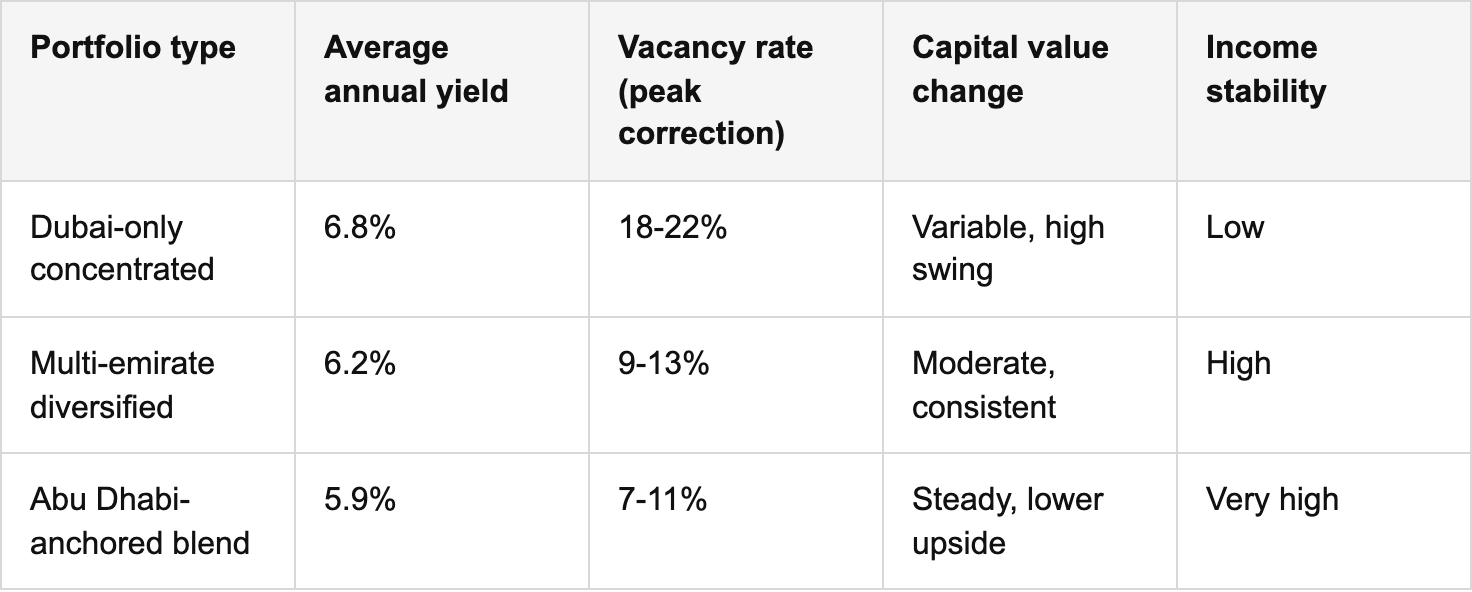
The diversified portfolio in this scenario accepts a slightly lower peak yield in exchange for meaningfully lower vacancy rates during corrections and far more predictable income. For high-net-worth investors managing capital at scale, income predictability often matters more than marginal yield differences. Making smart Dubai investment decisions within a broader multi-emirate context gives you the best of both worlds.
Here is a practical step-by-step framework for implementing emirate diversification:
- Audit your current exposure. Map every property asset by emirate, sub-market, tenant type, and lease duration. Identify concentration risks before adding any new positions.
- Define your portfolio objectives. Are you optimizing for maximum yield, capital preservation, income stability, or long-term capital growth? Different objectives lead to different emirate weightings.
- Establish target allocations. A common structure for a balanced UAE portfolio is 50-60% Dubai for liquidity and yield, 20-25% Abu Dhabi for defensive stability, and 15-25% across Sharjah, Ajman, or Ras Al Khaimah for diversified yield uplift.
- Research tenant demographics by location. Each emirate has a distinct tenant base. Match your property type and price point to the actual demand profile in each market, not your assumptions about it.
- Model net yields, not gross yields. Account for service charges, property management fees, vacancy assumptions, and transaction costs for each emirate before comparing performance.
- Review allocations annually. UAE market dynamics shift meaningfully year over year. Regular rebalancing ensures your evaluation of Dubai investments and broader UAE positions remains aligned with your objectives.
Common mistakes and best practices in emirate diversification
Now let’s move beyond theory to look at execution, where even experienced investors stumble, and how you can put best practices into action.

Diversification done poorly can actually increase complexity without meaningfully reducing risk. Spreading capital across five emirates without a coherent strategy is not diversification. It is fragmentation. The goal is strategic allocation, not geographic scatter.
Common mistakes investors make:
- Over-diversifying without a framework. Owning one unit in each of seven sub-markets creates a management burden without sufficient scale in any single market to optimize returns or negotiate favorable terms with property managers.
- Ignoring tenant supply and demand cycles. Buying in Ajman purely because of high gross yields without analyzing local oversupply conditions or tenant turnover data is a shortcut to underperformance.
- Assuming all freehold zones are equivalent. Freehold ownership rules, developer track records, and exit liquidity vary significantly across emirates. Understanding these distinctions is not optional; it is foundational.
- Neglecting currency and cross-emirate transaction costs. Even within the UAE, transferring properties, paying registration fees, and managing across multiple regulatory frameworks adds cost and complexity that investors routinely underestimate.
- Chasing the last cycle’s winner. Investors frequently allocate capital to the emirate that performed best over the past two years, which is typically the market approaching its peak rather than its entry point.
Best practices to counter these errors include:
- Anchor your portfolio in two or three emirates where you have genuine market intelligence, not five or six where you are operating on headlines.
- Use emirate-specific portfolio balancing strategies to establish minimum position sizes that justify the management and transaction costs associated with each market.
- Build your real estate portfolio workflow around systematic data review, not reactive reallocation triggered by short-term market noise.
Pro Tip: Consult local experts with active transaction history in each target emirate before allocating capital. Market intelligence from brokers who are actively closing deals in Ras Al Khaimah or Ajman today is worth more than any published market report with a six-month lag.
The most disciplined investors treat emirate diversification as a living strategy, one that evolves with smarter trend-based decisions as each market moves through its cycle. Rigidity in allocation is as dangerous as having no allocation strategy at all.
The uncomfortable truth: Why most investors miss the real value in emirate diversification
Years of working with high-net-worth investors in this market reveal a consistent pattern. The investors who build the most durable wealth are rarely the ones who chased Dubai’s highest yields in peak years. They are the ones who built quiet, compounding positions across multiple emirates while the crowd was bidding up Marina penthouses and Downtown studios.
Dubai’s headline yields are seductive. At 7-9% gross in certain communities, the numbers look compelling compared to London, Singapore, or New York. But most investors do not model what happens to those yields when vacancy climbs, service charges increase, or a wave of new off-plan completions hits the same sub-market simultaneously. The gross yield story often masks a net yield reality that is significantly more modest.
The real compounding effect in emirate diversification comes from a source most investors overlook: income continuity during down cycles. When Dubai corrects and an investor’s Abu Dhabi or Sharjah assets continue generating steady cash flow, that income does not just cover costs. It creates dry powder for counter-cyclical acquisitions in Dubai at distressed pricing. This is how disciplined multi-emirate investors actually build wealth, not by having the highest yield in a single good year, but by having uninterrupted capital to deploy when others are forced to sell.
As Dubai market research confirms, Abu Dhabi’s role as a defensive anchor is not a consolation prize for lower returns. It is a structural feature that funds opportunistic acquisition during corrections. Tracking Dubai real estate trends 2026 alongside Abu Dhabi and Northern Emirates data gives you the full picture that single-emirate investors simply never see.
The most overlooked truth is this: blend beats yield as a portfolio construction principle. The investor who allocates 60% to Dubai yield assets and 40% to defensive Abu Dhabi holdings does not just reduce risk. Over a full 10-to-15-year cycle, that blend typically generates superior risk-adjusted returns than a concentrated Dubai-only strategy, because the defensive positions fund the opportunistic ones.
Explore tailored strategies for your UAE portfolio
Knowing the theory of emirate diversification is valuable. Executing it with precision, real market data, and localized expertise is where the difference between average and exceptional portfolio performance is actually made.

At anthonyjosephaj.com, you get access to expert portfolio guidance built on years of active transaction experience across Dubai and the broader UAE market. Whether you are structuring your first multi-emirate allocation or rebalancing an existing portfolio to reduce concentration risk, Anthony Joseph’s platform offers personalized investment strategies grounded in current market intelligence. From off-plan opportunities in Ras Al Khaimah to defensive yield assets in Abu Dhabi, every recommendation is tailored to your specific objectives, capital position, and risk tolerance.
Frequently asked questions
How does emirate diversification reduce risk for property investors?
Spreading investments across multiple emirates lessens your exposure to localized downturns, tenant shifts, and supply-demand fluctuations, because each market operates on a distinct cycle with different demand drivers. As portfolio balancing research confirms, avoiding over-exposure to a single emirate’s dynamics is a core risk management principle.
Which emirate offers the highest rental yields?
Dubai is known for higher rental yields and liquidity, particularly in established communities, but Ajman and Ras Al Khaimah can offer even higher gross yields in specific asset classes. The portfolio role distinction between Dubai and Abu Dhabi illustrates that yield and stability represent different, equally valid portfolio objectives.
What are common mistakes when diversifying across emirates?
Frequent errors include over-diversification without a strategic framework, ignoring local tenant demand dynamics, and allocating capital based on gross yields rather than net returns after vacancy and management costs.
Should I include Sharjah or Ajman properties for diversification?
Including Sharjah or Ajman adds tenant variety and yield diversity to a portfolio anchored in Dubai or Abu Dhabi, but strategic selection based on data and minimum viable position sizes is essential to justify the added management complexity.


