
Build a winning real estate portfolio in Dubai: proven workflow guide
TL;DR:
- Building a disciplined, repeatable workflow is essential for success in Dubai real estate investing.
- Diversification across asset classes and geographic zones reduces risk and enhances long-term returns.
- Active management and ongoing performance review are crucial for sustaining rental yields and portfolio growth.
Building a real estate portfolio in Dubai without a structured plan is one of the fastest ways to erode capital in a market that rewards discipline and punishes guesswork. Boom-bust cycles, service charges, and geographic concentration are key risks that catch international investors off guard, especially those entering with enthusiasm but without a repeatable process. The good news: investors who follow a proven workflow consistently reduce exposure to these risks while optimizing rental yields and long-term capital appreciation. This guide walks you through every stage of that workflow, from initial strategy-setting to active portfolio optimization, so you can operate with clarity and confidence in one of the world’s most dynamic property markets.
Table of Contents
- Laying the groundwork: Setting strategy and due diligence
- Structuring your portfolio: Asset classes, diversification, and risk
- Acquisition workflow: Sourcing, vetting, and executing deals
- Optimizing and managing your portfolio for long-term results
- A contrarian’s view: Why workflow trumps market timing in Dubai
- Take your Dubai property portfolio to the next level
- Frequently asked questions
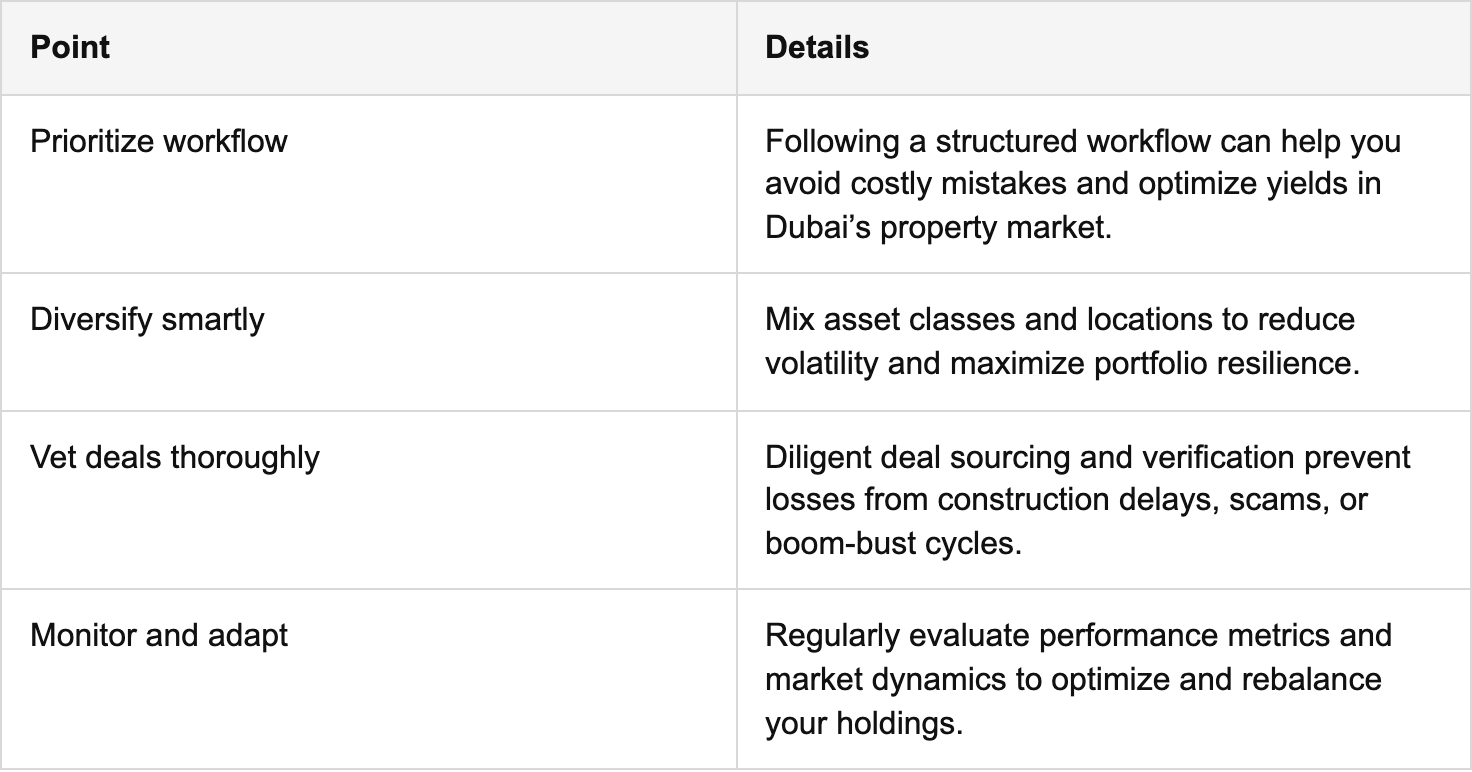
Key Takeaways
Laying the groundwork: Setting strategy and due diligence
Now that you understand the stakes, the logical starting point is setting a strong foundation. Before you evaluate a single property, you need to define what success looks like for your portfolio. Are you targeting passive income through rental yields, long-term capital gains, or a blend of both? Your investment time horizon shapes everything from asset class selection to financing structure.
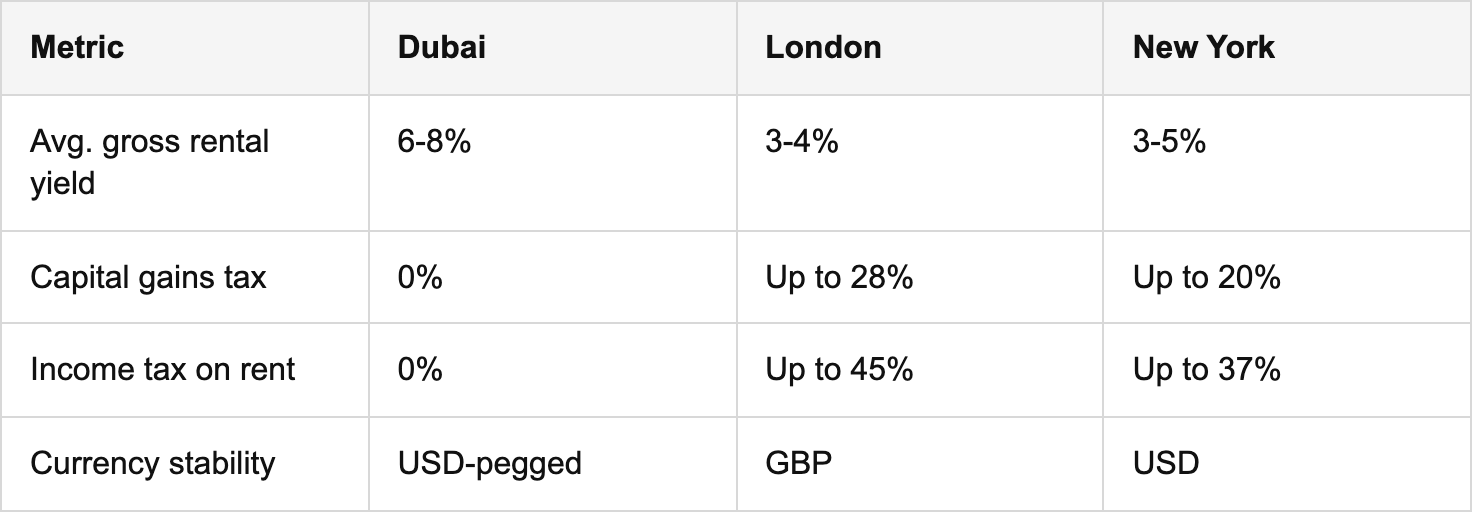
Dubai’s regulatory environment offers distinct advantages that most global markets cannot match. There is zero income tax, zero capital gains tax, and a stable currency pegged to the US dollar. These structural benefits make Dubai portfolio impact far more compelling than comparable markets in Europe or Southeast Asia. However, understanding the rules around freehold versus leasehold ownership, developer escrow requirements, and RERA (Real Estate Regulatory Agency) registration is non-negotiable before committing capital.
Due diligence checklist for Dubai investors:
- Confirm freehold ownership eligibility in your target area
- Verify developer track record and RERA registration
- Review the master community service charge schedule
- Check the property’s title deed history for encumbrances
- Assess proximity to infrastructure and planned developments
- Analyze comparable rental rates and vacancy levels in the submarket
Localized volatility and over-leverage are common edge-case risks for international investors who skip this stage. Do not underestimate the impact of service charges on net yields, particularly in premium tower developments where annual fees can reach AED 30 or more per square foot.
Dubai vs. global peers: Key investment indicators
Pro Tip: Cross-reference 2026 market trends before finalizing your strategy. Submarket dynamics shift quickly, and aligning your goals with current supply and demand data gives you a measurable edge.
Structuring your portfolio: Asset classes, diversification, and risk
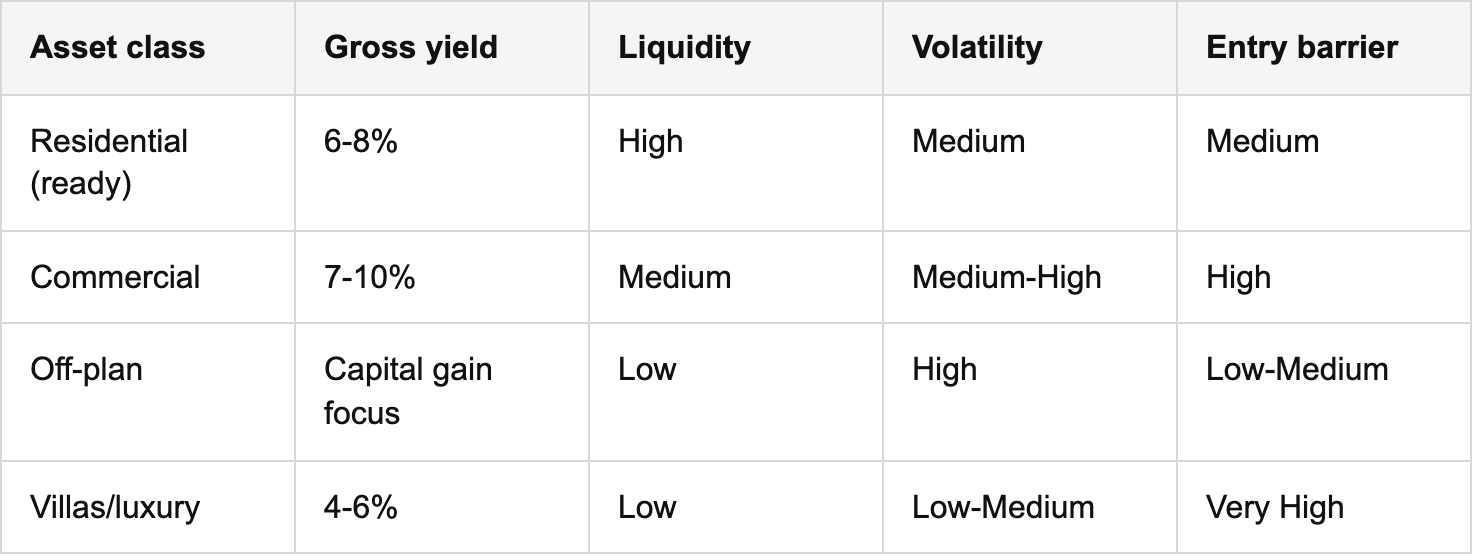
With your strategic foundation in place, let’s move into structuring your portfolio for maximum resilience and growth. Dubai’s property market offers four primary asset classes, each with distinct risk and return profiles: residential (apartments and villas), commercial (offices and retail), off-plan (pre-construction), and ready properties (completed, income-generating).
Understanding real estate investment types helps you allocate capital across classes that complement each other rather than duplicate risk.
Comparing Dubai property asset classes:
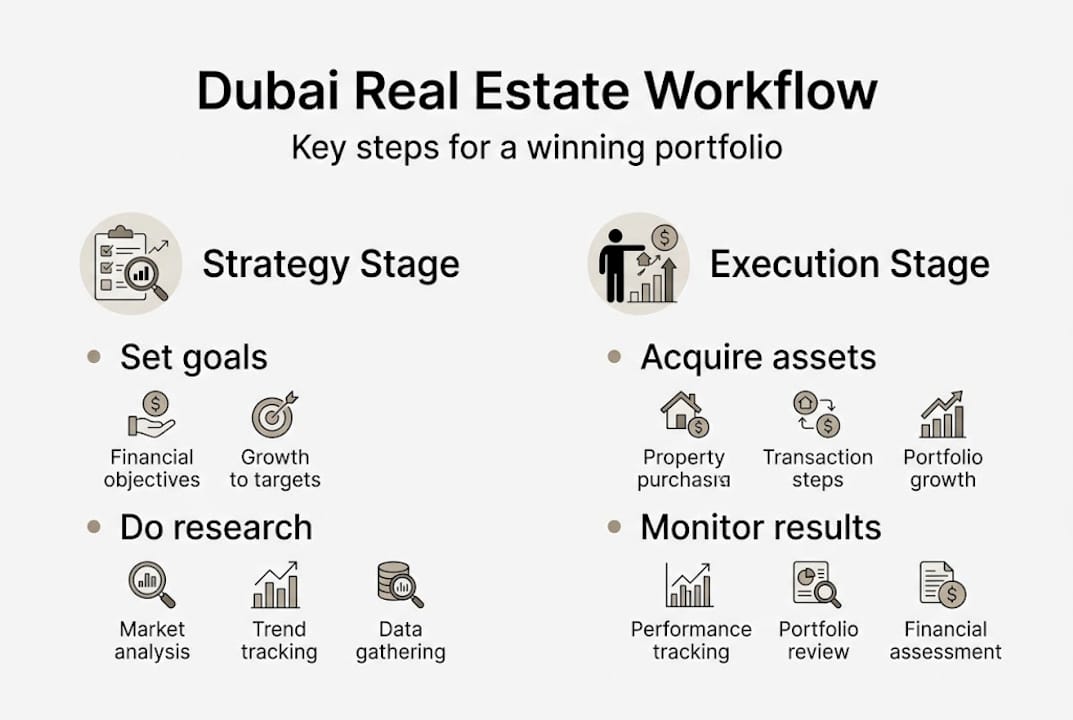
Step-by-step diversification process:
- Allocate a base position in ready residential properties for immediate cash flow
- Layer in off-plan assets in high-growth corridors for capital appreciation potential
- Add commercial exposure selectively to boost overall portfolio yield
- Spread holdings across at least two to three distinct geographic zones within Dubai
- Review allocation ratios every six months against your original return targets
Avoid concentration in one building or area due to localized volatility and market cycles. A single oversupplied tower or a submarket correction can significantly impair portfolio income if your holdings are too concentrated.
Monitoring Dubai rental yields by submarket gives you the granular data needed to make rebalancing decisions with confidence rather than guesswork. Active portfolio growth management is what separates investors who compound returns from those who stagnate.
Pro Tip: Use Dubai’s zero-tax regime and USD-pegged dirham as natural hedging tools. For investors holding USD-denominated assets or income streams elsewhere, Dubai properties function as a currency-stable, tax-efficient complement to global portfolios.
Acquisition workflow: Sourcing, vetting, and executing deals
The next successful step is disciplined acquisition. Here is how to do it right in Dubai.
Sourcing quality deals requires more than browsing property portals. Build relationships with RERA-registered brokers who specialize in your target asset class, attend developer launch events for off-plan access, and use platforms like Bayut and Property Finder to benchmark pricing. The best deals often surface through professional networks before they reach public listings.
Vetting checklist before committing capital:
- Confirm developer RERA registration and escrow account compliance
- Review the project’s construction milestone history or completion record
- Obtain an independent valuation for ready properties
- Analyze the projected net yield after service charges and management fees
- Verify title deed availability and absence of mortgage encumbrances
Sequential acquisition workflow:
- Identify target property and confirm it meets your portfolio criteria
- Conduct legal and financial due diligence with a qualified UAE property lawyer
- Submit a reservation form and pay the initial booking deposit (typically 5-10%)
- Sign the Sales and Purchase Agreement (SPA) within 30 days
- Register the transaction with the Dubai Land Department (DLD) and pay the 4% transfer fee
- Arrange property management or tenant placement for immediate income activation
Understanding the difference between off-plan vs ready properties is critical at this stage. Off-plan offers flexible payment plans and entry-level pricing, but requires patience and tolerance for construction risk. The off-plan investment guide provides a structured framework for evaluating these opportunities accurately.
Warning: Construction delays and scams are material risks in Dubai’s off-plan segment. Always verify that developer funds are held in a RERA-regulated escrow account and that the project has received all necessary approvals before signing. Never transfer funds outside of official banking channels.
Knowing how to evaluate Dubai real estate with a consistent analytical framework prevents emotional decision-making and keeps your acquisition process objective and repeatable.
Optimizing and managing your portfolio for long-term results
Acquisition is only half the equation; what happens next defines your portfolio’s trajectory.

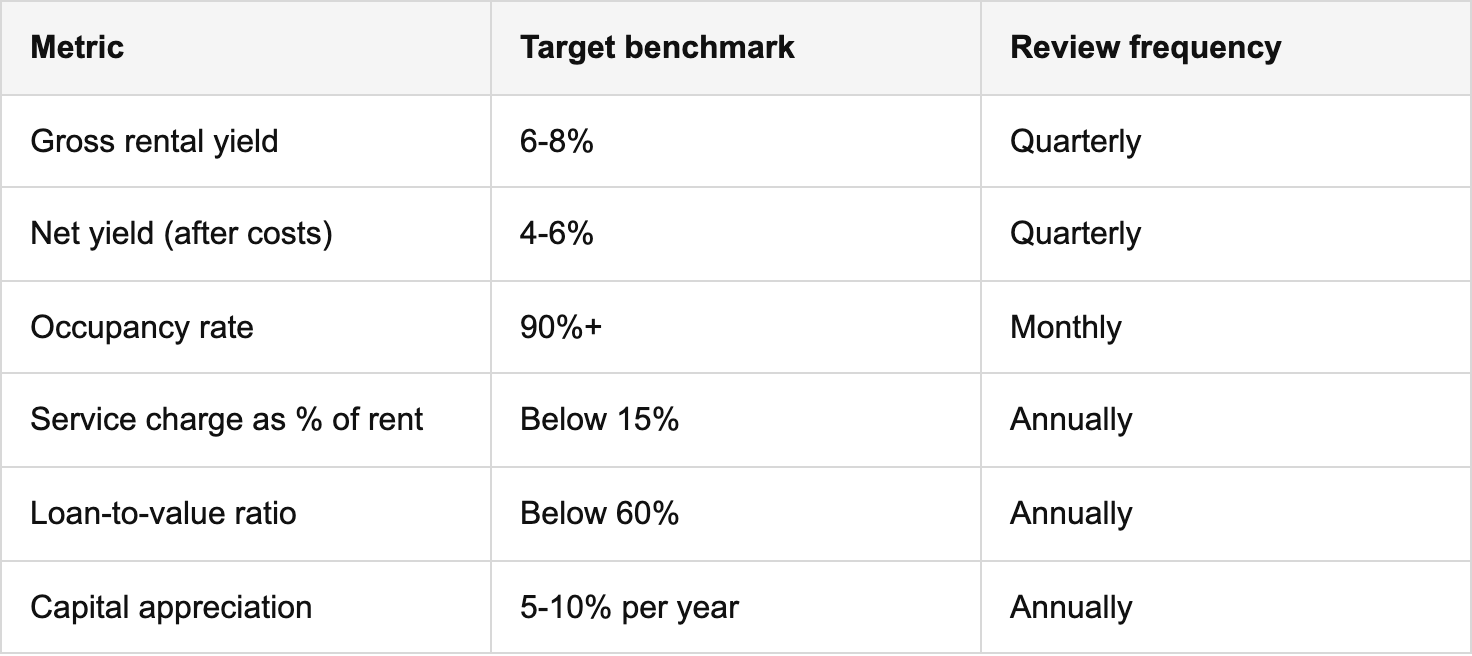
Once properties are acquired and generating income, active management becomes the primary driver of sustained returns. This means tracking performance metrics consistently, staying current with regulatory changes, and acting decisively when market conditions shift.
Key ongoing monitoring activities:
- Review rental income versus projected yield quarterly
- Track occupancy rates and tenant renewal patterns
- Monitor submarket supply pipeline for oversaturation signals
- Stay updated on RERA regulatory changes that affect landlord rights
- Assess leverage ratios and refinancing opportunities annually
Active monitoring helps avoid over-leverage and mitigates market swings, making Dubai’s high yields sustainable over multi-year holding periods. Without this discipline, even well-structured portfolios can underperform due to neglected maintenance costs, tenant disputes, or missed rebalancing windows.
Portfolio performance and risk monitoring metrics:
Effective portfolio optimization also involves knowing when to exit an asset. If a property’s net yield has compressed below your minimum threshold and capital appreciation has plateaued, redeploying that capital into a higher-performing asset class is often the smarter move. Sound property management strategies reduce operational friction and protect income continuity.
Pro Tip: Monitor service charge trends closely. In some master communities, annual service charges have increased by 15-20% over three years, directly compressing net yields. Factoring this into your acquisition underwriting and annual reviews helps you avoid investor pitfalls in Dubai that erode long-term returns.
A contrarian’s view: Why workflow trumps market timing in Dubai
After exploring tactical steps, let’s reflect on what actually delivers sustainable wealth for global investors in Dubai.
Most investors arrive in Dubai looking for the perfect entry point. They watch price indices, track transaction volumes, and wait for the ideal moment to buy. The reality is that market boom-bust cycles are unpredictable; disciplined workflows consistently outperform speculation over any meaningful time horizon.
What I have observed across hundreds of investor interactions is this: the investors who build lasting wealth in Dubai are not the ones who timed a cycle correctly. They are the ones who applied a repeatable system, adapted it after each transaction, and let compounding do its work. Avoiding common Dubai investor errors is less about market intelligence and more about process discipline.
The most overlooked truth in Dubai real estate is that your workflow is your competitive advantage. Document every acquisition decision, every due diligence finding, and every performance review. Over five to ten years, that institutional memory becomes more valuable than any market forecast.
Pro Tip: After each market cycle, audit your workflow. Identify what you would do differently and update your process accordingly. Learning compounds just as capital does.
Take your Dubai property portfolio to the next level
You now have a structured roadmap for building and optimizing a real estate portfolio in Dubai. But having a framework is only the beginning. Executing it effectively, especially across multiple assets and market cycles, is where expert guidance makes a measurable difference.

At anthonyjosephaj.com, Anthony Joseph and his team work directly with international investors to tailor portfolio workflows to their specific capital goals, risk profiles, and timelines. Whether you are acquiring your first Dubai asset or scaling an existing portfolio, access to proven advanced portfolio management strategies can accelerate your results significantly. Reach out today to begin building your Dubai portfolio with the structure and expertise it deserves.
Frequently asked questions
What types of real estate deliver the best yields in Dubai?
Residential properties in prime locations have historically provided 6-8% yields, outperforming comparable assets in London and New York by a significant margin.
How can I avoid scams or risky projects in Dubai?
Prioritize reputable developers, verify legal documentation, and avoid unregulated off-plan deals. Scams and construction delays are key risks for international buyers, making thorough due diligence essential before any commitment.
What is the main advantage of building a property portfolio instead of buying a single asset?
A portfolio offers diversification, reducing localized risk and providing more stable, long-term returns. Avoid concentrating investments in one area or building to protect against submarket corrections.
Is there a minimum capital required to start portfolio investing in Dubai?
While luxury assets are common entry points for high-net-worth individuals, portfolio strategies can begin with mid-range properties if diversified wisely. HNWIs from India and the UK are prominent, but diversified portfolio building suits a range of capital levels.
How do I monitor my real estate portfolio performance over time?
Track rental yields, capital appreciation, occupancy rates, and adjust your holdings based on regular market reviews. Active monitoring is essential for sustaining the high yields Dubai’s market can deliver over the long term.


