

Build-to-rent: A guide for Dubai real estate investors
TL;DR:
- Build-to-rent in Dubai offers long-term income and professional management, differing from traditional buy-to-let.
- The sector benefits from Dubai’s strong demand, regulatory support, and high rental yields of 6-9%.
- Treating BTR as a business focused on occupancy and operator quality ensures durable, stable returns.
Most investors assume the only real play in Dubai real estate is buy, wait, and sell at a profit. That thinking leaves a significant and growing opportunity on the table. Build-to-rent (BTR) is a residential development model purpose-built for the long-term rental market rather than individual unit sales, and it’s reshaping how sophisticated investors generate sustainable income in one of the world’s most dynamic property markets. If you’re looking for consistent cash flow, institutional-grade management, and a model that aligns with Dubai’s rapidly maturing rental demand, this guide gives you a clear, actionable roadmap.
Table of Contents
- Understanding build-to-rent: The basics
- How build-to-rent operates in Dubai
- Benefits of build-to-rent for investors and renters
- Understanding regulations and risk in Dubai’s build-to-rent sector
- Why build-to-rent is the smart play for Dubai’s next decade
- Take the next step in Dubai build-to-rent investments
- Frequently asked questions
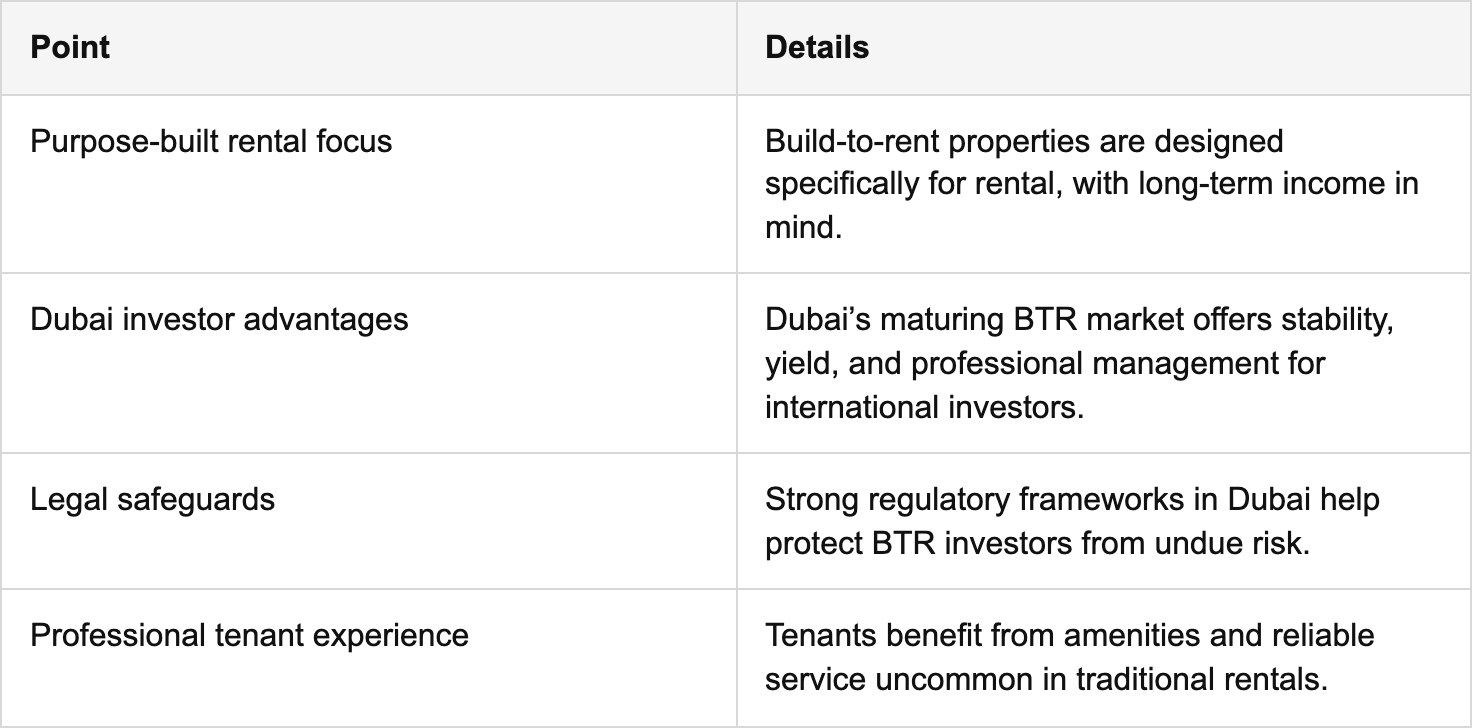
Key Takeaways
Understanding build-to-rent: The basics
Now that you know build-to-rent isn’t simply owning a rental, let’s define how it actually works and what sets it apart from conventional investment models.
At its core, BTR refers to entire residential developments that are purpose-built for rental, managed by institutional operators, and designed with professional amenities specifically to attract and retain long-term tenants. This is not a landlord owning a single apartment and listing it on a short-term platform. BTR is a structured, large-scale approach where the asset is never intended for individual sale.
The key stakeholders in a BTR project are distinct from those in a traditional residential scheme:
- Developers design and construct the entire building or complex with rental retention in mind, incorporating shared amenities, flexible floor plans, and durable finishes.
- Institutional landlords or operators take ownership of the completed asset and manage it as a unified portfolio, not as individual units.
- Tenants benefit from professionally managed, amenity-rich living environments with consistent service standards.
- Investors participate either by funding development directly, acquiring equity stakes in BTR vehicles, or purchasing completed BTR assets as income-generating properties.
Understanding how BTR differs from buy-to-let (BTL) is essential before committing capital. Here’s a direct comparison:
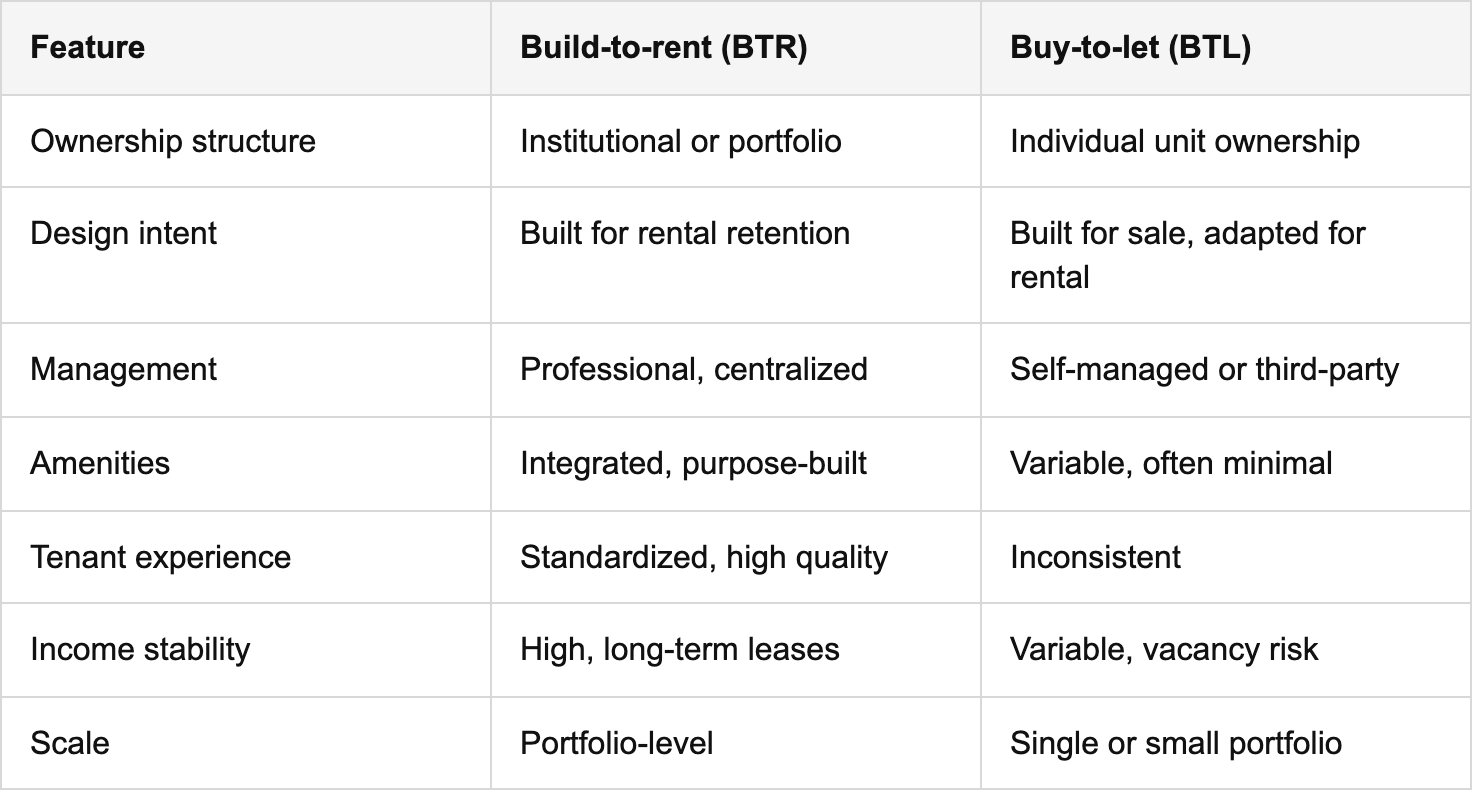
“Build-to-rent properties are purpose-built and professionally managed for the rental market, not designed for resale. This distinction fundamentally changes the investment calculus for institutional and international investors.”
For investors familiar with Dubai real estate terminology, it’s worth noting that BTR sits between traditional freehold investment and serviced apartment models. It occupies a unique position: long-term residential, professionally operated, and optimized for yield rather than capital appreciation alone.
How build-to-rent operates in Dubai
With the basics covered, it’s crucial to see how the model translates specifically to the Dubai landscape, where the market has its own regulatory structure, investor profile, and tenant demographics.
Dubai’s BTR sector is still maturing relative to markets like the United Kingdom or Australia, but it’s accelerating quickly. The city’s population growth, high expatriate concentration, and preference for professionally managed living environments make it a natural fit for the BTR model. Here’s how the lifecycle of a BTR property typically unfolds in Dubai:
- Site acquisition and planning: A developer or institutional investor identifies a site within a designated freehold or leasehold zone. Planning approval is obtained through the Dubai Land Department (DLD) and relevant master developers such as Emaar or Nakheel.
- Design and development: The building is designed with rental retention as the primary goal. This means prioritizing amenities like co-working spaces, fitness centers, rooftop terraces, and concierge services that appeal to Dubai’s international tenant base.
- Pre-leasing and marketing: Before or shortly after completion, the operator begins pre-leasing campaigns targeting corporate tenants, long-term expatriates, and high-net-worth individuals seeking quality managed living.
- Operational phase: A professional property management company takes over day-to-day operations, handling maintenance, tenant relations, rent collection, and compliance with UAE tenancy law.
- Portfolio management and refinancing: As the asset stabilizes with strong occupancy, investors may refinance, bring in additional capital partners, or hold for long-term income.
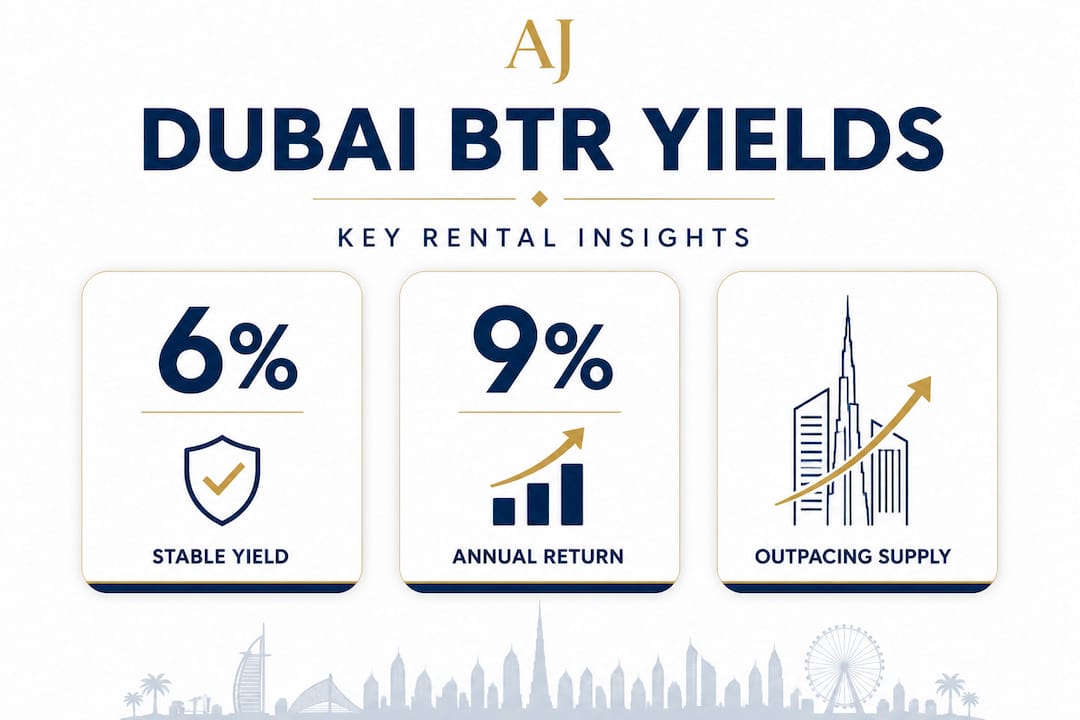
According to Dubai property market trends, demand for professionally managed rental units is outpacing supply in several key districts, including Dubai Marina, Downtown Dubai, and Jumeirah Village Circle. This supply gap is exactly where BTR projects find their strongest performance.
Managed amenities and rental-focused operations in BTR add measurable value for international investors who cannot be physically present to manage individual units. This is a critical point for overseas capital: the institutional management layer removes the operational burden entirely.
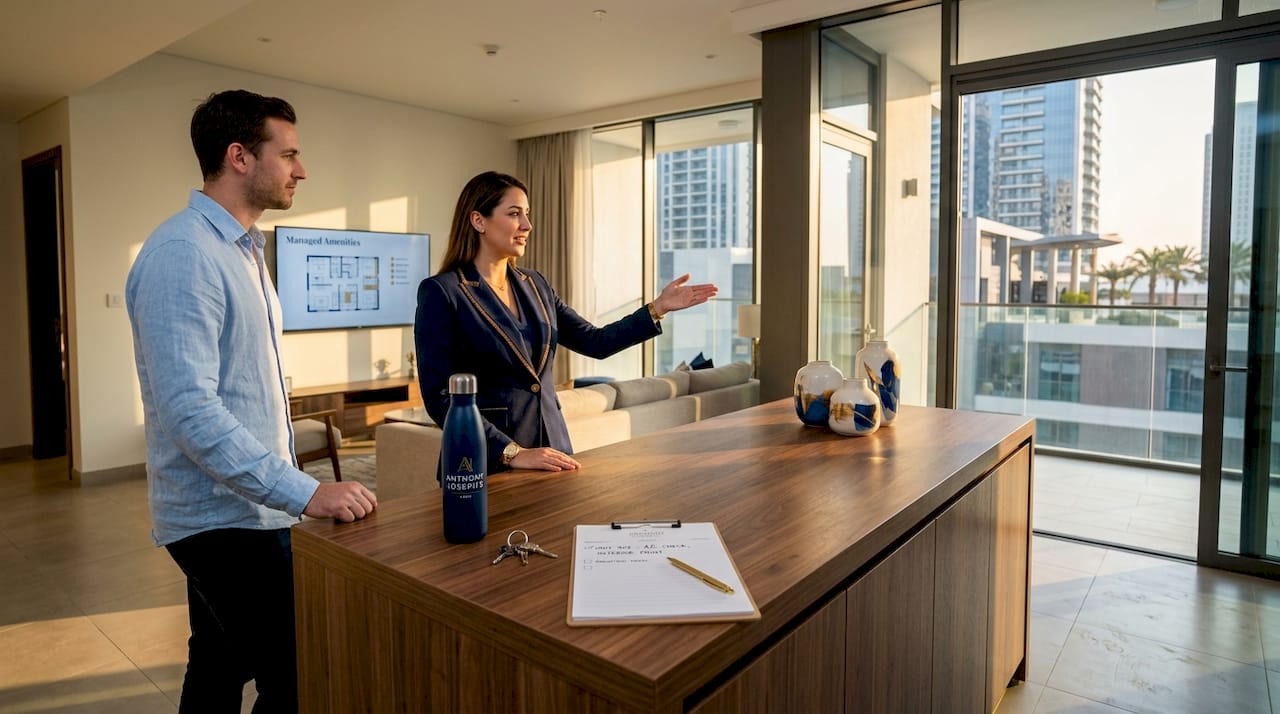
Pro Tip: If you’re evaluating a BTR opportunity in Dubai, always assess the operator’s track record alongside the asset itself. A poorly managed BTR building in a prime location will underperform a well-managed one in a secondary location every time.
Reviewing current Dubai rental yields data is essential when benchmarking BTR returns against traditional buy-to-let options. Dubai consistently ranks among the top global cities for gross rental yields, often delivering 6% to 9% annually in prime areas, and BTR assets with professional management can sustain these figures more reliably over time.
Benefits of build-to-rent for investors and renters
Understanding how the process works is key, but the real draw comes from the tangible advantages for both investors and tenants. BTR is not a compromise between residential and commercial real estate. It’s a purpose-optimized model that serves both sides of the equation exceptionally well.
For investors, the primary benefits include:
- Stable, predictable income: Long-term tenancy agreements, typically one to three years, reduce vacancy risk and provide reliable cash flow forecasting.
- Lower management burden: Professionally managed BTR properties provide stable rental income and streamlined tenant experiences, removing the day-to-day friction of individual landlord responsibilities.
- Portfolio scalability: Owning a stake in a BTR asset gives you exposure to dozens or hundreds of units through a single investment vehicle, diversifying risk across a large tenant base.
- Institutional-grade asset quality: BTR buildings are built to a higher specification than typical residential developments because tenant retention is the business model. Lower maintenance costs and higher durability protect long-term returns.
- Alignment with Dubai’s growth trajectory: Dubai’s population is projected to reach 5.8 million by 2040 under the Dubai 2040 Urban Master Plan, and a significant portion of that growth will consist of expatriate renters rather than homeowners.
For tenants, the appeal is equally strong:
- Professional service standards: Tenants in BTR buildings benefit from responsive maintenance, clear lease terms, and consistent quality across all shared spaces.
- Community amenities: Fitness centers, pools, business lounges, and social spaces are standard in purpose-built BTR developments, creating a lifestyle product rather than just a place to live.
- Flexibility with stability: BTR operators often offer flexible lease terms while maintaining the security of a professionally managed environment, which appeals strongly to Dubai’s mobile expatriate workforce.
The advantages of professional property management extend beyond convenience. In Dubai’s competitive rental market, professionally managed buildings command premium rents and lower vacancy rates, which directly improves net operating income for investors.
Statistic callout: Dubai’s rental market saw transaction volumes increase by over 30% in recent years, with demand concentrated in professionally managed, amenity-rich developments. BTR assets are positioned directly at the center of this demand curve.
For international investors exploring the advantages of owning Dubai property, BTR offers a particularly compelling entry point because it combines income generation with reduced operational complexity. You don’t need to be in Dubai to make your investment work.
It’s also worth comparing BTR to serviced apartments in Dubai, which serve a different segment of the market. Serviced apartments typically target short-stay and corporate guests, while BTR focuses on long-term residential tenants. Both have merit, but BTR offers more predictable, lower-risk income streams for investors with a longer time horizon.
Understanding regulations and risk in Dubai’s build-to-rent sector
Of course, no investment is risk-free, so let’s address the regulatory environment and how it supports sustainable BTR investment in Dubai.
Dubai has one of the most investor-friendly regulatory frameworks in the region, and this extends to the BTR sector. BTR developments are subject to local real estate and rental laws, which protect both investors and renters, creating a balanced environment that supports long-term market stability.
Key regulatory considerations for BTR investors in Dubai include:
- Freehold vs. leasehold zones: Foreign investors can own property outright in designated freehold areas. BTR projects in these zones offer full ownership rights, while leasehold arrangements in other areas require careful legal structuring.
- RERA registration: The Real Estate Regulatory Agency (RERA) oversees all rental activity in Dubai. BTR operators must register tenancy contracts through the Ejari system, ensuring transparency and legal enforceability.
- Rent increase caps: Dubai’s rental index, managed by RERA, governs permissible rent increases based on market benchmarks. This protects tenants from arbitrary hikes and gives investors a predictable framework for revenue modeling.
- Escrow requirements for off-plan BTR: If you’re investing in a BTR project before completion, developer escrow regulations under Law No. 8 of 2007 protect your capital during the construction phase.
- Strata and jointly owned property laws: For BTR assets within larger master developments, understanding strata regulations is essential for managing shared costs and service charges.
“Dubai’s regulatory framework for real estate, including BTR, is designed to attract and protect international capital while maintaining market integrity and tenant rights.”
For a detailed understanding of your obligations and protections, reviewing the Dubai rental law overview and the broader UAE investor protections framework is strongly recommended before committing to any BTR investment.
The primary risks in Dubai’s BTR sector are market oversupply in specific submarkets, regulatory changes to rent caps, and operator performance. Each of these risks is manageable with proper due diligence, experienced local partners, and a clear understanding of the submarkets where demand fundamentals are strongest.
Why build-to-rent is the smart play for Dubai’s next decade
Having explored the hard facts and frameworks, it’s worth stepping back to consider the bigger picture and where the real opportunity lies for investors who are willing to think beyond the conventional.
Here’s a perspective that most market commentary overlooks: the investors who will generate the most durable returns from Dubai real estate over the next decade are not the ones chasing capital appreciation in hot submarkets. They are the ones who treat BTR as an operating business, not just a passive asset.
This distinction matters enormously. When you approach BTR as a business, you focus on occupancy rates, tenant retention, net operating income, and operator quality. You stop asking “what will this unit be worth in five years?” and start asking “how do I optimize cash flow and reduce vacancy across this portfolio?” That shift in thinking is what separates institutional-grade investors from retail speculators.
Global BTR markets in the UK, US, and Australia have already demonstrated this principle. In London, BTR assets managed by institutional operators consistently outperformed traditional buy-to-let portfolios on a risk-adjusted basis over the past decade, precisely because professional management reduced vacancy and maintained asset quality. Dubai is at an earlier stage of this same curve, which means the opportunity to enter at favorable valuations still exists.
The investors who ignore the shift toward institutionally managed rental in Dubai risk being left behind as the market matures. As more capital flows into professionally operated BTR assets, the premium for quality management will only increase. Individual landlords with poorly maintained units in the same buildings will find it increasingly difficult to compete on rent and tenant quality.
Exploring smarter Dubai investments means recognizing that the market is evolving from a transaction-driven culture toward an income-driven one. BTR is not a trend. It’s the structural direction of a maturing real estate market.
Take the next step in Dubai build-to-rent investments
You now have a clear framework for understanding, evaluating, and approaching build-to-rent investment in Dubai. The model is sound, the market fundamentals are strong, and the regulatory environment supports long-term investor confidence.

Turning that knowledge into a well-structured investment requires local expertise, market access, and a trusted advisor who understands both the opportunity and the nuances of Dubai’s property landscape. At anthonyjosephaj.com, Anthony Joseph and his team work directly with international investors and high-net-worth individuals to identify, evaluate, and execute BTR opportunities that align with their income goals and risk profiles. From off-plan BTR projects to stabilized income assets and full property management support, the guidance you need is available. Reach out today to start building a Dubai BTR strategy that generates sustainable returns for years to come.
Frequently asked questions
How does build-to-rent differ from ordinary buy-to-let in Dubai?
BTR is purpose-built and managed for rental, not sale, while buy-to-let involves individuals purchasing standalone units and managing them independently or through third parties. BTR offers institutional management, integrated amenities, and portfolio-scale income stability that individual buy-to-let typically cannot match.
Can foreign investors participate in Dubai’s build-to-rent projects?
Yes, foreign investors can invest in build-to-rent in Dubai, particularly within designated freehold zones, but must comply with local real estate laws governing ownership, tenancy registration, and operator licensing. Working with a qualified local advisor ensures full compliance and protects your investment.
What returns can international investors expect from build-to-rent in Dubai?
Professional management and rental-focused operations support stable gross yields typically ranging from 6% to 9% annually in Dubai’s prime BTR submarkets, often outperforming comparable global cities due to Dubai’s tax-free income environment and sustained rental demand.
Are there risks unique to the build-to-rent model in Dubai?
Like any property investment, BTR carries risks including submarket oversupply and operator underperformance, but local regulations protect investors and renters through RERA oversight, escrow requirements, and standardized tenancy frameworks that significantly reduce systemic risk.


