
Why relocate to Dubai: Key benefits for expats and investors
TL;DR:
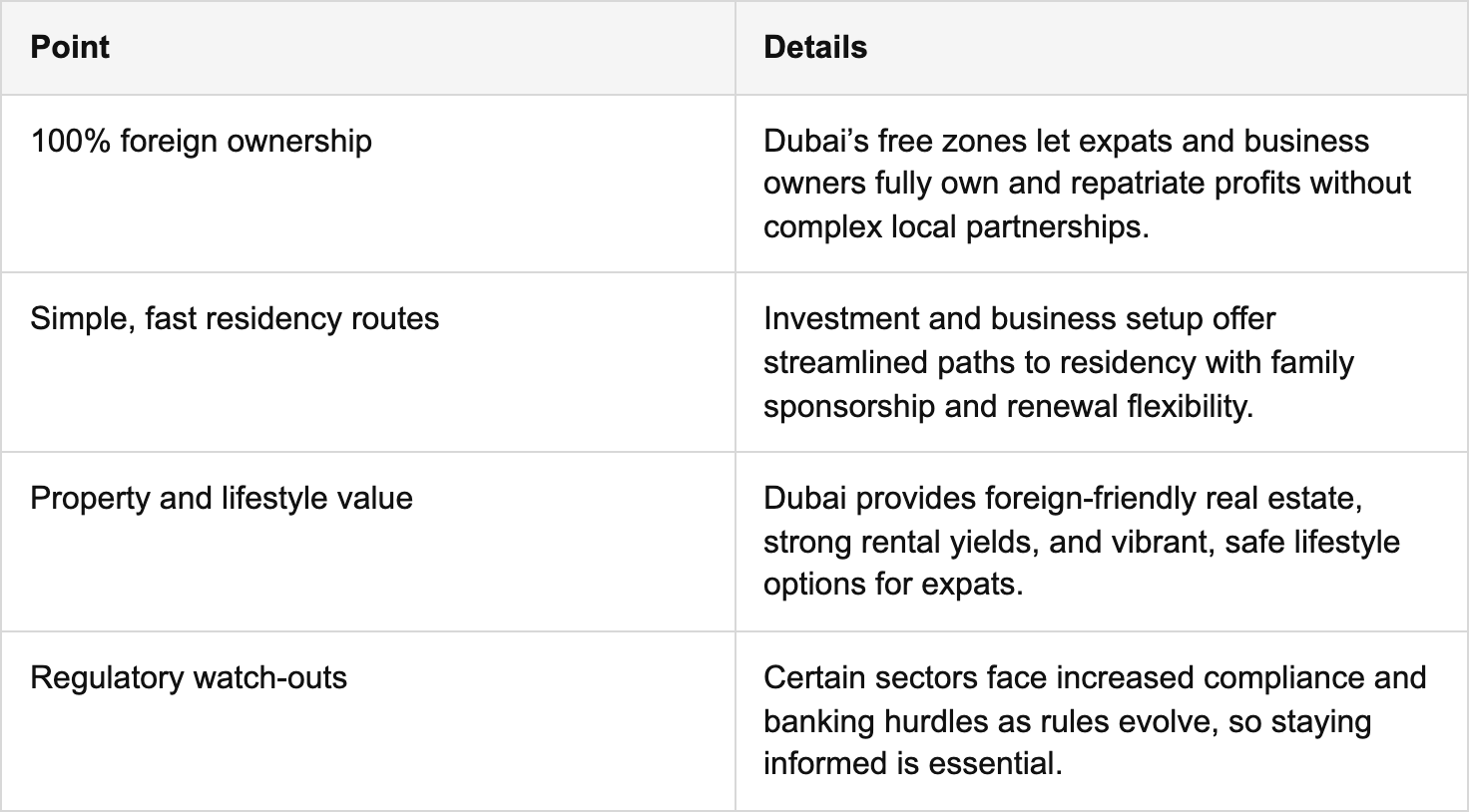
- Dubai’s free zones offer 100% foreign ownership, quick setup, and tax exemptions, simplifying business relocation.
- Multiple residency pathways are available, including company, property, and long-term Golden Visas.
- Dubai combines high safety, lifestyle quality, and strong investment returns, attracting expatriates worldwide.
Relocating abroad often feels like navigating a maze of legal requirements, tax uncertainties, and unfamiliar business cultures. Dubai is a different story. With over 40 free zones offering 100% foreign ownership, zero income tax, and company formation timelines as short as one day, it has quietly become one of the most straightforward destinations for expats and entrepreneurs seeking a genuine fresh start. This guide walks you through the core advantages, from business setup to residency pathways and real estate ownership, so you can move from curiosity to a well-informed decision with confidence.
Table of Contents
- Dubai’s business environment: What sets it apart
- Pathways to residency: Investment, real estate, and visa stability
- Real estate and lifestyle advantages for relocators
- Risks, evolving regulations, and what to watch for in 2026
- Our perspective: What most guides miss about relocating to Dubai
- Ready to relocate? Get expert help for your Dubai move
- Frequently asked questions
Key Takeaways
Dubai’s business environment: What sets it apart
When people talk about Dubai’s appeal for foreign entrepreneurs, free zones come up immediately. A free zone is a designated geographic area within the UAE where businesses enjoy a distinct regulatory framework, separate from mainland company rules. These zones were purpose-built to attract foreign capital and talent, and they deliver on that promise in measurable ways.
The UAE Ministry of Economy confirms that free zones provide 100% foreign ownership, 100% profit repatriation, tax exemptions, no customs duties, and company setup timelines ranging from just 1 to 7 days. That combination is genuinely rare anywhere in the world. Most competing jurisdictions require a local partner or shareholder to hold a majority stake, which immediately creates a layer of dependency that many entrepreneurs want to avoid.
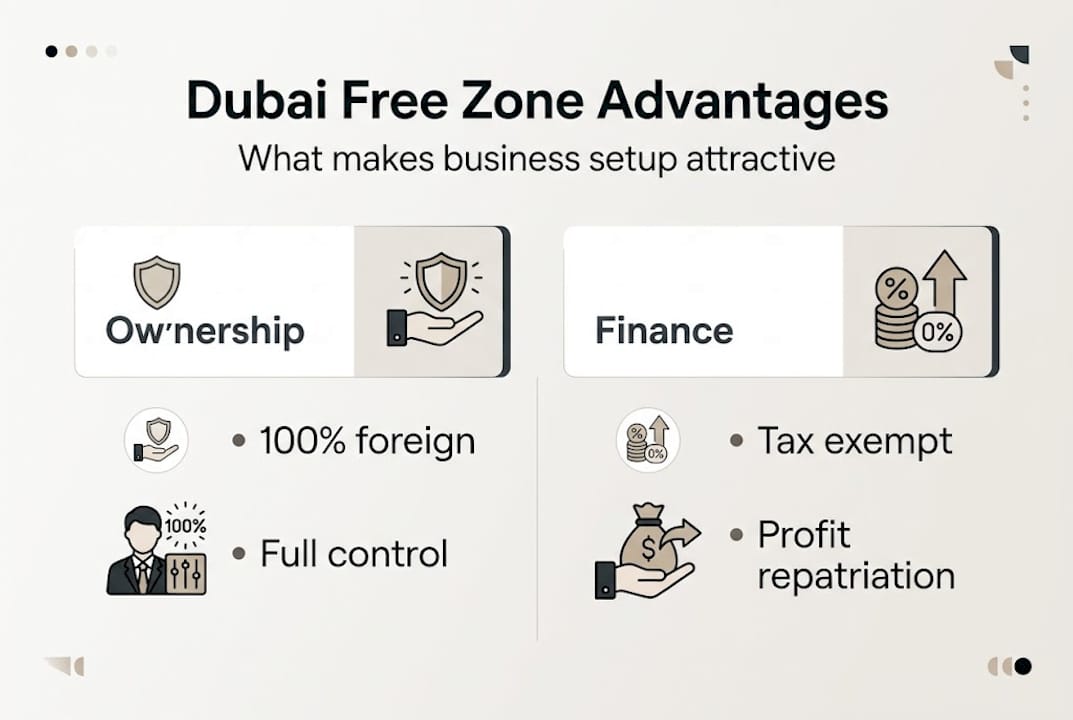
For expats considering a move, free zone investment setup is also a recognized pathway to residency. As noted by GSB Global, free zones offer quick, low-barrier residency through investment, making the business and visa process mutually reinforcing rather than two separate bureaucratic hurdles.
Dubai free zone vs. mainland company setup: A comparison
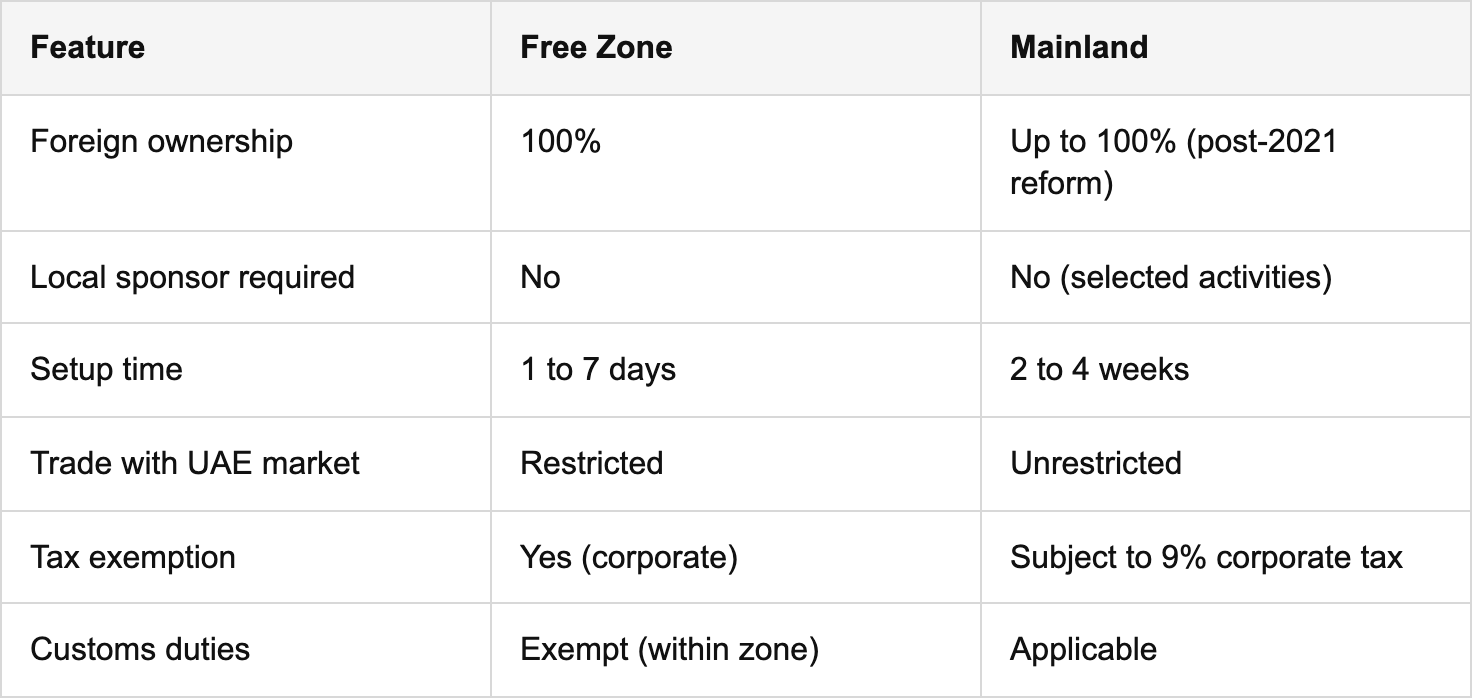
Mainland setups have their own advantages, particularly if you want direct access to the broader UAE market. However, for most internationally focused businesses, free zones deliver superior speed, cost, and ownership clarity.

Pro Tip: If you want to fast-track both your business license and your residency visa, choose a free zone that bundles both services in a single application package. Zones like DMCC, IFZA, and RAKEZ are known for efficient, integrated processes that can have you operational within a week.
Pathways to residency: Investment, real estate, and visa stability
Understanding the business incentives, it’s important to know the paths available for legal residency. Dubai’s residency framework has expanded significantly, and today there are multiple structured routes depending on your investment profile and long-term goals.
Here are the primary residency pathways available to expats and investors:
- Company formation visa: Establish a business in a free zone or on the mainland and receive a residence visa tied to your company. This is one of the most common routes for entrepreneurs.
- Property purchase visa: Purchase real estate meeting the minimum value threshold and qualify for a property investor visa with renewable terms.
- Golden Visa: A long-term, 10-year renewable visa available to investors, real estate buyers, entrepreneurs, and skilled professionals meeting specific financial criteria.
- Employment visa: Sponsored by an employer registered in the UAE, valid for two years and renewable.
- Retirement visa: Available to those over 55 who meet financial benchmarks through savings, property, or income.
As GSB Global highlights, Dubai offers low-barrier investment and quick residency for business owners, which is a meaningful differentiator compared to slower-moving jurisdictions in Europe or Southeast Asia.
Residency route investment thresholds (2026)
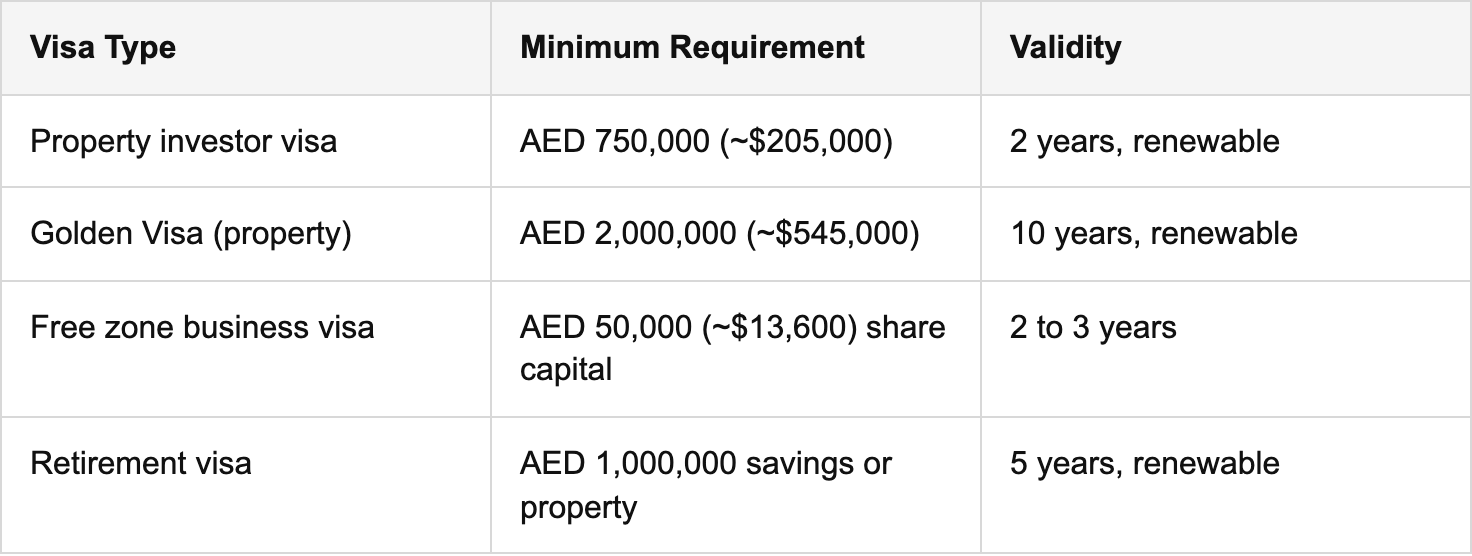
For a detailed breakdown of all ways to obtain Dubai residency, it’s worth reviewing your eligibility across multiple routes before committing to one.
Pro Tip: If you plan to sponsor family members, the Golden Visa is the most stable option. It allows you to include a spouse, children, and even domestic staff under a single long-term visa, reducing the administrative burden of annual renewals.
Real estate and lifestyle advantages for relocators
With residency avenues covered, let’s examine how Dubai’s property market and lifestyle truly set it apart. For many expats, the decision to relocate eventually intersects with a decision to invest in property, and in Dubai, these two goals align naturally.
As detailed in the Dubai Real Estate Investment guide, Dubai’s property market offers ownership freedom and is a prime draw for global investors. Foreigners can purchase freehold property in designated zones with full legal title, meaning you own the asset outright without a local partner, time limit, or restrictive lease structure. That is not the default in most of the Middle East.
The financial case is equally compelling. Rental yields in prime Dubai neighborhoods regularly range between 6% and 9% annually, which outpaces comparable cities like London (3% to 4%) or Singapore (2% to 3%). Capital appreciation has also been strong, with certain districts posting double-digit price growth over recent years. You can explore the full property ownership advantages to understand how these returns are structured across different asset classes.
Dubai consistently ranks among the top 10 safest cities globally, with an exceptionally low crime rate, world-class healthcare infrastructure, and one of the highest concentrations of internationally accredited schools in the region.
Beyond returns, lifestyle is a genuine pull factor. Here is what expats consistently cite as Dubai’s most significant quality-of-life advantages:
- Tax-free personal income: No income tax on salaries or business profits for individuals.
- World-class connectivity: Dubai International Airport connects to over 240 destinations, making global travel seamless.
- International schooling: Hundreds of accredited schools follow British, American, IB, and other curricula.
- Healthcare quality: Both public and private systems meet international standards, with fast access to specialists.
- Safety and stability: Consistently low crime and strong rule of law create a predictable environment for families.
- Cosmopolitan community: Over 200 nationalities call Dubai home, creating a genuinely global social fabric.
For those ready to act, understanding the steps to buy Dubai property is a practical first move before engaging any developer or broker.
Risks, evolving regulations, and what to watch for in 2026
No opportunity is without risk, and Dubai’s 2026 regulatory climate brings specific considerations for new arrivals. The picture is largely positive, but informed investors prepare for the full landscape, not just the highlights.
One real concern is regulatory tightening in certain sectors. As The Traveler reports, some sectors face regulatory tightening and banking challenges following post-2026 geopolitical shifts. Businesses in financial services, crypto, and certain consulting niches have found that opening UAE bank accounts has become more document-intensive and slower than it was a few years ago. This doesn’t make Dubai off-limits for these sectors, but it does require better preparation.
The entrepreneurs who struggle in Dubai are usually those who arrived expecting a zero-friction environment. The regulatory framework is favorable, but compliance is real and ongoing. Staying informed is not optional; it is your competitive advantage.
Here are practical steps to reduce your exposure to regulatory and operational risk:
- Work with licensed professionals: Use registered brokers, legal advisors, and company formation agents who hold valid UAE licenses. Verify credentials before signing any agreements.
- Monitor policy updates regularly: The UAE government publishes regulatory changes through official channels. Bookmark the UAE Ministry of Economy and RERA (Real Estate Regulatory Authority) sites.
- Diversify your investment: Don’t concentrate all assets in a single property or business sector. Spread exposure across asset classes to reduce volatility.
- Maintain compliance documentation: Keep your trade license, visa renewals, and financial records current. Lapsed documents create compounding delays.
- Engage a local banking advisor early: Opening a UAE business bank account can take weeks. Start this process in parallel with your company formation, not after.
For a current read on the real estate market outlook, staying updated on sector-specific trends is essential before committing capital.
Our perspective: What most guides miss about relocating to Dubai
To round out the picture, here is our direct perspective on relocating to Dubai. Most relocation guides focus almost entirely on the financial advantages, and those advantages are real. But they often skip the adaptation curve that comes with building a life in a new city, culture, and regulatory environment.
Dubai rewards patience and relationship-building. The formal structures are efficient, but the informal networks, the trusted advisors, the community connections, are what determine whether your first year feels like momentum or friction. Many expats who struggle are not underprepared financially. They are underconnected on the ground.
Residency and business setup are genuinely streamlined compared to most jurisdictions. But understanding how to use that structure effectively, which free zone fits your business model, which property type builds the most stable residency, requires nuanced guidance, not just a checklist. We’ve seen this play out repeatedly in real investment journeys where the difference between a good outcome and a great one was simply better-informed decisions at the start.
Dubai is not perfect. Banking friction for certain industries is real. Cultural adaptation takes time. But for the right investor or entrepreneur, it remains one of the most structurally advantaged cities in the world for building long-term wealth and lifestyle.
Ready to relocate? Get expert help for your Dubai move
If Dubai seems like your next move, here is how to transition from research to action. Knowing the benefits is one thing; executing a relocation with the right legal structure, property choice, and visa strategy is where expertise pays off most.

Anthony Joseph is a Dubai-based real estate expert with a track record of helping international investors and expats structure their move strategically, from property acquisition to company formation and residency. Whether you are evaluating your first Dubai purchase or ready to move forward, the property buying guide is a strong starting point. Reach out directly to explore a tailored approach to your relocation and investment goals.
Frequently asked questions
What is the minimum investment to obtain Dubai residency?
The minimum varies by route, but starts at AED 750,000 (~$205,000) for property or AED 50,000 (~$13,600) for business setup in many UAE free zones, making it accessible across different budget levels.
Can foreign nationals own property in Dubai?
Yes, foreigners can purchase freehold property in designated areas with full ownership rights, as confirmed by Dubai’s property market framework that prioritizes global investor access.
How quickly can I set up a business in Dubai?
Most free zone company setups can be completed in as little as 1 to 7 days, with the UAE’s streamlined procedures designed to remove the typical bureaucratic delays found in other jurisdictions.
Are there any business sectors where relocation is risky?
Regulated sectors such as financial services and crypto may face increased banking and compliance challenges due to regulatory tightening following post-2026 geopolitical developments, requiring more thorough preparation before setup.


