

SPVs in real estate: streamline investment and risk in Dubai
TL;DR:
- SPVs are separate legal entities that protect investors’ personal assets from property liabilities.
- They offer advantages like risk isolation, easier succession, portfolio management, and financing options.
- Setting up and maintaining an SPV involves costs and compliance, making them ideal for portfolios rather than single-property purchases.
International investors entering Dubai’s property market often face a maze of legal structures, ownership rules, and tax considerations that can feel paralyzing. One of the most powerful yet frequently misunderstood tools available is the Special Purpose Vehicle, or SPV. Many investors hear the term and assume it’s reserved for institutional players or family offices with armies of lawyers. In reality, an SPV can be a practical, strategic structure for a wide range of international buyers. This guide breaks down what SPVs are, how they work in Dubai, their real advantages and trade-offs, and exactly when they make sense for your portfolio.
Table of Contents
- What is an SPV in Dubai real estate?
- Key benefits of using an SPV for Dubai property investment
- Potential drawbacks and compliance considerations
- SPVs vs. direct ownership: Which structure fits your strategy?
- How to set up an SPV for Dubai real estate: Step-by-step
- A smarter approach to SPVs: What the brochures won’t tell you
- Ready to optimize your Dubai property investments?
- Frequently asked questions
Key Takeaways
| Point | Details |
|---|---|
| SPV defined | A Special Purpose Vehicle is a legal entity designed to hold real estate while isolating risk and simplifying structured ownership. |
| Major advantages | SPVs protect your other assets, streamline estate planning, and can facilitate easier co-investment and financing. |
| Key drawbacks | SPVs add complexity, compliance, and annual costs, making them more suitable for larger portfolios or long-term strategies. |
| Direct vs SPV | Direct ownership is simpler but offers less protection, while SPVs add layers of legal and tax structure. |
| Setup process | Establishing an SPV in Dubai is straightforward but requires diligence in meeting regulatory, tax, and legal obligations. |
What is an SPV in Dubai real estate?
Before anything else, let’s get precise about terminology. Understanding Dubai real estate terms is essential before committing capital, and SPV is one of the most misused phrases in the industry.
An SPV in real estate is a separate legal entity created solely to hold specific property assets, isolating liabilities, risks, and facilitating structured ownership for investors. In plain terms, instead of buying a Dubai apartment in your personal name, you create a company whose only purpose is to own that apartment. You then own the company, not the property directly.
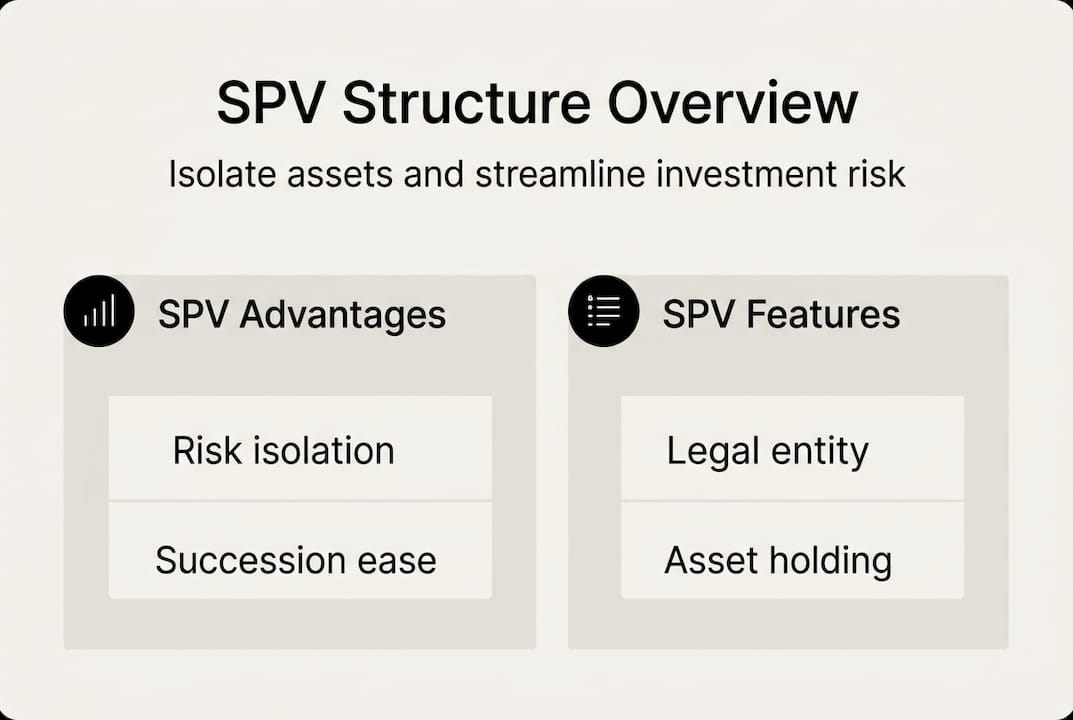
Here’s how the structure typically looks in practice:
| Feature | SPV ownership | Personal ownership |
|---|---|---|
| Legal separation | Yes, full isolation | No |
| Liability exposure | Limited to SPV assets | Personal assets at risk |
| Transferability | Transfer shares, not title | Full property transfer needed |
| Privacy | Shareholder details private | Owner name on title deed |
| Succession | Via shares/will | Subject to local inheritance law |
The core features of an SPV in Dubai real estate include:
- Risk isolation: Creditors can only pursue the SPV’s assets, not your personal wealth
- Structured ownership: Multiple investors can hold shares in proportion to their stake
- Operational clarity: The SPV exists solely for the property, making accounting and reporting clean
- Flexibility: Shares can be transferred without triggering a full property sale
“An SPV creates a legal firewall between the investor and the asset, which is exactly what sophisticated investors need when operating across multiple jurisdictions.”
For example, imagine you are a German investor purchasing a luxury apartment in Dubai Marina. Rather than buying in your personal name, you form a Dubai-registered SPV. The SPV holds the title deed. You hold 100% of the SPV shares. If a legal dispute arises related to that property, your personal assets in Germany remain protected.
Key benefits of using an SPV for Dubai property investment
With the basics established, let’s explore the tangible advantages SPVs provide international real estate investors. The benefits for international investors are significant: liability shielding, portfolio consolidation, easier succession, better financing terms, and co-investment flexibility.
Here is a breakdown of each advantage:
- Personal asset protection: Your private wealth stays separate from any claims or disputes tied to the property. This is especially critical for investors who own assets across multiple countries.
- Portfolio consolidation: You can hold multiple Dubai properties within a single SPV, simplifying management, reporting, and eventual sale. This aligns directly with smart Dubai property investment strategies that prioritize scalability.
- Succession planning: SPV shares can be passed to heirs via a will or trust, often bypassing Sharia inheritance law that would otherwise apply to property held in a personal name. This is a major consideration for non-Muslim investors.
- Financing advantages: Many lenders prefer lending to a structured entity rather than an individual, particularly for larger or commercial investments. An SPV signals seriousness and financial discipline.
- Co-investment capability: If you want to partner with other investors, each party simply holds a percentage of the SPV shares. No need for complex joint ownership arrangements on the title deed itself.
On the Dubai real estate tax front, SPVs can also offer flexibility in structuring income flows, though this depends heavily on your home country’s tax treaties with the UAE.
Pro Tip: If you plan to build a portfolio of three or more properties in Dubai, setting up an SPV from the start is far more efficient than restructuring later. Retrofitting an SPV around existing personally held properties can trigger transfer fees and additional legal costs.
It’s worth noting that Dubai’s real estate market recorded over AED 500 billion in total transactions in 2024, a figure that signals the scale of opportunity available to investors who structure their entry correctly.
Potential drawbacks and compliance considerations
Of course, every tool has trade-offs. Here’s what investors need to consider on the flip side.
SPVs are not free, simple, or maintenance-light. Before committing, review these key considerations:
- Setup costs: Forming a company in Dubai involves registration fees, legal drafting, and notarization. Expect initial costs ranging from AED 15,000 to AED 50,000 or more depending on the jurisdiction and structure.
- Annual maintenance fees: SPVs require annual license renewals, registered agent fees, and sometimes mandatory audits. These recurring costs can erode returns on a single low-yield property.
- Regulatory compliance: You must maintain proper corporate governance, including board resolutions, shareholder registers, and financial statements. Missing filings can result in penalties.
- Home country tax exposure: Owning a foreign company may trigger controlled foreign corporation (CFC) rules or reporting obligations in your home country. Always review real estate tax rules and consult a cross-border tax advisor before proceeding.
- Transfer fee implications: Transferring property into an SPV after purchase may still trigger Dubai’s property transfer fees, currently set at 4% of the property value.
- Not always necessary: For a single property purchase with no co-investors and a simple estate plan, personal ownership may be cleaner and cheaper.
“SPVs excel for international investors in Dubai via risk isolation, tax structuring, and flexibility, but add compliance costs and complexity; they are ideal for portfolios and family offices rather than single personal purchases.”
You should also review the legal requirements in Dubai for foreign-owned entities before choosing your jurisdiction, as free zone and mainland SPVs have different rules.
Pro Tip: Ask your advisor to model the total five-year cost of SPV ownership versus direct ownership before making a decision. The numbers often tell a clearer story than the theory.
SPVs vs. direct ownership: Which structure fits your strategy?
To make this practical, let’s stack SPVs against direct ownership so you see which fits your investment needs.
| Factor | SPV ownership | Direct personal ownership |
|---|---|---|
| Risk protection | Strong, assets isolated | Weak, personal exposure |
| Setup cost | Higher | Lower |
| Ongoing compliance | Required annually | Minimal |
| Lending flexibility | Often preferred by banks | Standard mortgage process |
| Succession ease | High, via share transfer | Complex, subject to local law |
| Privacy | Greater | Lower |
| Co-investment | Easy via share split | Complicated on title deed |
As structured ownership offers risk isolation while direct ownership is simpler but less protective, the right choice depends entirely on your goals.
An SPV makes strong sense when you:
- Plan to own two or more Dubai properties
- Have co-investors or family members sharing the investment
- Want to protect personal assets from property-related liabilities
- Are building a portfolio with an eventual exit or inheritance plan
- Want to leverage the global portfolio benefits of Dubai while maintaining clean corporate structure
Direct ownership may be better when you:
- Are buying a single property for personal use or straightforward rental income
- Have a simple estate plan with no cross-border succession concerns
- Want to minimize setup and annual overhead costs
For investors exploring company formation for real estate purposes, the SPV route integrates naturally with broader corporate strategies in Dubai.
How to set up an SPV for Dubai real estate: Step-by-step
For those ready to take the next step, here’s how to actually establish your SPV in Dubai.
- Assess your strategy: Confirm that an SPV aligns with your portfolio size, investment timeline, and succession goals. Review the Dubai investor legal requirements to understand what’s expected of foreign-owned entities.
- Choose the right jurisdiction: Decide between a Dubai mainland company or a free zone entity. Mainland SPVs can hold freehold property in designated areas. Free zone entities have different ownership and banking rules.
- Prepare your documents: Gather passport copies, proof of address, source of funds documentation, and any existing corporate documents if you are using a parent company structure.
- Appoint directors and shareholders: Define ownership percentages clearly. If co-investors are involved, a shareholder agreement drafted by a qualified lawyer is essential.
- Open a corporate bank account: This step can take two to six weeks. Banks in the UAE require thorough due diligence, so prepare detailed documentation of your business purpose and fund sources.
- Register the property in the SPV’s name: Once the entity is active, the property purchase proceeds with the SPV as the buyer on the title deed. This must comply with Dubai’s regulatory framework, as SPVs must adhere to Dubai’s compliance and regulatory standards throughout.
- Maintain ongoing compliance: File annual returns, renew licenses, and keep financial records current. If you hold a residency visa tied to the investment, review your visa services for investors to ensure alignment with your SPV structure.
A smarter approach to SPVs: What the brochures won’t tell you
Here’s an uncomfortable truth that many advisors in Dubai won’t say out loud: SPVs are frequently oversold. The pitch sounds compelling, asset protection, tax efficiency, succession planning, and it is compelling, but only when the structure genuinely fits your situation.
We’ve seen investors spend AED 30,000 or more setting up an SPV for a single studio apartment generating AED 60,000 per year in rental income. The compliance costs alone consumed nearly a third of their annual yield. That is not strategic investing. That is paying for complexity you don’t need.
The investors who benefit most from SPVs are those building real portfolios, not those making a single purchase. If you are buying one property to test the Dubai market, direct ownership is almost always the smarter starting point. You can always restructure later, though yes, that comes with costs.
Also, never assume that an SPV solves your home country tax problem. Many investors from high-tax jurisdictions believe that holding property through a UAE entity shields all income from foreign tax. It often does not. Your home country’s CFC rules may still capture that income. Get proper cross-border tax advice before you sign anything.
When you are ready to think seriously about choosing Dubai property and the right structure for your goals, approach it with clarity about what you actually need, not what sounds sophisticated.
Ready to optimize your Dubai property investments?
Navigating SPV structures, ownership rules, and tax implications in Dubai requires local expertise that goes beyond generic legal templates. Working with professionals who understand both the Dubai market and the cross-border realities international investors face makes a measurable difference.

At anthonyjosephaj.com, we provide expert Dubai property guidance tailored to your specific investment profile, whether you’re exploring your first purchase or scaling a multi-property portfolio. From SPV setup and company formation to property selection and management, our team connects you with the right specialists at every stage. Explore our Dubai investment strategies resources or reach out directly to discuss how to structure your next move with confidence.
Frequently asked questions
Do I need an SPV to buy property in Dubai as a foreign investor?
No, you can buy Dubai property directly in your personal name, but many international investors use SPVs for added protection, privacy, and portfolio flexibility.
How does an SPV improve inheritance and succession in Dubai?
An SPV allows you to pass on property through share transfers via a will or trust, which can bypass Sharia inheritance rules that apply to personally held assets in Dubai.
Will using an SPV reduce my property taxes in Dubai?
SPVs do not eliminate Dubai’s property taxes, but they may support international tax structuring. Note that Dubai levies a 9% tax on real estate income, and your home country’s rules still apply.
What are the ongoing costs of maintaining an SPV in Dubai?
Expect annual license renewals, registered agent fees, and potential audit requirements, which means SPV compliance costs can significantly exceed those of direct personal ownership.
How complicated is it to set up an SPV for Dubai property?
The steps are clear but more involved than direct ownership, so expert guidance is recommended to avoid costly errors in jurisdiction selection, documentation, and banking setup.


