

Dubai Commercial Property Process: Secure Profitable Investments
Finding the perfect commercial property in Dubai can feel like a high-stakes puzzle for serious European and Asian investors. The region’s steady growth and transaction activity offer lucrative possibilities, but success hinges on understanding each step from goal setting to performance monitoring. This guide delivers a clear, strategic approach so you can pinpoint market opportunities, avoid costly surprises, and capitalize on Dubai’s dynamic commercial real estate scene with confidence.
Table of Contents
Step 1: Assess investment goals and market opportunities
Before you commit capital to Dubai’s commercial property market, you need absolute clarity on what you’re trying to achieve. This isn’t just about deciding you want to make money. Your investment goals shape every decision that follows, from which property type makes sense for your portfolio to how long you’re willing to hold an asset. Take time now to define whether you’re seeking steady rental income, capital appreciation, portfolio diversification, or a combination of these. The specificity here matters tremendously. Are you looking to generate AED 100,000 annually in rental yields, or are you targeting a 15 percent annual capital appreciation? Are you planning a five-year exit strategy or building a long-term legacy asset? These distinctions determine which commercial sectors and property values align with your actual objectives.
Once your goals are crystal clear, evaluate Dubai’s current market landscape against your specific targets. Commercial real estate in Dubai operates differently than residential markets. Office spaces, retail units, and industrial facilities each respond to different economic drivers. Office demand correlates with business growth and visa policies. Retail performance hinges on consumer spending and tourism patterns. Industrial properties track e-commerce expansion and supply chain activity. Research current absorption rates, average lease prices per square meter, and tenant stability in your target sector. Look at which areas are experiencing development activity and which submarkets appeal to international companies or regional distributors. Study economic indicators like foreign direct investment flows, corporate relocations, and government initiatives that attract businesses to Dubai. Understanding Dubai’s commercial property dynamics gives you the market context needed to spot opportunities others miss. Compare projected growth rates across different property types and locations. Some areas experience 8 to 12 percent annual appreciation while others plateau at 3 to 4 percent. Your risk tolerance and return expectations should align with realistic market data, not optimistic projections.
Here is a comparison of commercial property types in Dubai and their investment profiles:

Don’t skip the investor profile exercise. Your personal circumstances affect what’s practical. International investors face different considerations than residents. Tax obligations, repatriation policies, financing options, and currency fluctuations all impact returns differently depending on your home country. European investors often prioritize stable, long-term yields. Asian investors frequently pursue capital growth with shorter holding periods. Your investment capital, liquidity needs, and ability to hold through market cycles shape whether you should pursue premium properties in hot zones or stabilized assets in emerging areas. Connect your goals directly to market realities. If you want to generate current income but the market shows primarily appreciation potential, recalibrate your expectations or adjust your sector focus. If you’re prepared to hold for ten years but targeting quick exits, you’re chasing incompatible outcomes.
Pro tip: Create a written investment brief that documents your target yield or appreciation rate, preferred property types, geographic focus, capital allocation, and exit timeline before evaluating any specific asset.
Step 2: Establish legal compliance and financial readiness
Before you sign any purchase agreement or transfer funds, you must understand the legal framework governing commercial property transactions in Dubai and ensure your finances are structured correctly. This step separates serious investors from those who encounter costly surprises after committing capital. Legal compliance in Dubai involves multiple layers: understanding freehold versus leasehold structures, comprehending tax obligations for foreign investors, securing proper visa sponsorship if required, and ensuring your purchase aligns with foreign ownership regulations for your specific property type and location. Financial readiness goes beyond having money available. It means organizing your funding sources, understanding financing options, calculating total acquisition costs including registration fees and transfer taxes, and ensuring your capital structure supports your investment timeline and exit strategy.
Start by clarifying your legal status and what that means for your purchase. The United Arab Emirates permits foreign ownership of freehold commercial properties in designated areas, but restrictions apply in certain zones. You need to verify whether your target property falls within an area open to foreign ownership or whether you must establish a local company to acquire the asset. This distinction fundamentally changes your transaction structure and tax implications. Understanding commercial property ownership regulations helps you avoid acquiring property you legally cannot hold or discovering restrictions after negotiation completes. Engage a qualified real estate attorney or legal consultant familiar with Dubai commercial law early in your process. They’ll review the property’s title, confirm ownership restrictions, identify any liens or encumbrances, and explain your specific rights and obligations as a foreign purchaser. This costs money upfront but prevents far more expensive legal complications later. Next, address your tax situation transparently. Dubai itself imposes no personal income tax, but your home country may tax your rental income or capital gains from the investment. Some European jurisdictions require reporting of foreign real estate holdings. Asian countries often have different reporting and taxation frameworks. Consult with an international tax advisor before purchase to understand your actual tax exposure, not after you’ve already committed funds.
Financial readiness requires honest assessment of your total capital requirement and available funding. The purchase price is never the full cost. Calculate transfer registration fees, which typically run 4 percent of the property value. Add legal and advisory fees, due diligence costs, potential renovation or refurbishment expenses, and operating reserves for your first 12 months. If financing a portion through a bank, prepare for deposit requirements typically ranging from 25 to 50 percent depending on lender and property type. Understand that financing commercial property requires business plans, revenue projections, and financial documentation more rigorous than residential mortgages. If you’re establishing a company to hold the property, factor in company formation costs and annual compliance expenses. Verify your funding sources are documented and legitimate, particularly if transferring money internationally. Banks increasingly require source of funds documentation and proof that capital doesn’t originate from restricted sources. This compliance step takes time but streamlines your transaction considerably. Once your finances are organized and your legal status clarified, you’re positioned to move forward with confidence, knowing exactly what ownership means for your specific situation and what it truly costs.
Pro tip: Hire a legal consultant and tax advisor simultaneously before your purchase offer, not after, so they can structure your transaction optimally and prevent costly restructuring later.
Step 3: Identify and evaluate suitable commercial properties
Now that you’ve clarified your investment objectives and secured your legal and financial foundation, it’s time to actively identify commercial properties that match your criteria. This step transforms your strategy into concrete opportunities. You’ll be searching for assets that not only fit your financial parameters but also demonstrate strong operational potential, tenant quality, location advantages, and growth prospects aligned with your investment timeline.

Begin your search by focusing on prime commercial corridors where international businesses concentrate their operations. Dubai’s leading commercial locations like Business Bay and Jumeirah Lake Towers attract consistent tenant demand because they offer proximity to corporate headquarters, banking institutions, and professional services firms. Business Bay particularly appeals to investors targeting mid-market office space with stable corporate tenants. Jumeirah Lake Towers works well for those seeking mixed-use properties combining office and retail components. As you evaluate potential assets, analyze location from three angles: accessibility for tenant employees and clients, proximity to complementary businesses that drive foot traffic or referral networks, and positioning within the overall Dubai commercial ecosystem. A property in a thriving business district commands premium rental rates and attracts higher-quality tenants who maintain longer lease terms and demonstrate lower default risk. Properties in emerging areas may offer acquisition prices 15 to 25 percent lower but require patience while the submarket matures. Match your risk tolerance to location positioning. Conservative European investors often prefer established zones with proven tenant bases. Growth-oriented Asian investors frequently target emerging areas with development momentum and discounted entry points.
When evaluating specific properties, conduct due diligence on three critical dimensions. First, property fundamentals. Inspect the physical condition honestly, understanding that older buildings require capital expenditure for systems upgrades, facades, or interior modernization. Obtain architect reports on structural integrity. Review tenant rosters and lease agreements, examining tenant creditworthiness, lease expiration dates, and rental rate escalation clauses. A property with five-year leases expiring simultaneously poses refinancing risk. One with staggered lease expirations provides stable, predictable cash flow. Confirm rental rates against comparable properties. If a property’s rentals exceed market comparables by 15 to 20 percent, investigate why. Either the property possesses exceptional features or the rent is unsustainable. Second, financial metrics. Calculate capitalization rate by dividing net operating income by purchase price. Typical commercial cap rates in Dubai range from 4 to 7 percent depending on location and property quality. Lower cap rates indicate premium properties with strong tenant quality but limit margin for error. Higher cap rates suggest greater cash flow relative to price but may indicate higher vacancy risk or tenant turnover. Evaluate cash-on-cash returns by comparing annual cash flow to your equity investment. Third, market dynamics. Research tenant absorption rates in the specific submarket. Strong absorption indicates growing demand and potential for rent growth at lease renewal. Weak absorption suggests vacant space, downward rental pressure, and longer leasing timelines. Examine development pipelines. Heavy new construction competing with your property may suppress rental growth for years.
Don’t rely solely on financial metrics or market positioning. Schedule physical property inspections at different times of day. Visit during morning rush and evening hours to observe tenant activity levels, parking availability, and traffic patterns. Speak informally with building staff, other tenants, and nearby businesses about occupancy stability and tenant satisfaction. These conversations reveal operational realities that formal documentation doesn’t capture. Connect with the leasing agent or property manager about lease velocity, tenant retention rates, and maintenance issues. Request a full disclosure document listing any structural issues, regulatory violations, or environmental concerns. This comprehensive evaluation process takes weeks or months but provides the clarity needed to identify genuinely suitable assets rather than simply attractive asking prices.
Pro tip: Request a trailing 24-month operating statement, rent roll, and tenant lease agreements for any property under serious consideration so you can verify financials independently rather than relying on seller representations.
Step 4: Negotiate terms and secure the transaction
You’ve identified a property that aligns with your investment criteria. Now comes the phase where your financial returns either expand or contract based on negotiation skill and transaction execution. This step determines whether you acquire the asset at fair market value, below market value, or overpay due to emotional attachment or competitive pressure. Negotiation isn’t adversarial in Dubai’s commercial real estate market. It’s a structured dialogue where both parties work toward mutually acceptable terms that reflect actual property value, market conditions, and each party’s priorities.
Begin by establishing your walk away price before making any formal offer. This number represents the maximum you’ll pay based on your financial analysis, comparable properties, and return requirements. Knowing this boundary prevents bidding wars from driving you into overpaying. Research recent comparable sales in the same area and similar property type. If comparable office space in Business Bay sold at AED 3,500 per square meter three months ago, and the subject property is asking AED 4,200 per square meter without significant recent improvements, you have concrete data supporting a lower offer. Prepare your initial offer at 8 to 12 percent below asking price for most commercial properties. This positions you for negotiation movement without appearing unrealistic. Submit your offer in writing through your agent or attorney, including proposed closing timeline, financing contingencies if applicable, and any condition precedents like inspections or lender approval. Understanding Dubai commercial transaction procedures helps you structure offers that align with local practice and protect your interests through proper contingencies and timelines.
As negotiations progress, focus on variables beyond price that create value. Seller financing terms matter tremendously. If the seller will finance 10 percent of the purchase price at 3 percent interest, that’s worth approximately 2 to 3 percent off your effective cash purchase price. Flexible closing timelines allow you to coordinate financing, manage working capital, or position the acquisition for tax planning purposes. Tenant agreements warrant attention. If the current seller has below market leases with strong tenants, confirm those leases transfer to you with the same terms and expiration dates. Request a rent schedule detailing each tenant, lease commencement date, expiration date, base rent, and any tenant improvement obligations. Clarify maintenance responsibilities. Some properties require the landlord to handle major systems maintenance while others require tenants to manage their own maintenance through service charges. These distinctions significantly impact your net operating income. Discuss seller concessions like capital improvements, tenant improvement allowances, or equipment included in the sale. Sometimes reducing price by AED 100,000 while the seller completes AED 150,000 in systems upgrades works better than negotiating on price alone.
Once you’ve negotiated acceptable terms, move quickly to document and secure the transaction. Your attorney drafts a purchase agreement reflecting all negotiated terms. This document must specify exact property identification, purchase price, payment schedule, condition precedents and their timelines, representations and warranties from the seller regarding title and property condition, and provisions for post-closing adjustments like prorated rent or utilities. Request an escrow arrangement where your deposit funds rest with a neutral third party until closing, protecting your money if disputes arise. Confirm title clearance before your contingency period expires. The seller must produce a clear title deed showing no liens, mortgages, or encumbrances that transfer to you. Complete your due diligence inspections and obtain municipal records confirming no outstanding violations or fines against the property. Secure your financing commitment letter from your bank showing loan amount, rate, and conditions. Coordinate with your legal advisor and accountant regarding entity structuring for tax optimization. Some investors acquire property through personal names while others establish holding companies or use trust structures depending on their home country tax treatment and liability preferences. Execute all documentation by your agreed closing date. Transfer funds through verified banking channels, obtain insurance policies effective at closing, and collect all keys, access codes, leases, and operating documents from the seller.
Pro tip: Never waive inspection or financing contingencies, even if the seller requests it to create competitive advantage; these protections are worth far more than a faster closing if problems emerge after you own the property.
Step 5: Verify completion and monitor property performance
The transaction has closed and you now hold title to your commercial property. But ownership is just the beginning. This step ensures your asset performs as projected, your tenants meet their obligations, and you maintain the property in condition to preserve or grow its value. Verification and monitoring transform passive ownership into active asset management, directly influencing whether your investment achieves its targeted returns or underperforms due to neglect or operational issues.
Start by formally verifying that all closing conditions have been satisfied and all transferable documents are in your possession. Confirm that your name appears on the title deed at Dubai Land Department. Request certified copies of the title document for your records and insurance purposes. Verify that all tenant leases transferred correctly with original documentation showing lease terms, rental amounts, payment schedules, and any special provisions. Collect building operating manuals, maintenance records, and warranties for major systems like HVAC, electrical, plumbing, and security infrastructure. Request utility account numbers and confirm the transition of utility services to your name. Obtain building permits, occupancy certificates, and municipal compliance documentation proving the property meets all regulatory requirements. Review Dubai’s property completion tracking systems to understand how official records track your property and what documentation the Land Department maintains. If you purchased off-plan commercial space that wasn’t yet complete, verify that the developer has delivered the finished property matching specifications and that all construction defects have been remedied. Document the property’s condition with professional photography and video immediately after taking possession. This baseline documentation protects you if disputes arise later about pre-existing damage or maintenance issues.
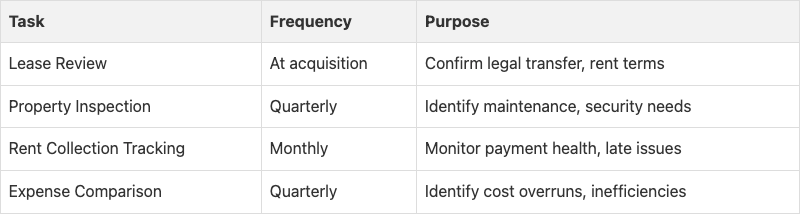
Now establish systematic monitoring protocols that provide early warning of problems. Create a tenant management spreadsheet tracking each tenant’s lease expiration date, base rent, rental escalation percentages, payment history, and contact information. Set calendar reminders 90 days before lease expirations so you can begin renewal negotiations or prepare for tenant transition. Monitor rent collection religiously. Late payments within the first month often signal financial distress. Establish clear payment procedures and enforce them consistently. Schedule quarterly property inspections, walking through the building to observe maintenance conditions, tenant improvements, and any damage requiring attention. Meet with your building manager or maintenance contractor monthly to review operational issues, maintenance expenditures, and tenant concerns. Track all expenses meticulously. Compare actual operating costs against your pro forma projections. If insurance costs exceeded budget by 20 percent or maintenance spending doubled unexpectedly, investigate why and adjust your management approach. Review Dubai market performance data periodically to track how your property’s performance compares to broader market trends, ensuring you remain informed about competitive pressures and market shifts affecting your asset’s valuation and rental potential.
Here is a summary of operational checks for new commercial property owners in Dubai:
Beyond operational monitoring, track financial performance against your investment thesis. Calculate actual cap rate by dividing net operating income by your purchase price. If projected cap rate was 5.5 percent but actual performance delivered 4.8 percent due to higher-than-expected vacancies or maintenance costs, understand why. Analyze rent growth compared to market. If local market rents grew 4 percent annually but your tenants’ lease escalations capped at 2 percent, you’re losing rental income potential. Evaluate capital appreciation through periodic property appraisals. Most investors conduct formal appraisals annually or every two years to track asset value growth and inform refinancing, sale, or acquisition decisions. Monitor interest rates if you financed your purchase. Rising rates increase your debt service costs if you have adjustable rate debt, or they improve your refinancing flexibility if rates decline. Track tenant quality and retention. If your tenant roster includes established corporations with strong credit ratings, your risk profile improves and your asset value strengthens. If tenants become primarily small businesses or startups, your vacancy risk and collection risk increase accordingly. Maintain strong relationships with your property manager or management company. Regular communication ensures proactive problem solving rather than reactive crisis management. Consider hiring professional property management if you don’t have local expertise, particularly if you’re managing the property remotely from Europe or Asia.
Pro tip: Schedule an annual property performance review meeting with your accountant, property manager, and attorney to compare actual results against projections, identify underperformance areas, and adjust your management strategy or exit timeline accordingly.
Unlock Success in Dubai Commercial Property Investment with Expert Guidance
Navigating Dubai’s complex commercial real estate market demands clarity, careful planning, and expert support. Whether you are defining your investment goals, securing legal compliance, or evaluating specific properties, the challenges outlined in the article are real and require experienced guidance. From understanding market drivers like visa policies and tenant stability to negotiating contracts and monitoring asset performance, every step impacts your return. Don’t let uncertainty or costly mistakes hold you back.

Partner with Anthony Joseph, a highly awarded Dubai-based real estate broker and business mentor, who offers tailored solutions across property sales, off-plan investments, and company formation. His deep knowledge ensures your investment aligns perfectly with Dubai’s market realities and legal requirements. Take confident action today by visiting https://anthonyjosephaj.com to explore comprehensive services that safeguard your capital and maximize profitable opportunities. Discover how Anthony’s expertise turns complex processes into clear, manageable steps so you can secure valuable assets with peace of mind.
Frequently Asked Questions
What are the key steps in the Dubai commercial property investment process?
Begin by assessing your investment goals and understanding the market opportunities. Next, ensure legal compliance and financial readiness, identify suitable properties, negotiate terms, and finally verify completion while monitoring property performance.
How can I determine my investment goals for commercial property?
To define your investment goals, consider whether you are seeking rental income, capital appreciation, or a combination of both. Document specific targets, like aiming for a certain annual rental yield or a defined exit strategy, to guide your property search.
What should I consider regarding legal compliance when investing in commercial property in Dubai?
It’s essential to understand the legal framework governing commercial transactions, including foreign ownership regulations and tax obligations. Engage a legal consultant to clarify your status and ensure compliance with all relevant laws before buying a property.
How do I evaluate potential commercial properties in Dubai?
Evaluate properties based on key factors such as location, tenant quality, and market dynamics. Conduct thorough due diligence, including inspections, financial performance reviews, and market analysis, to ensure the property aligns with your investment criteria.
What negotiation strategies can I use to secure the best deal on a commercial property?
Establish a maximum price before making an offer and start your negotiations approximately 8 to 12 percent below the asking price. Focus not only on price but also on favorable terms, such as financing arrangements or tenant agreements, to maximize value.
How can I monitor the performance of my newly acquired commercial property?
Set up a systematic monitoring process that includes tracking tenant lease expirations, monitoring rent collection, and conducting regular property inspections. This proactive management can identify issues early and enhance overall asset performance.


