

Dubai company formation explained for international investors
Many international real estate investors believe forming a company in Dubai is either prohibitively complex or that Free Zones are always the best choice. The reality is more nuanced. Choosing the wrong jurisdiction or structure can trigger compliance headaches, limit your operational scope, and even jeopardize your real estate trading license. Understanding the distinctions between Mainland and Free Zone setups, alongside the critical role of RERA licensing, is essential for building a compliant and scalable business. This guide walks you through the fundamentals, compares your options, and provides actionable steps to establish your Dubai real estate company with confidence.
Table of Contents
- Key takeaways
- Understanding Dubai company formation basics
- Why Mainland setup with RERA matters for real estate investors
- Comparing Mainland and Free Zone for real estate businesses
- Practical steps for forming your Dubai real estate company
- Explore expert assistance for your Dubai company formation
- Frequently asked questions
Key Takeaways
Understanding Dubai company formation basics
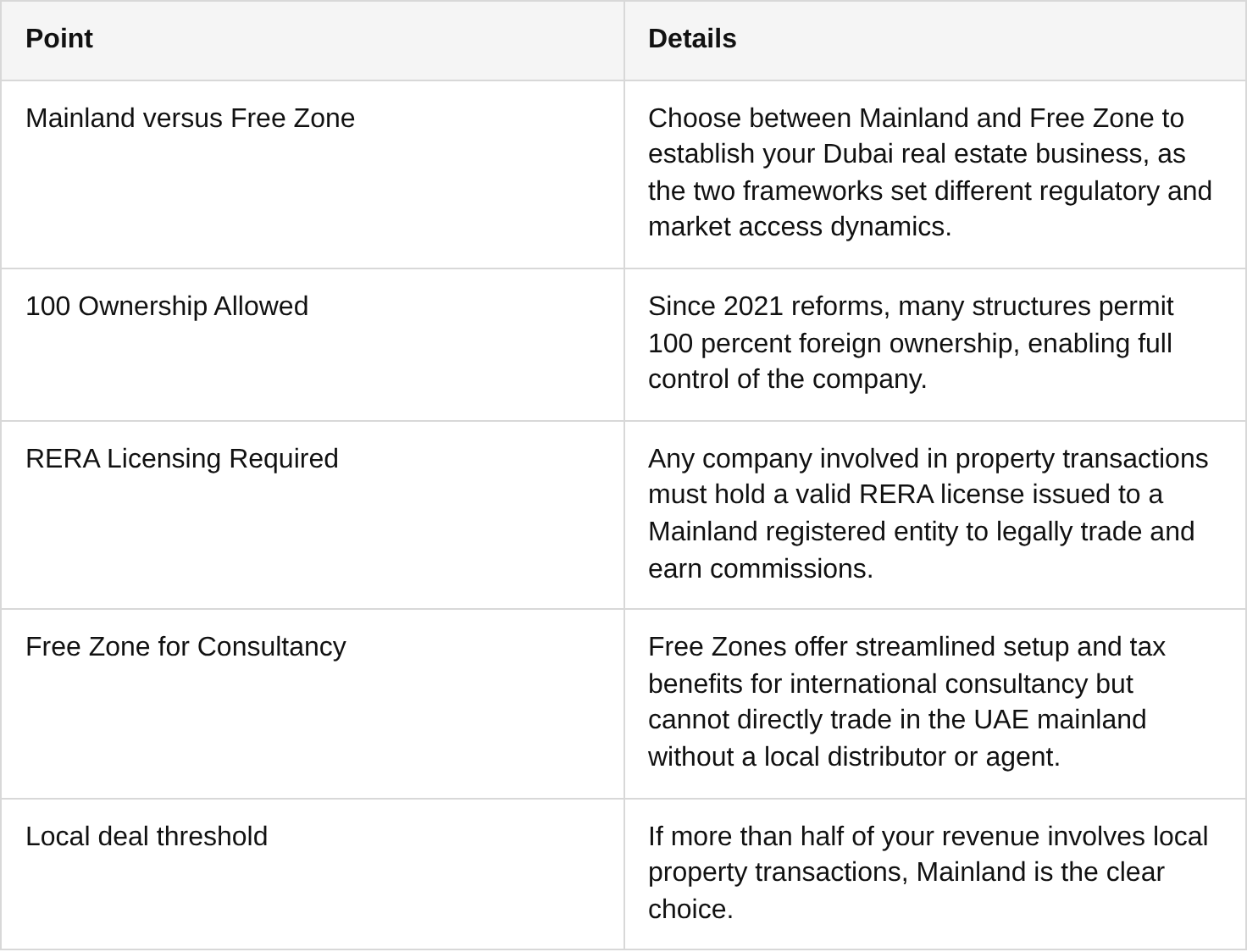
Dubai company formation primarily involves choosing between Mainland and Free Zone setups, with 100% foreign ownership allowed in most cases since 2021 reforms. Mainland companies operate under the Department of Economic Development (DET) and can trade freely within Dubai and the wider UAE. Free Zone companies function within designated economic zones, each with its own regulatory authority and specific benefits.
Mainland companies offer unrestricted access to the local market. You can sign contracts with UAE-based clients, bid on government tenders, and operate across all seven emirates without limitation. This flexibility is crucial for real estate investors who plan to buy, sell, or manage properties directly within Dubai’s local market. However, Mainland registration involves more documentation and typically requires a local service agent, though not a local partner since the ownership reforms.
Free Zone companies provide streamlined setup processes, 100% foreign ownership guarantees, and zero corporate tax on qualifying activities. They are designed to attract international businesses focused on export, consultancy, or regional operations. The trade-off is geographic restriction. Free Zone entities cannot directly trade within the UAE mainland market without appointing a local distributor or agent, which adds cost and complexity.
A common misconception is that Free Zones are universally better because of tax benefits and ease of setup. For real estate investors planning to trade properties or provide brokerage services locally, a Mainland setup is often essential. Free Zones work well for international real estate consultancy, investment advisory, or holding companies, but not for direct property transactions within Dubai.
Pro Tip: Before committing to a jurisdiction, map out your revenue model. If more than 50% of your business involves local property transactions, Mainland is the clear choice.
Key regulatory bodies include the DET for Mainland companies, individual Free Zone authorities like DMCC or DIFC, and the Real Estate Regulatory Agency (RERA) for property-related licensing. Understanding which authority governs your activities prevents compliance gaps that could delay operations or trigger penalties.
Why Mainland setup with RERA matters for real estate investors
International investors in real estate should prioritize Mainland + RERA for local trading, using Free Zones only for international consultancy to avoid compliance issues. RERA is the regulatory body overseeing all real estate brokerage, sales, and leasing activities in Dubai. Any company involved in property transactions must hold a valid RERA license, which is only issued to Mainland-registered entities.
Without RERA licensing, you cannot legally represent buyers or sellers, list properties on official portals, or earn commission from property deals. Attempting to operate through a Free Zone company for local real estate trading creates a regulatory gray area that exposes you to fines, business closure, or reputational damage. RERA compliance is non-negotiable for brokers, agents, and property management firms.
Mainland jurisdiction also facilitates partnerships with local developers, government entities, and financial institutions. Many UAE banks prefer Mainland companies for business accounts and financing, viewing them as more established and compliant. This access is critical when scaling operations, securing property listings, or negotiating exclusive deals with master developers.

Free Zone companies face restrictions when trying to engage in local property transactions. You would need to establish a separate Mainland entity or work through a licensed local partner, doubling your administrative burden and costs. For international investors focused on Dubai’s property market, this dual-structure approach is inefficient and often unnecessary.
Pro Tip: If you plan to offer property management or rental services alongside sales, ensure your Mainland company’s trade license explicitly includes these activities. Adding services later requires amendments and additional fees.
RERA also mandates professional standards, including agent certification, escrow account management, and transparent fee structures. Mainland companies integrated with RERA gain credibility with clients and access to official property databases, giving you a competitive edge in a crowded market. Aligning your company setup with RERA from the start positions you for sustainable growth and regulatory peace of mind.
Comparing Mainland and Free Zone for real estate businesses
Choosing between Mainland and Free Zone depends on your operational priorities, target market, and long-term business model. The table below summarizes the key differences:
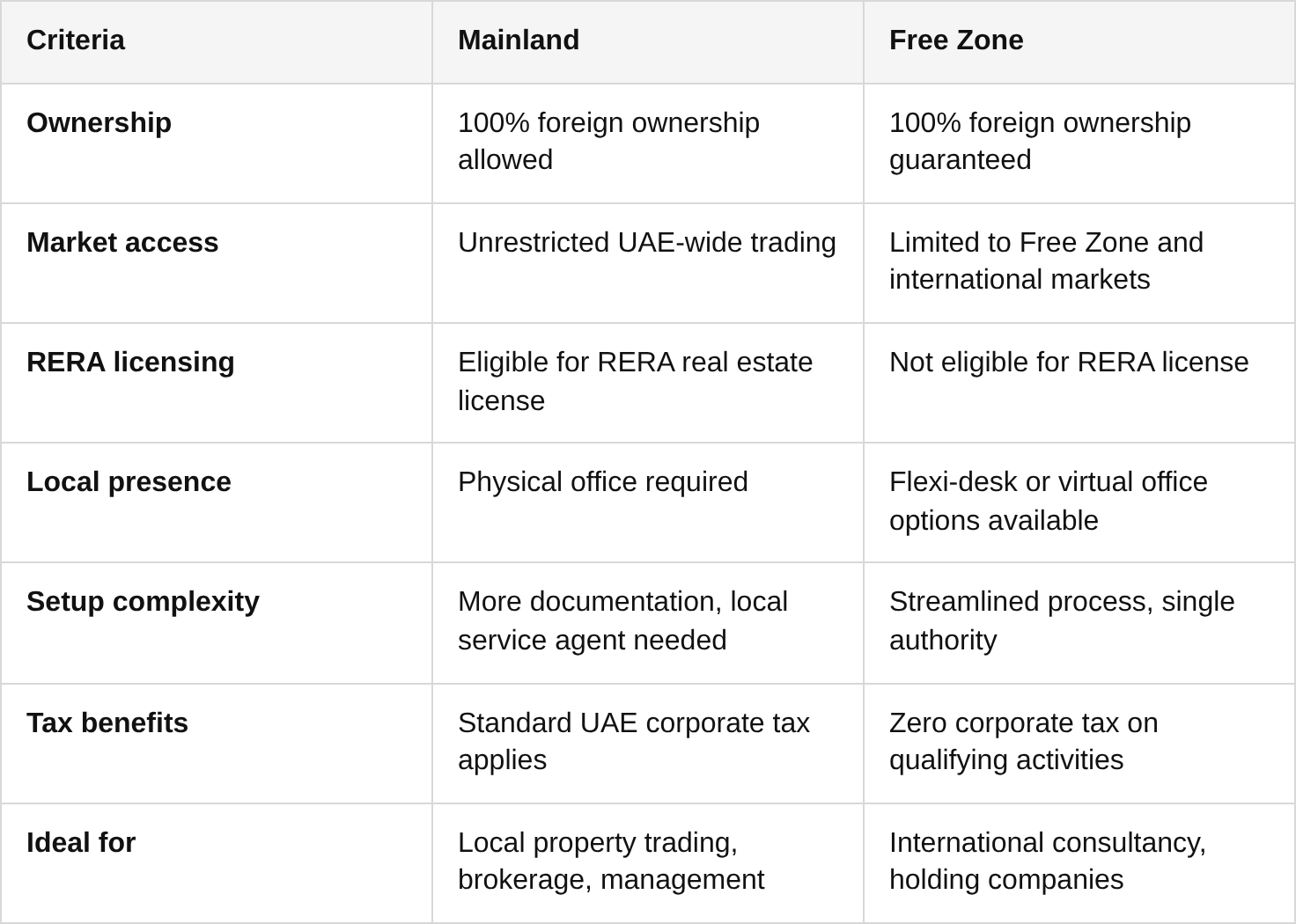
Mainland companies suit investors who want to trade properties, manage portfolios, or provide brokerage services directly to Dubai-based clients. You gain full access to the local market, can sign contracts with UAE entities, and meet RERA requirements without workarounds. The trade-off is higher setup costs, mandatory office space, and more paperwork during registration.
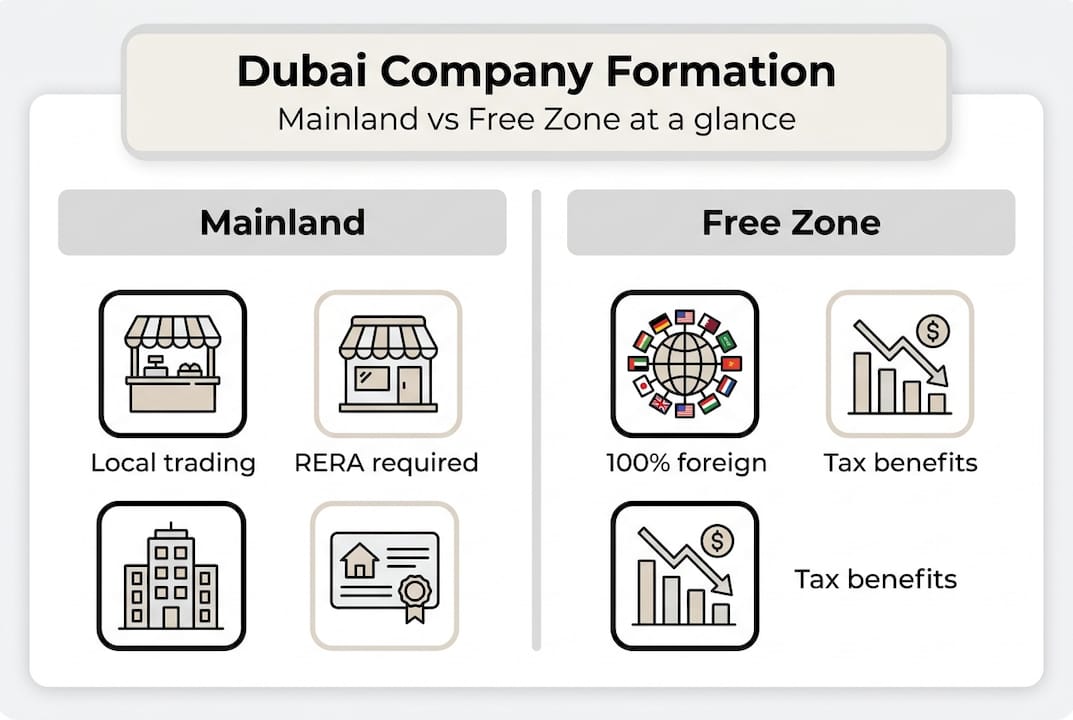
Free Zone companies excel for international real estate advisory, investment consultancy, or holding structures. If your business model involves advising overseas clients on Dubai property investments, managing international portfolios, or structuring cross-border deals, a Free Zone setup offers tax efficiency and operational simplicity. However, you cannot directly transact properties within Dubai without additional licensing or partnerships.
Some investors adopt a hybrid approach, establishing a Mainland entity for local operations and a Free Zone holding company for international activities. This structure provides operational flexibility and tax optimization but requires careful legal planning to ensure compliance across jurisdictions. It is more common among established firms with diversified revenue streams.
Pro Tip: If you are uncertain about your primary market, start with Mainland. It is easier to expand into international markets from a Mainland base than to retrofit local trading capabilities onto a Free Zone entity.
Operational benefits of Mainland include access to government tenders, partnerships with local developers, and eligibility for UAE banking services without restrictions. Free Zone benefits include faster setup, lower initial costs, and simplified visa processing for employees. Your choice should align with where your revenue will come from and how you plan to serve clients.
Practical steps for forming your Dubai real estate company
Forming a real estate company in Dubai involves several procedural steps, whether you choose Mainland or Free Zone. Following a structured approach minimizes delays and ensures compliance from day one.
-
Define your business activities and choose jurisdiction. List the specific services you will offer, such as brokerage, property management, or consultancy. This determines whether Mainland or Free Zone is appropriate and which trade license categories you need.
-
Select a trade name and reserve it. Your company name must comply with UAE naming conventions, avoiding prohibited words and ensuring uniqueness. Submit your proposed name to the relevant authority for approval before proceeding.
-
Prepare required documentation. Gather passport copies, visa documents, business plans, and proof of address for all shareholders and managers. Mainland setups require a Memorandum of Association, while Free Zone authorities have their own templates.
-
Secure office space and obtain approvals. Mainland companies need a physical office with a tenancy contract. Free Zones offer flexible options including flexi-desks or virtual offices. Submit your lease agreement along with initial approvals from the economic department or Free Zone authority.
-
Apply for your trade license. Submit your application with all supporting documents and pay the required fees. Mainland licenses are issued by DET, while Free Zone licenses come from the respective Free Zone authority. Processing times vary from a few days to several weeks.
-
Obtain RERA licensing if applicable. For Mainland real estate companies, apply for RERA registration after receiving your trade license. This involves additional fees, agent certification exams, and escrow account setup. RERA approval is mandatory before you can legally transact properties.
-
Open a corporate bank account. With your trade license and RERA approval in hand, approach UAE banks to open a business account. Prepare financial projections, business plans, and reference letters to streamline the banking process.
-
Register for VAT and other compliance. If your annual turnover exceeds AED 375,000, register for VAT with the Federal Tax Authority. Ensure ongoing compliance with annual audits, license renewals, and regulatory filings.
Pro Tip: Engage a local business setup consultant or legal advisor early in the process. They navigate bureaucratic nuances, expedite approvals, and help you avoid common pitfalls that delay formation.
Common mistakes include underestimating office space requirements, choosing the wrong trade license category, or neglecting RERA compliance. Each error triggers amendments, additional fees, and operational delays. Investing time upfront to understand requirements and seek expert guidance pays dividends in faster setup and smoother operations. For deeper insights into structuring your investment approach, explore our complete guide to Dubai real estate investment and learn how to evaluate Dubai real estate opportunities effectively.
Explore expert assistance for your Dubai company formation
Navigating Dubai’s company formation landscape is complex, especially when aligning your structure with real estate regulations and RERA compliance. Professional consultants streamline the entire process, from jurisdiction selection and documentation to licensing and bank account setup. They provide tailored legal and regulatory advice that minimizes risk and accelerates your market entry.

Whether you are establishing your first Dubai entity or expanding an existing portfolio, expert guidance ensures you choose the optimal structure for your business model. Discover professional company formation services that simplify setup and position you for long-term success. For additional clarity on jurisdiction choices, review our Mainland vs Free Zone insights to make informed decisions aligned with your investment goals.
Frequently asked questions
What is the process to set up a company in Dubai?
The process involves selecting your jurisdiction (Mainland or Free Zone), reserving a trade name, preparing documentation including passport copies and business plans, securing office space, and applying for your trade license through the relevant authority. For real estate companies, you must also obtain RERA licensing if operating in the Mainland. Typical timelines range from two weeks for Free Zones to four to six weeks for Mainland setups, depending on documentation completeness and authority workload. Engaging a business setup consultant can reduce processing time and ensure compliance with all regulatory requirements from the start.
Can foreign investors have 100% ownership of a real estate company in Dubai?
Yes, 100% foreign ownership is generally allowed in most company formations since 2021 reforms. Both Mainland and Free Zone jurisdictions permit full foreign ownership without requiring a local partner or sponsor. This regulatory change removed a major barrier for international investors and simplified the ownership structure. However, certain strategic sectors may still have ownership restrictions, so verify your specific business activities with the relevant authority. For real estate brokerage and investment companies, full foreign ownership is standard and widely accessible.
What are the key differences between Mainland and Free Zone companies in Dubai?
Mainland companies operate under DET regulation and can trade freely across the UAE, making them ideal for local property transactions and RERA-licensed brokerage. Free Zone companies function within designated economic zones, offering streamlined setup and tax benefits but restricting direct trading in the local market. Mainland setups require physical office space and involve more documentation, while Free Zones provide flexible office options and faster approvals. For real estate investors focused on local trading, Mainland is essential. For international consultancy or holding structures, Free Zones offer operational and tax efficiency without the need for local market access.


