

Dubai ownership structures: Your complete 2026 guide
TL;DR:
- Dubai’s real estate market set a record sales volume of over AED 120 billion in Q1 2026, with most buyers being international.
- Ownership structures vary from freehold, leasehold, to corporate options, each impacting legal rights and residency eligibility.
- Proper due diligence, understanding regulations, and expert guidance are essential for secure and strategic Dubai property investment.
Dubai’s real estate market hit a record AED 120 to 145 billion in transactions during Q1 2026 alone, with more than half of all buyers coming from outside the UAE. That figure alone signals a fundamental shift in how global investors perceive property ownership in this city. Yet many international buyers still approach Dubai with outdated assumptions, believing ownership is complicated, restricted, or risky for foreigners. The reality is far more accessible and strategic than that. This guide walks you through every major ownership structure available, explains how each one aligns with different investor goals, and helps you avoid the pitfalls that cost uninformed buyers both time and money.
Table of Contents
- Why ownership structure matters in Dubai
- Decoding Dubai’s main ownership structures
- Choosing the right structure: Factors and frameworks
- Navigating regulations and common pitfalls
- Our take: What most guides won’t tell you about Dubai ownership
- Partner with the right advice for your Dubai investment
- Frequently asked questions
Key Takeaways
| Point | Details |
|---|---|
| Ownership options | Dubai offers freehold, leasehold, and company ownership structures for foreigners and residents. |
| Global investor surge | Over half of Dubai’s 2026 real estate buyers are international, highlighting favorable ownership policies. |
| Custom-fit strategies | The right structure depends on your goals, profile, and regulatory considerations for security and returns. |
| Avoid common pitfalls | Due diligence and understanding Dubai’s legal frameworks are vital for risk management. |
Why ownership structure matters in Dubai
When you invest in Dubai real estate, the ownership model you choose is not just a legal formality. It shapes your asset protection, your ability to pass wealth to the next generation, your visa eligibility, and ultimately your return on investment. Getting it right from the start is one of the most consequential decisions you will make as an international investor.
Dubai offers several distinct ownership models, and each one carries a different set of rights and obligations. The main categories include:
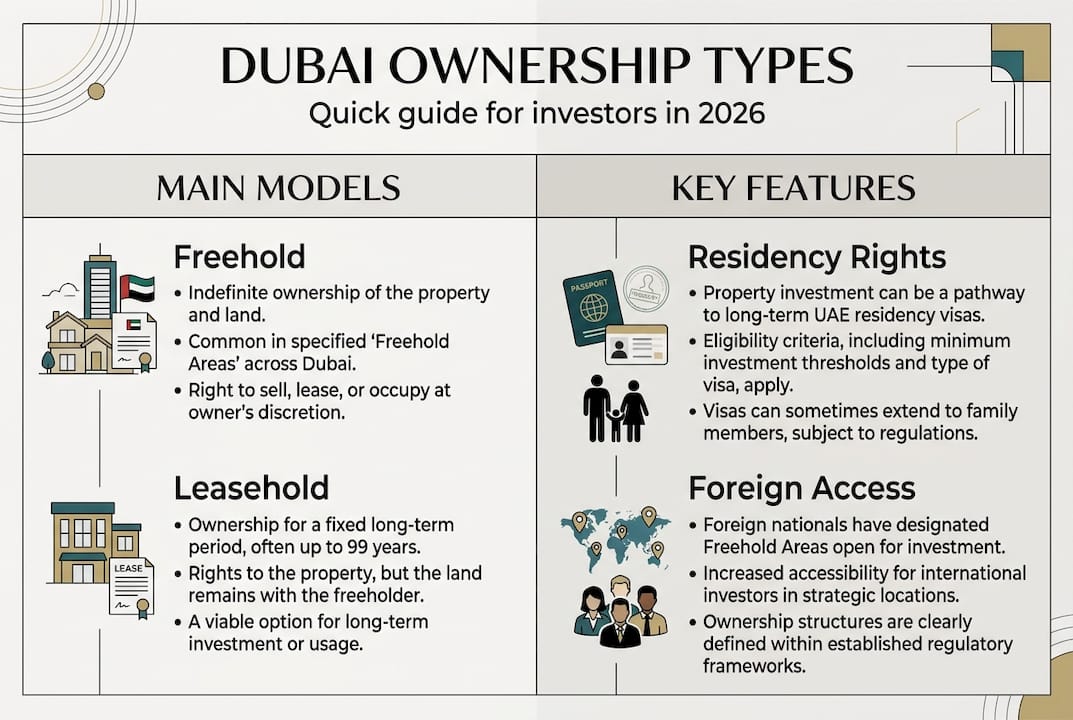
- Freehold ownership: Full title to the property and the land it sits on, available to foreigners in designated zones.
- Leasehold ownership: A long-term lease arrangement, typically up to 99 years, where the investor holds rights to the property but not the land.
- Corporate ownership: Holding property through a registered entity such as a JAFZA Offshore company, a mainland LLC, or a free zone company.
- Usufruct and Musataha rights: Less common but legally recognized rights that allow use of a property or land for a defined period.
The choice between these models affects far more than your paperwork. It determines whether you qualify for a UAE residency visa, how your estate is handled under UAE succession law, and whether your asset is shielded in the event of a legal dispute. Understanding investor rights and risks before signing anything is essential.
One of the most persistent misconceptions is that Dubai property ownership remains largely closed to foreigners. The numbers tell a different story. 52% of buyers in early 2026 were foreign nationals, with Indians accounting for 18% and British nationals making up 12% of all transactions. This level of foreign participation reflects a market that has actively opened its doors, backed by clear legal frameworks and transparent regulation.
Understanding Dubai property laws explained in full gives you the confidence to act decisively rather than hesitating on the sidelines while opportunities move past you.
Decoding Dubai’s main ownership structures
With the importance of structure established, let’s break down the options you will actually encounter as an investor. Each model has a specific legal basis, a defined eligibility criteria, and a set of strategic advantages worth understanding in detail.
Freehold is the most straightforward and widely sought structure. It grants you full ownership of both the property and the land, with no time limit. Foreigners can purchase freehold property in over 60 designated areas across Dubai, including popular zones like Dubai Marina, Downtown Dubai, Palm Jumeirah, and Jumeirah Village Circle. This structure is ideal for long-term capital appreciation and qualifies buyers for UAE residency visas at certain investment thresholds.

Leasehold gives you the right to use and occupy a property for a fixed term, most commonly 99 years. You do not own the land, which means certain decisions about the property remain with the freeholder. Leasehold is common in older parts of the city and some commercial districts. It can still generate strong rental yields, but resale value and inheritance planning require more careful attention.
Corporate structures add a layer of strategic flexibility. A JAFZA Offshore company, for example, allows 100% foreign ownership and can hold Dubai real estate, making it attractive for estate planning and asset protection. A mainland LLC can also hold property but involves a local service agent arrangement. Types of property ownership vary significantly in their tax and legal implications.
| Ownership type | Eligibility | Key benefits | Limitations |
|---|---|---|---|
| Freehold | UAE nationals and foreigners (designated zones) | Full title, visa eligibility, resale freedom | Limited to specific areas |
| Leasehold | Open to all | Access to broader locations | No land ownership, time-limited |
| JAFZA Offshore | Foreign nationals | Asset protection, estate planning | Cannot conduct onshore business |
| Mainland LLC | Foreign and UAE nationals | Operational flexibility | Local service agent required |
The 2025 market recorded 215,000 sales with 18.9% year-over-year growth, reflecting how structural changes in ownership law are directly fueling transaction volumes. Familiarizing yourself with real estate terms in Dubai ensures you can evaluate any deal with confidence.
Pro Tip: Always verify the developer’s registration and the title deed status directly through the Dubai Land Department’s online portal before committing to any purchase. This single step eliminates most fraud risk. You can also review the freehold ownership guide for a deeper breakdown of designated zones and eligibility rules.
Choosing the right structure: Factors and frameworks
You have learned the ownership types, but the right fit depends on your specific circumstances. Follow this framework to narrow down your options based on your goals, residency status, and long-term plans.
Step 1: Define your primary investment goal. Are you buying for personal use and residency, passive rental income, business operations, or long-term wealth transfer to your family? Each goal points toward a different structure.
Step 2: Assess your residency status. Non-residents purchasing freehold property above AED 750,000 qualify for an investor visa. Residents may have different financing options and tax considerations depending on their home country’s treaties with the UAE.
Step 3: Evaluate tax and inheritance implications. The UAE has no personal income tax or capital gains tax, which makes individual ownership straightforward for most investors. However, if your home country taxes global assets, holding property through an offshore company may offer legitimate protection. Always consult a tax advisor familiar with both jurisdictions.
Step 4: Consider succession and estate planning. UAE law applies Sharia principles to inheritance by default unless a registered will or corporate structure specifies otherwise. For non-Muslim investors, registering a will with the Dubai International Financial Centre (DIFC) or holding assets through a company structure provides critical protection.
Step 5: Match structure to investor profile.
| Investor profile | Recommended structure | Primary reason |
|---|---|---|
| Individual buyer seeking residency | Freehold (personal name) | Visa eligibility, simplicity |
| Family wealth planning | JAFZA Offshore company | Succession control, asset protection |
| Business operator | Mainland LLC | Operational and property flexibility |
| Short-term yield investor | Freehold or leasehold | Rental income, liquidity |
Dubai’s market recorded strong foreign transaction growth through both 2025 and 2026, confirming that international investors are applying exactly this kind of structured thinking to their decisions. Review the legal requirements for Dubai investors to ensure your chosen structure meets all compliance standards. A solid Dubai property investment guide can also help you align structure with strategy.
Pro Tip: If you are purchasing with a business partner or as part of a family group, establish a shareholder agreement or a memorandum of understanding before the transaction closes. This prevents costly disputes over control, exit rights, and profit distribution later.
Navigating regulations and common pitfalls
Frameworks simplify the process, but regulation and the realities on the ground play a huge role. Here is what savvy investors need to know before they commit capital.
Dubai’s regulatory environment is governed primarily by the Real Estate Regulatory Agency (RERA) and the Dubai Land Department (DLD). All developers must be RERA-registered, all transactions must be recorded with the DLD, and escrow accounts are mandatory for off-plan sales. This structure gives buyers a level of legal protection that rivals many established Western markets.
“Robust regulation and clearly defined rights are attracting more foreign buyers each year, reinforcing Dubai’s position as a transparent and investor-friendly market.”
Despite this strong framework, international buyers still make avoidable mistakes. Here are the top five pitfalls to watch for:
- Skipping developer verification: Always confirm the developer is registered with RERA and that the project has an approved escrow account.
- Ignoring inheritance planning: Buying in your personal name without a registered will or corporate wrapper can expose your estate to unintended legal outcomes.
- Underestimating ongoing costs: Service charges, DLD registration fees (typically 4% of purchase price), and agency fees add up. Budget for them from day one.
- Misunderstanding off-plan risks: Payment plans are attractive, but project delays and developer insolvency remain real risks. Review the property law risks and returns before committing to off-plan.
- Overlooking rental regulations: If you plan to lease your property, understanding rental laws in Dubai is not optional. RERA’s rental index governs permissible increases and tenant rights.
Due diligence is not a checkbox exercise. It is the foundation of a secure investment. Request the title deed, verify it against the DLD registry, check for any encumbrances or mortgages, and confirm the seller’s legal authority to transact.
Our take: What most guides won’t tell you about Dubai ownership
Most articles on Dubai ownership structures present a clean, linear decision tree: pick your goal, match it to a structure, and proceed. The reality we see from working with international investors is more nuanced, and frankly more interesting.
The biggest myth is that corporate structures are universally superior for foreign buyers. They are not. For many individual investors buying a single residential property, the added administrative cost and complexity of an offshore company outweighs the benefits. The structure should serve the investment, not the other way around.
Another overlooked reality is that Dubai real estate trends 2026 are shifting fast. Regulations that applied two years ago have already been updated, and what worked as a tax-efficient structure in 2023 may carry different implications today. Relying on generic guides or advice from non-specialists is a genuine risk.
Smart investors in 2026 are taking hybrid approaches, combining personal freehold ownership for residency benefits with corporate structures for additional assets. They are also investing heavily in due diligence, because in a market moving this fast, the quality of your information is your real competitive advantage.
Partner with the right advice for your Dubai investment
Navigating Dubai’s ownership landscape is far more rewarding when you have experienced, licensed professionals guiding each decision. Whether you are evaluating your first freehold purchase or structuring a multi-asset portfolio through a corporate entity, the right advisor makes the difference between a good investment and a great one.

At anthonyjosephaj.com, we work directly with international investors and entrepreneurs to match ownership structures to real goals, not generic templates. From initial consultation through to title deed registration, our team provides on-the-ground expertise backed by years of transacting in Dubai’s most competitive market segments. Ready to move from research to results? Explore ownership types or reach out to discuss your specific situation with a trusted local expert today.
Frequently asked questions
Can foreigners own property directly in Dubai?
Yes, foreigners can directly own freehold property in designated areas of Dubai, and over 50% of buyers in 2026 were foreign nationals, confirming how accessible the market has become.
What is the difference between freehold and leasehold ownership in Dubai?
Freehold gives you full rights to both the property and the land with no time limit, while leasehold means you hold usage rights for a defined period, typically up to 99 years, without owning the land itself. Both are recognized ownership models in Dubai’s legal framework.
Is it better to buy property as an individual or through a company in Dubai?
It depends entirely on your goals. Companies can offer asset protection, succession planning, and potential tax advantages, while individual ownership is simpler and qualifies you directly for residency visas. Transaction surges reflect both individual and corporate buyers finding value in Dubai’s market.
Are there restrictions on transferring ownership?
Most ownership transfers are permitted when they comply with Dubai Land Department rules, though certain corporate structures and leasehold arrangements carry additional conditions. Clear investor rights and regulatory transparency are key reasons international confidence in Dubai continues to grow.


