

Dubai inheritance laws: your guide to protecting property investments
TL;DR:
- Registering a will in Dubai is essential to ensure estate distribution aligns with your intentions and avoids strict Sharia inheritance rules. The DIFC Wills system offers a fast, flexible, and legally recognized way for non-Muslim expatriates to protect their assets within a common-law framework. Proper estate planning, including timely registration and regular updates, safeguards your legacy and simplifies inheritance for your family.
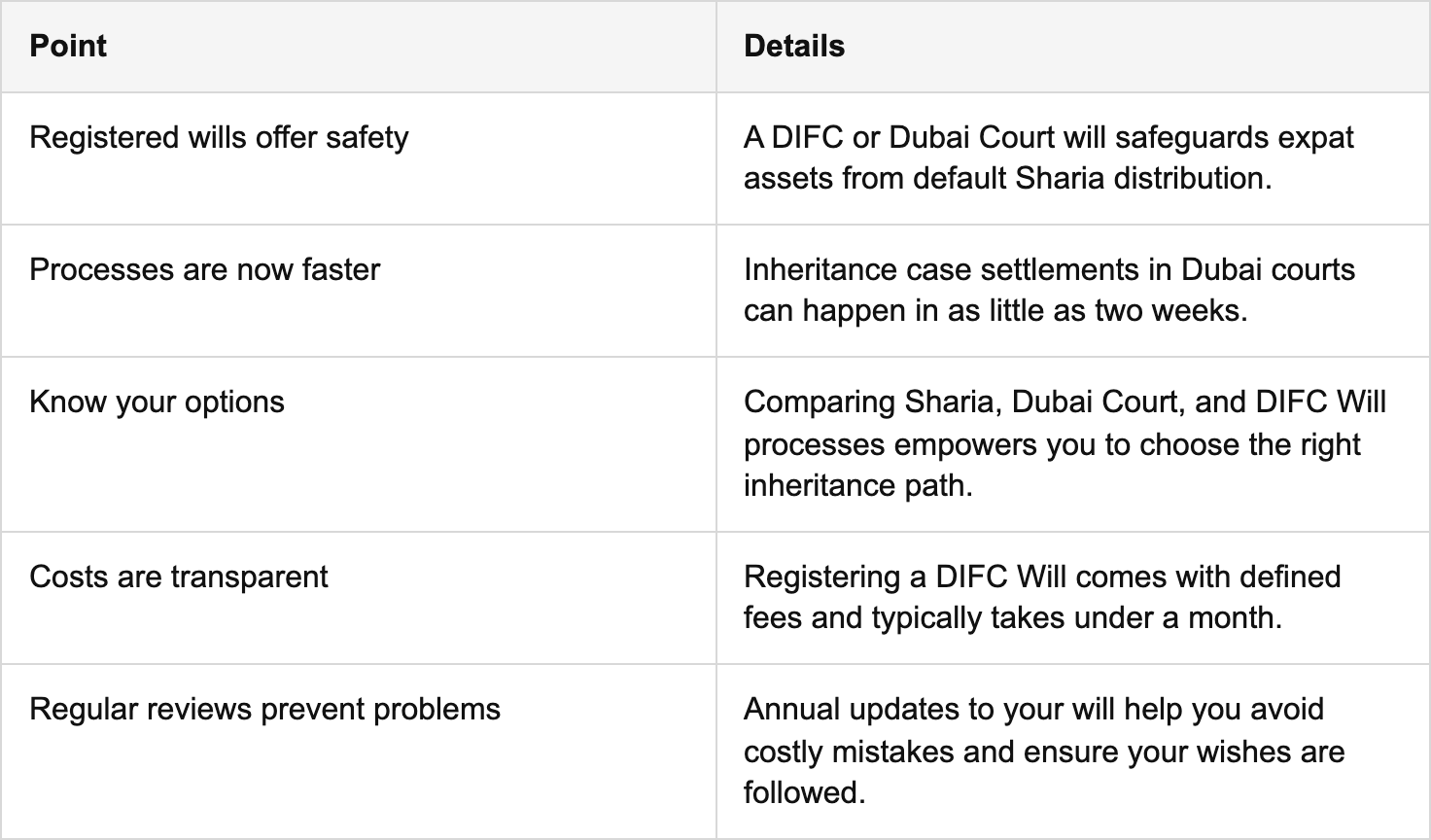
Settling a high-value estate in Dubai moves faster than most expat investors expect. The Dubai Courts Inheritance Department processed Dh3.5 billion in 2025, with amicable cases closing in an average of just 13.8 days. Yet speed alone does not protect you. Without a registered will, your Dubai property may default to Sharia inheritance rules regardless of your nationality, your family’s wishes, or your home country’s legal system. This guide gives you a clear roadmap to understand the frameworks, register the right will, and keep your legacy exactly where you intend it.
Table of Contents
- Why inheritance law matters for Dubai property investors
- Understanding Dubai’s inheritance frameworks: Sharia, Dubai Courts, DIFC Wills
- How to register a DIFC Will and what it costs
- Common mistakes and pitfalls in Dubai inheritance planning
- What most expat investors miss about Dubai inheritance law
- Next steps: secure your legacy in Dubai
- Frequently asked questions
Key Takeaways
Why inheritance law matters for Dubai property investors
With clarity on how quickly cases can move, it is critical to understand why inheritance planning should be a top priority for every property-owning expatriate in Dubai. Dubai’s real estate market attracts high-net-worth individuals from across the globe, and many of them accumulate significant assets here over years or even decades. What those investors often underestimate is that the legal transfer of those assets after death follows local law, not the law of their home country.
Under UAE federal law, the default inheritance framework is Sharia law. For non-Muslims without a registered will, this can result in distributions that differ significantly from personal intentions. Assets can be frozen during court proceedings, causing real financial hardship for surviving family members. Joint accounts may be restricted, rental income may halt, and dependents can be left without access to funds for months. Reviewing the legal requirements for Dubai investors before acquiring property gives you a far stronger foundation.
Here is what a registered will actually protects for you:
- Asset distribution control: You determine exactly who receives each property, investment account, or financial asset rather than leaving it to a default formula.
- Guardianship designation: For parents of minor children, a will allows you to formally appoint a guardian of your choosing, which is a protection that Sharia defaults do not automatically provide in alignment with Western legal expectations.
- Preferred beneficiary rights: You can name beneficiaries outside the immediate family, including partners, business associates, or charities that Sharia rules might not recognize.
- Speed and certainty: Registered wills reduce contested claims and streamline the court process considerably.
- Cross-border coordination: A properly structured will can align with your home country estate plan, reducing conflicts between jurisdictions.
Statistic callout: According to estate planning specialists, the DIFC Wills system is now the preferred route for non-Muslim expatriates because it mirrors common-law concepts, supports virtual registration, and ensures custom property distributions tailored to individual investment portfolios.
Understanding the types of property ownership in Dubai, whether freehold, leasehold, or usufruct, is equally important because the inheritance mechanism can vary depending on how title is held.
Understanding Dubai’s inheritance frameworks: Sharia, Dubai Courts, DIFC Wills
Now that we understand the importance, let us look at the key frameworks and how they differ for expat investors. There are three primary systems you need to know, and each serves a distinct group of investors depending on religious background, legal familiarity, and asset complexity.
Sharia law as the default applies to all UAE residents and asset holders unless a registered will supersedes it. For Muslims, this is the intended system. For non-Muslims, however, it can create distributions that conflict with family wishes, particularly around spousal inheritance, equal division of assets, and guardianship of children.
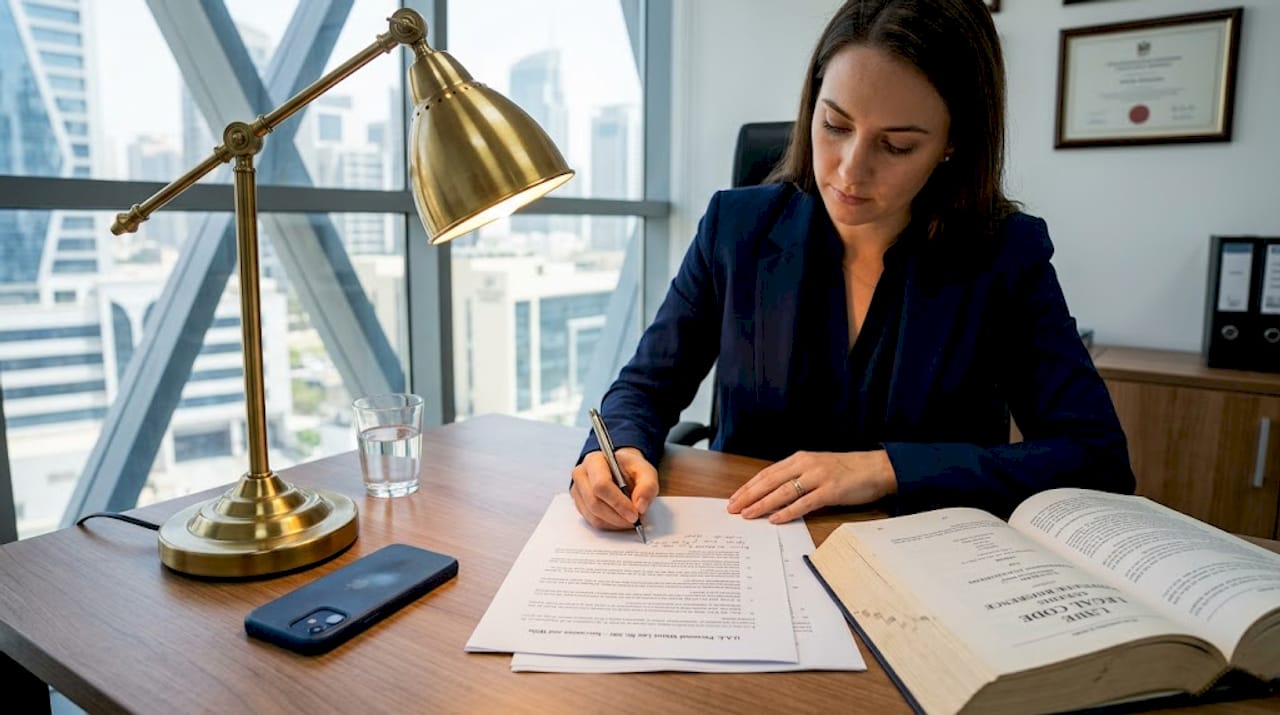
Dubai Courts provide a formal civil process for inheritance disputes and estate settlements. The court’s Inheritance Department accepts cases from both Muslims and non-Muslims, and the amicable settlement track, which has averaged 13.8 days per case in 2025, is designed for cases where family members agree on the distribution. Contested cases take considerably longer. Reviewing the foundational Dubai property laws explained resource helps you understand how the court system interfaces with property title.
DIFC Wills represent the third path, and for most non-Muslim expat investors, the most protective one. The Dubai International Financial Centre (DIFC) operates a separate, common-law-based legal system within the UAE. Its Wills Service Centre allows non-Muslims to register wills that are recognized by Dubai Courts and that follow common-law principles of estate distribution. The process is available virtually, making it accessible even for investors based outside the UAE. For a broader look at how this fits into the regulatory environment, the UAE real estate regulations guide is a useful companion resource.
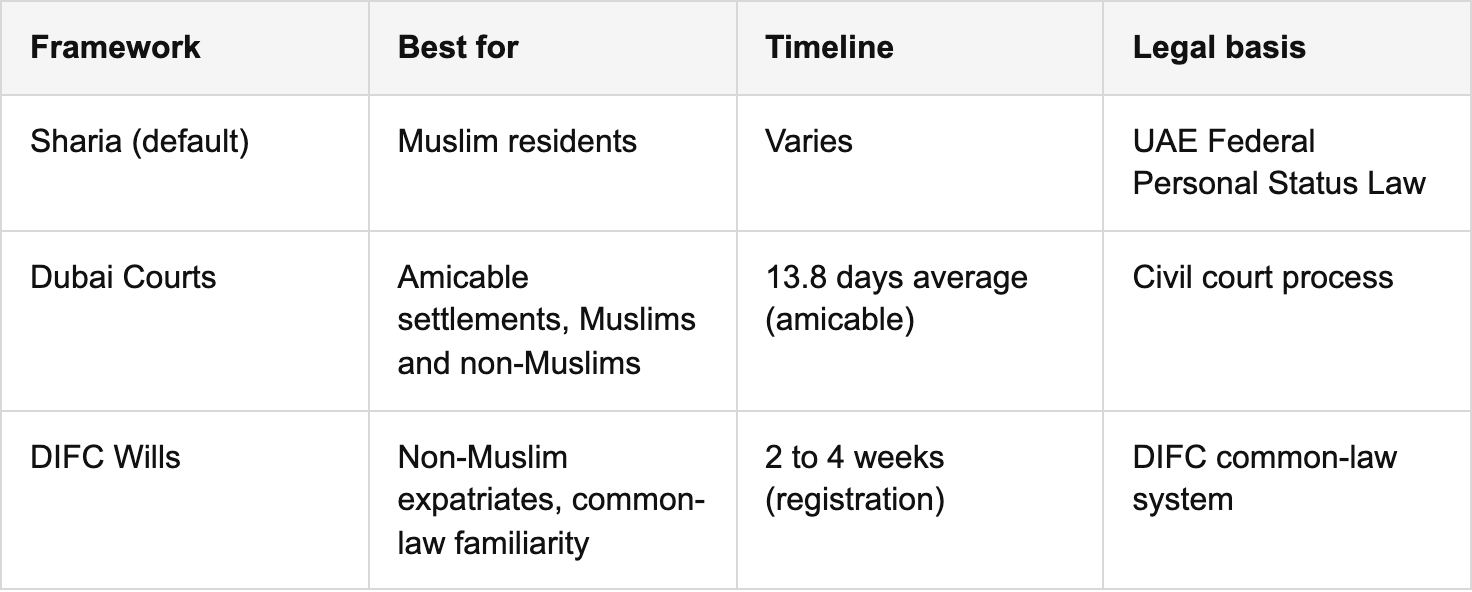
The registration of a DIFC Will does not replace Dubai Courts entirely. Instead, the will becomes the governing document that Dubai Courts honor when processing the estate, giving you the speed of the court system with the legal certainty of a registered document.
How to register a DIFC Will and what it costs
Understanding your options, here is what practical DIFC Will registration looks like, step by step. The process is more straightforward than most investors assume, and the costs, while meaningful, are modest relative to the value of assets being protected.
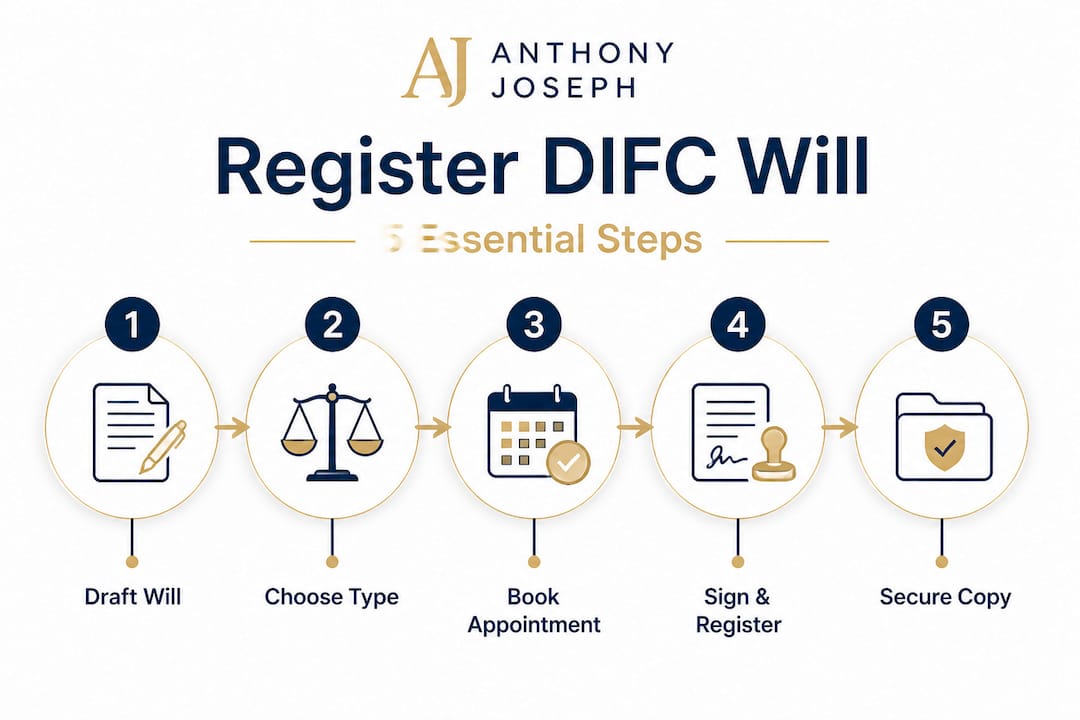
Step 1: Draft your will with a qualified lawyer. Before you approach the DIFC Wills Service Centre, you need a properly drafted document. Legal drafting fees typically range from AED 3,000 to AED 6,000, depending on the complexity of your estate. This stage is where you specify beneficiaries, asset allocations, guardianship appointments, and any specific instructions for property in your portfolio.
Step 2: Choose the type of will that matches your needs. The DIFC offers several formats. A Full Will covers all your UAE assets. A Property Will covers specific real estate assets only. The right choice depends on whether you hold financial accounts, business interests, or purely real estate in Dubai.
Step 3: Book your appointment. The DIFC Wills Service Centre offers both virtual and in-person appointments. Virtual registration is particularly useful for expats who are currently based outside the UAE. You will need to confirm your identity, bring your original passport, and arrange for two witnesses who are not beneficiaries of the will.
Step 4: Sign and register. The registration appointment involves signing in front of the registrar with your witnesses present. The registrar confirms the document’s legal validity and registers it within the DIFC system.
Step 5: Store and communicate the will’s existence. Once registered, keep a certified copy in a secure location. Inform a trusted family member or legal representative of its location and the reference number, so there are no delays during estate proceedings.
The full fee schedule breaks down as follows:
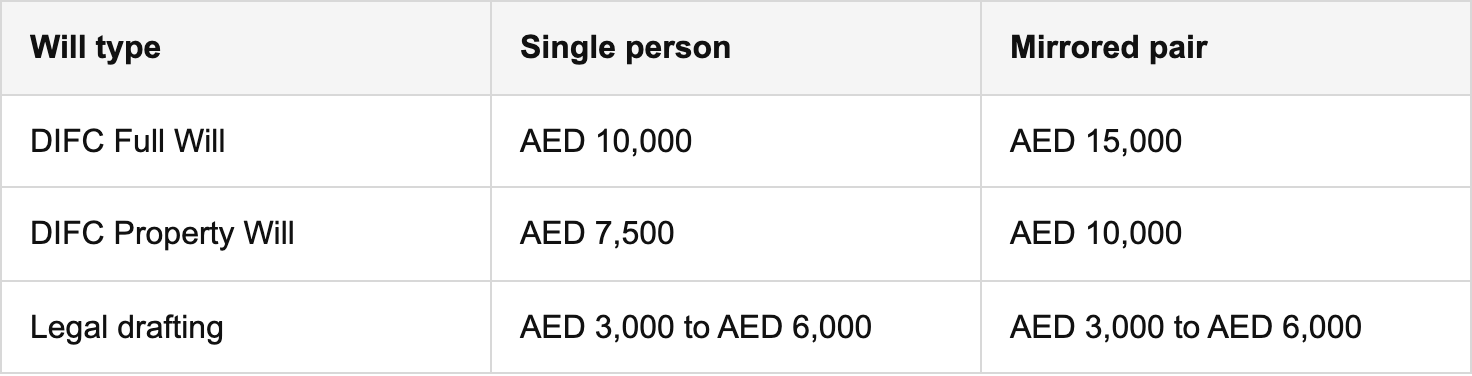
These DIFC registration fees represent a fixed, one-time cost. Compare that to the potential legal fees, court delays, and family disputes that arise when an estate is settled without a registered will, and the investment becomes straightforward to justify. Understanding the role of the DLD in property transfers also clarifies how your will interacts with title transfer processes at the Dubai Land Department.
Pro Tip: Always engage a lawyer who specializes in UAE estate planning rather than a general conveyancer. Asset listing errors and incorrect guardianship designations are the two most common reasons DIFC Wills are challenged or delayed in court, and an experienced specialist will identify these issues during the drafting stage.
Common mistakes and pitfalls in Dubai inheritance planning
Even with a will system in place, mistakes can prove costly. Here are the most common ones to watch for when structuring inheritance plans for Dubai-based assets.
- Failing to register the will at all. A handwritten or unregistered will has very limited standing in Dubai’s legal system. Without formal registration through the DIFC or Dubai Courts, Sharia defaults can still apply.
- Not updating your home country will after acquiring Dubai assets. Many expats have a will in their country of origin that does not reference UAE property. This creates a jurisdictional gap, and your Dubai assets may not transfer as intended.
- Overlooking guardianship designations. Parents with minor children often focus entirely on financial assets and forget to formally designate a guardian within the UAE legal framework. A Dubai-registered will is the only reliable mechanism for this.
- Choosing the wrong type of will. Registering a Property Will when you also hold financial accounts in Dubai means those accounts remain outside the will’s coverage, creating an incomplete estate plan.
- Ignoring changes in asset value and portfolio composition. A will drafted when you owned one apartment may be dangerously out of date after you have acquired multiple units, a commercial space, or business shares.
“The most common and costly estate planning error we see among expatriate investors is not the absence of a will, but the presence of an outdated one that no longer reflects the actual composition of the estate.” This observation aligns with how estate planning professionals advise high-net-worth non-Muslim clients: registered wills tailored to property investments are essential, and they require regular maintenance.
Understanding the full scope of legal requirements for Dubai expats helps you recognize all the points at which your estate plan can be strengthened. Additionally, protecting your expat property through coordinated legal, financial, and real estate planning creates a far more resilient structure than any single document alone.
Pro Tip: Schedule an annual review of your will with your UAE estate lawyer, ideally at the same time you review your property portfolio. Any change in asset holdings, beneficiary circumstances, or relevant regulations should trigger an update.
What most expat investors miss about Dubai inheritance law
Most guides on this topic focus on registering a will and selecting between DIFC and Dubai Courts. That is the right starting point, but it is not the full picture. Here is a perspective drawn from working closely with high-net-worth expatriates across diverse nationalities and investment structures.
The single most underestimated factor is not legal framework selection but jurisdictional layering. When you own property in Dubai, a business in the DIFC, and a home in London, three separate legal systems govern your estate simultaneously. A DIFC Will handles your Dubai assets. Your UK will handles British assets. But the gap between them, specifically around assets that straddle both systems like bank accounts held in multi-currency structures, is where families lose time, money, and clarity.
Many investors also underestimate the emotional and financial cost of unclear documentation on surviving family members. Even in amicable cases, families report stress from frozen accounts, delayed property transfers, and bureaucratic processes they were completely unprepared for. The 13.8-day average settlement figure is encouraging, but that timeline only applies to cases where documentation is complete and all parties agree. Any dispute or missing document extends that dramatically.
There is also a genuinely underused strategy worth considering for blended families and investors with complex holdings: running DIFC and Dubai Courts structures in complementary ways. A DIFC Will can govern specific high-value freehold properties while a Dubai Courts-registered document handles more liquid assets. For families with children from multiple relationships, this layered approach allows for more precise asset allocation without a single monolithic document that may be harder to execute cleanly.
Finally, integrating inheritance planning with your active rental law obligations and property management structure creates a level of asset protection that few investors fully realize. Understanding how rental law impacts property income during estate proceedings helps you structure leases and management agreements so income continues flowing to the right parties even before formal transfer is complete.
A will is not a one-time fix. It is a living document within an active investment strategy, and treating it as such is what separates genuinely protected estates from vulnerable ones.
Next steps: secure your legacy in Dubai
Knowing the frameworks is the first step. Implementing the right structure for your specific situation is where the real protection begins.

For high-net-worth expatriates with cross-border estates, multi-property portfolios, or complex family structures, generic advice simply will not cover the full picture. The decisions you make around will type, registration route, asset listing, and guardianship have lasting consequences for your family and your investment legacy. At anthonyjosephaj.com, Anthony Joseph and his team bring deep expertise in Dubai real estate law, investment strategy, and estate planning to help you build a structure that is both legally sound and strategically aligned with your goals. Whether you are acquiring your first freehold property or managing a diverse portfolio, the right guidance at this stage protects everything you have built.
Frequently asked questions
Do Dubai inheritance laws apply to all foreigners who own property?
Unless you have a registered will in place, your Dubai property may be subject to Sharia inheritance rules regardless of your nationality, religion, or home country legal system.
How long does it take to settle an inheritance case through Dubai Courts?
Amicable inheritance cases at Dubai Courts now average 13.8 days for settlement, a significant improvement from the 24-day average recorded in 2024.
What is the cost of registering a DIFC Will?
A DIFC Full Will costs AED 10,000 for a single registrant or AED 15,000 for a mirrored pair, with property-specific will options available at lower registration fees.
Are online appointments available for registering a DIFC Will?
Yes, the DIFC Wills Service Centre offers virtual appointment options, making registration accessible for investors currently residing outside the UAE, with the full process taking two to four weeks from drafting to completion.


