

Dubai Company Formation: A Complete Guide for Entrepreneurs
TL;DR:
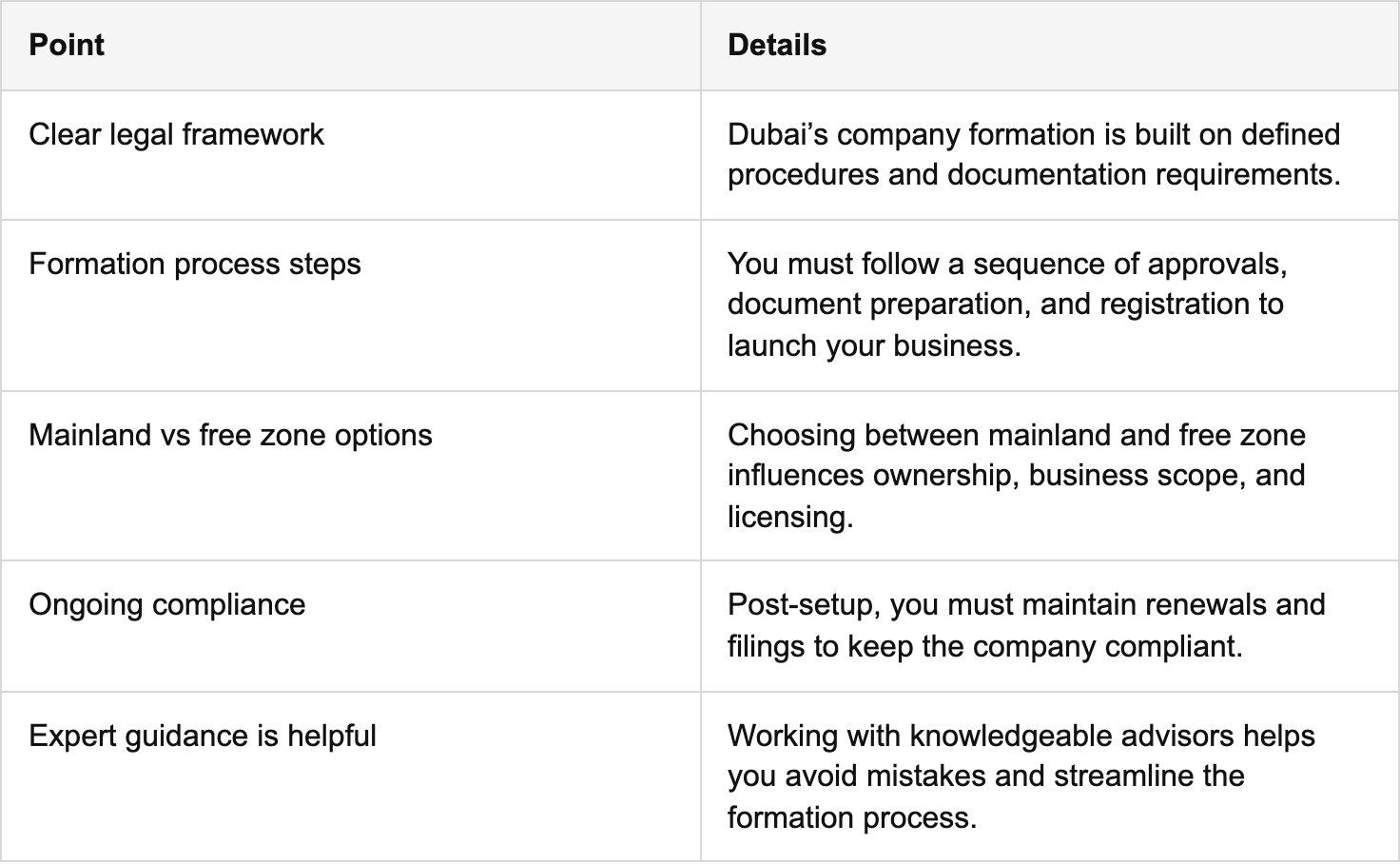
- Dubai’s company formation is a transparent, structured legal process open to foreigners, governed by federal law.
- Entrepreneurs can choose among various entities like LLCs, joint stock companies, and free zone companies, each with different requirements.
- Successful setup requires careful compliance with documentation, licensing, office requirements, and post-formation obligations.
Dubai Company Formation: A Complete Guide for Entrepreneurs
Many international entrepreneurs assume that setting up a business in Dubai involves layers of bureaucracy accessible only to those with deep local connections. That assumption is simply wrong. Under Federal Decree-Law No. 32, company formation is a structured legal process with clearly defined steps, and it is fully open to foreign nationals. Dubai’s business environment is designed to attract global talent and capital, which is why understanding the exact process, your options, and your obligations gives you a decisive advantage before you invest a single dirham.
Table of Contents
- What does company formation in Dubai mean?
- Step-by-step guide to forming a company in Dubai
- Mainland vs free zone: Comparing company formation options
- Legal documents and compliance essentials
- The reality of forming a Dubai company: What most guides miss
- Ready to form your company in Dubai?
- Frequently asked questions
Key Takeaways
What does company formation in Dubai mean?
Before you can act strategically, you need a precise definition. Company formation in Dubai is not simply registering a trade name or opening a bank account. It is a formal legal process governed by Federal legislation, and skipping even one step can invalidate your entire setup.
“Company formation is the legal process of incorporating a commercial entity and obtaining a business license through the competent authorities, followed by incorporation and registration steps and issuance or recording in the commercial register.” Federal Decree-Law No. 32
This definition has three distinct pillars: incorporation, licensing, and registration. Each pillar has its own requirements, timelines, and responsible authority. Understanding all three from the start means you will not be surprised midway through the process.
Types of commercial entities available in Dubai
Dubai’s legal framework accommodates several company structures, each suited to different business models and ownership goals:
- Limited Liability Company (LLC): The most common structure for mainland businesses. An LLC offers liability protection for shareholders, meaning personal assets remain separate from business debts. It suits trading, contracting, and service activities.
- Private Joint Stock Company: Suited to larger ventures with multiple shareholders seeking a more formal corporate structure, typically required for specific regulated industries.
- Public Joint Stock Company (PJSC): Required for businesses intending to list on a UAE stock exchange or raise capital from the public. This structure carries heavier regulatory requirements.
- Sole Establishment: A single-owner structure used by professionals and freelancers. The owner bears full liability, but setup is faster and administrative load is lighter.
- Branch or Representative Office: Allows an existing foreign company to operate in Dubai without forming a new legal entity, though activities are limited to those of the parent company.
Understanding these company formation basics is essential before you choose a structure, because your choice affects ownership percentages, liability exposure, capital requirements, and the types of activities your license will cover.
Why Dubai’s system matters to you as an international entrepreneur
Dubai’s legal framework is not arbitrary. It is designed to give investors confidence through transparency and regulatory clarity. The commercial register, for example, is a public record that legitimizes your business in the eyes of banks, government bodies, and trading partners. When a counterpart checks your company’s registration, they can verify your license, your shareholders, and your authorized activities. That credibility is a business asset that pays dividends long after your formation is complete.
The system also matters because Dubai imposes zero personal income tax and a competitive 9% corporate tax on profits above AED 375,000. For most startups, that threshold means early-stage operations remain largely tax-free, making Dubai one of the most financially attractive jurisdictions for new ventures.
Step-by-step guide to forming a company in Dubai
With the definition established, let’s break down the actual steps involved in forming your company. The mechanics of company formation follow a logical progression, and knowing each milestone in advance lets you prepare documents, budget correctly, and avoid delays.
-
Choose your business activity and company structure. Every Dubai license is tied to specific permitted activities. You must select activities from the official list maintained by the Department of Economy and Tourism (DET) for mainland businesses, or from your chosen free zone authority’s catalog. Your activity choice directly determines which structure is appropriate and which regulator oversees you.
-
Reserve your trade name and obtain initial approvals. Your company name must comply with UAE naming conventions: no offensive language, no references to political or religious organizations without approval, and no names too similar to existing registered companies. Once reserved, some activities require preliminary approvals from sector regulators such as the Dubai Health Authority, the Roads and Transport Authority, or the Securities and Commodities Authority before you proceed.
-
Draft and attest your constitutional documents. For an LLC, this means preparing a Memorandum of Association (MOA). For a joint stock company, Articles of Association (AOA) are also required. These documents define the company’s purpose, share structure, management roles, and profit distribution. They must be notarized and, for foreign parties, often require attestation from the relevant embassy and the UAE Ministry of Foreign Affairs.
-
Satisfy office and space requirements. Most business structures in Dubai require a physical address. For mainland companies, you need a tenancy contract registered with Ejari, Dubai’s official rental registration system. Free zones typically offer flexi-desk, shared workspace, or dedicated office options within their own facilities.
-
Receive your trade license and register in the commercial register. Once all documents are verified and fees are paid, the competent authority issues your trade license and records your company in the commercial register. This is the moment your company legally exists.
-
Handle post-formation obligations. Formation does not end at the license. You must open a corporate bank account, register for corporate tax with the Federal Tax Authority if applicable, apply for employee visas through the General Directorate of Residency and Foreigners Affairs (GDRFA), and register for social insurance if you hire UAE nationals.
Pro Tip: The most commonly delayed step is opening a corporate bank account. UAE banks conduct thorough Know Your Customer (KYC) checks, and incomplete documentation or unclear business models can stall the process by weeks. Prepare a detailed business plan, three to six months of personal bank statements, proof of source of funds, and a clear explanation of your expected transactions before you approach any bank.
If you are comparing the mainland vs. free zone process for the first time, pay close attention to Step 4, because office requirements differ significantly between the two environments and can affect your total setup cost.
Mainland vs free zone: Comparing company formation options
Since not all company formations are alike, it is important to understand the major options available and how they compare. Dubai offers two primary formation environments: mainland and free zone. Each carries distinct advantages, limitations, and cost profiles.
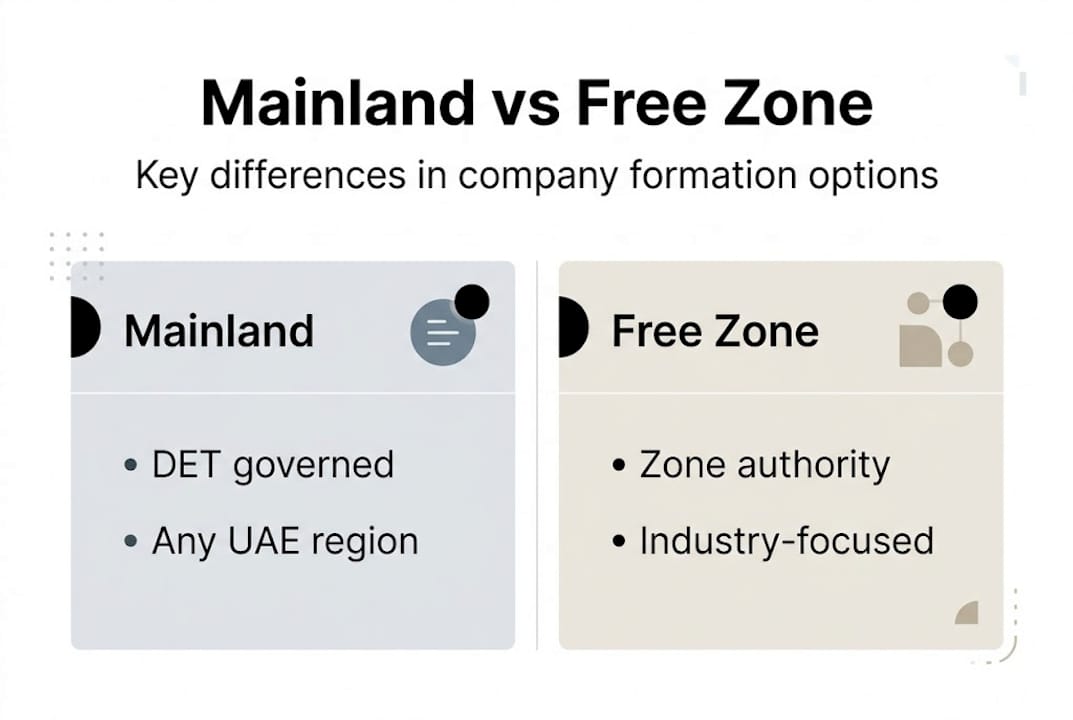
Mainland company formation is governed by the DET and allows you to conduct business anywhere in the UAE, bid on government contracts, and operate without restrictions on trading partners. Since 2021, many mainland activities allow 100% foreign ownership, removing the historical requirement for a UAE national sponsor holding 51% of shares.

Free zone company formation is overseen by individual free zone authorities such as the Dubai Multi Commodities Centre (DMCC), Dubai International Financial Centre (DIFC), or Dubai Silicon Oasis (DSO). Free zones always permit 100% foreign ownership, offer streamlined setup processes, and frequently provide industry-specific infrastructure and networking communities. However, free zone companies generally cannot conduct business directly with the UAE mainland market without engaging a local distributor or establishing a separate mainland entity.
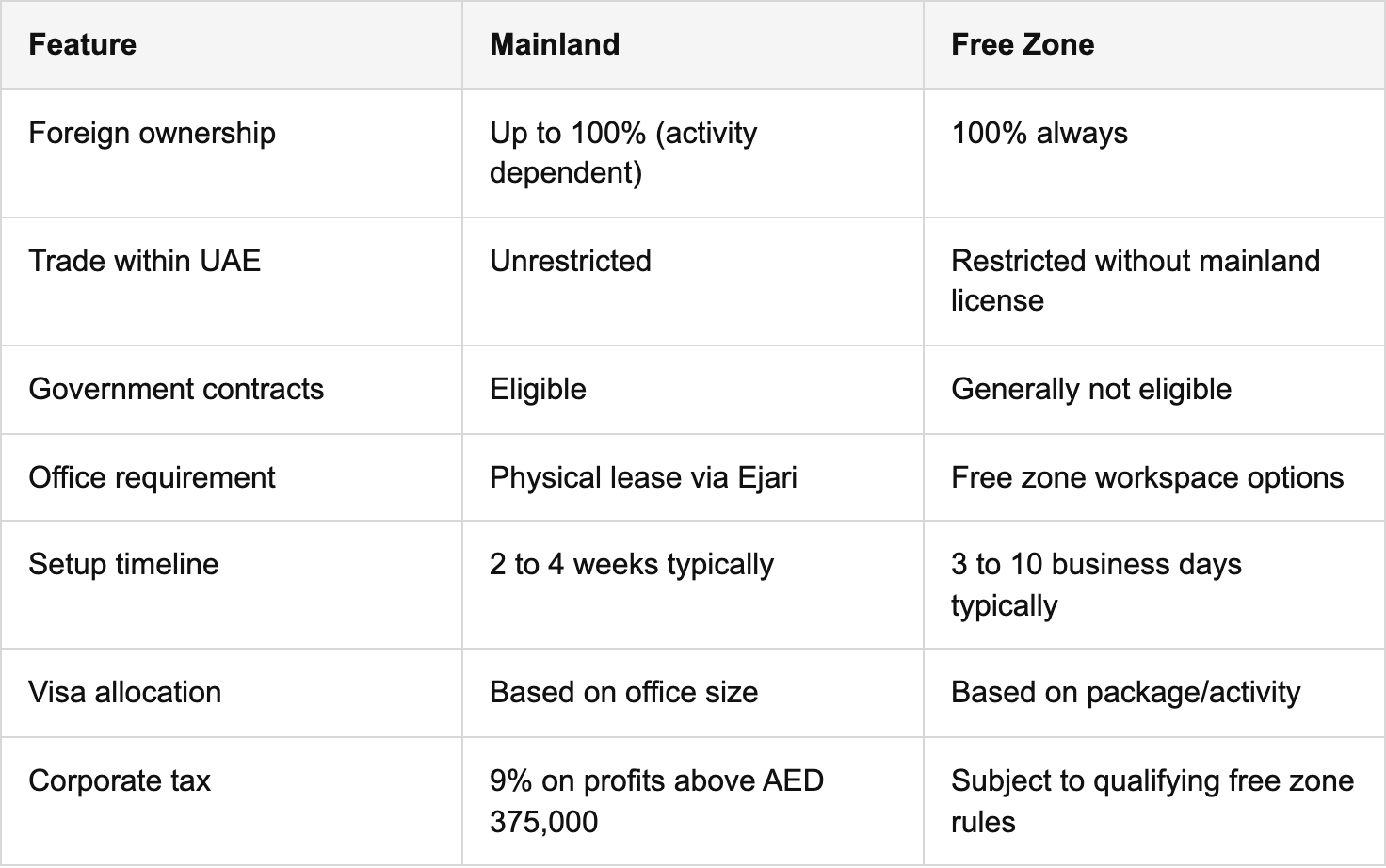
Federal Decree-Law No. 32 governs the application process for both environments: you submit an application to the competent authority, await a decision, and upon approval, receive registration in the commercial register and your business license.
Key advantages by type:
- Mainland advantages: Broader market access, eligibility for government tenders, no restrictions on the number of visa applications relative to business scale, and direct trade with UAE-based clients.
- Free zone advantages: Faster setup, 100% repatriation of profits and capital, zero import and export duties within the free zone, and dedicated support from the zone authority.
Statistic callout: Dubai currently has over 40 free zones, each catering to specific industry verticals ranging from media and technology to healthcare and commodities. This specialized ecosystem means you can often find a free zone whose existing tenant community, regulatory framework, and infrastructure are purpose-built for your industry, providing a competitive edge from day one. For a focused look at Dubai free zone setup, there are resources that walk through specific zone comparisons in detail.
Legal documents and compliance essentials
Once you have chosen where to form, documentation and compliance become critical. Many entrepreneurs focus entirely on getting the license and then find themselves unprepared for the ongoing obligations that follow. Staying compliant is not optional: failures can result in fines, license suspension, or visa cancellations for your employees.
Mandatory formation documents
Federal Decree-Law No. 32 requires the creation and attestation of constitutional documents, specifically the MOA and AOA, and registration in the commercial register as non-negotiable steps. Beyond those, the full document set typically includes:
- Passport copies of all shareholders and directors
- Emirates ID copies (for UAE resident shareholders)
- No Objection Certificate (NOC) if a shareholder is employed in the UAE
- Board resolution authorizing the formation (for corporate shareholders)
- Proof of initial share capital deposit (for joint stock companies)
- Tenancy contract or free zone workspace agreement
- Relevant sector-specific approvals (healthcare, education, financial services, etc.)
Understanding the range of business license types and the matching ownership structures available to you will directly shape which documents you need to prepare.
Compliance calendar after formation
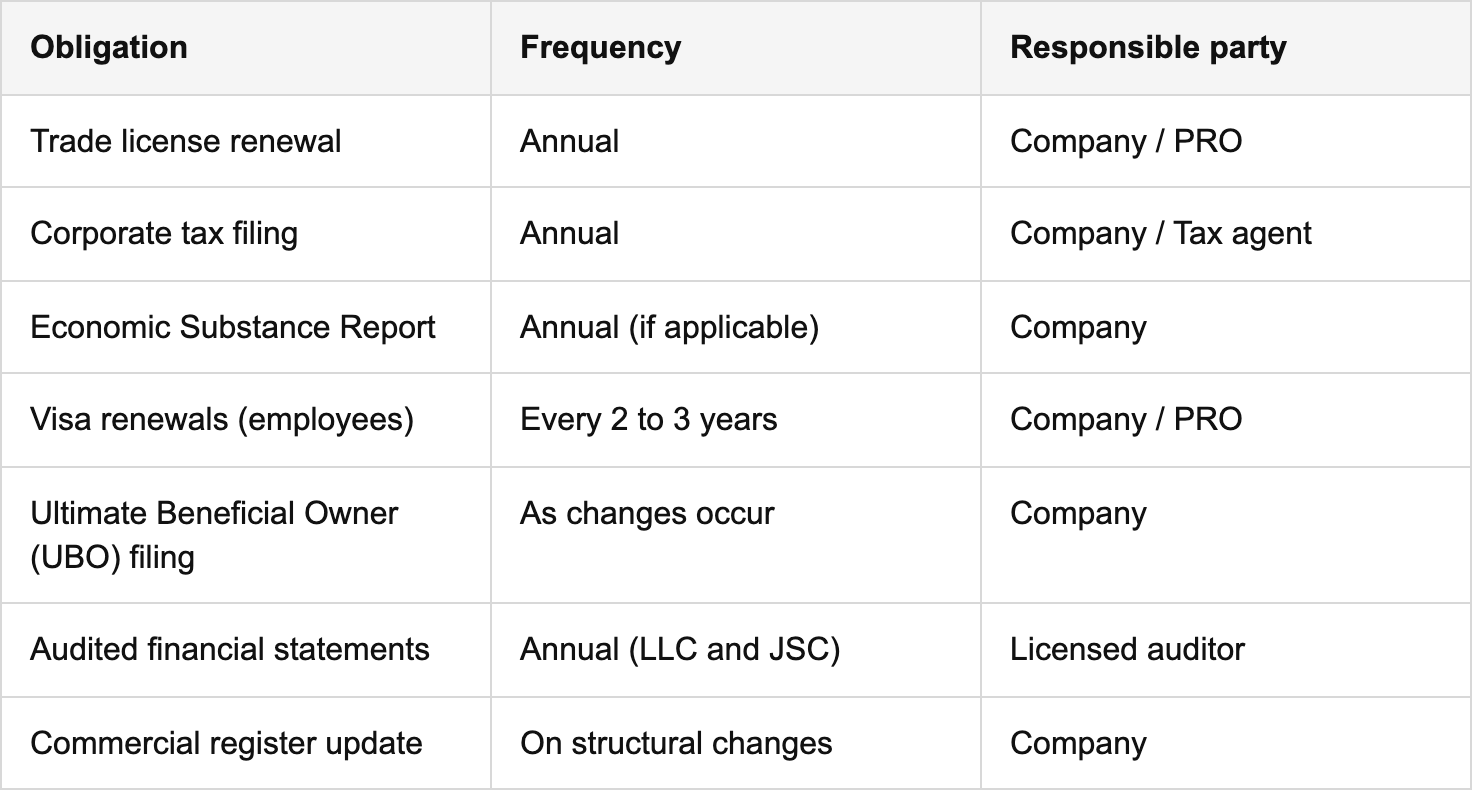
Pro Tip: The most overlooked compliance requirement is the Ultimate Beneficial Owner (UBO) declaration. Every UAE company must maintain and update a UBO register, disclosing the individuals who ultimately own or control 25% or more of the company. Failure to file or update this register carries significant financial penalties. Set a calendar reminder whenever there is any change in shareholding, even minor adjustments.
The reality of forming a Dubai company: What most guides miss
Most guides present company formation as a linear checklist. In practice, the process is linear only on paper. The real challenge for international entrepreneurs is not knowing what to do; it is managing the gap between the legal framework and the practical realities on the ground.
One common area where clients encounter friction is document attestation. The MOA and related papers must often be attested by multiple parties: a local notary, the relevant embassy in the entrepreneur’s home country, and the UAE Ministry of Foreign Affairs. Each step has its own processing time, and delays compound. An entrepreneur who budgets two weeks for attestation alone may find themselves waiting four to six weeks if they are unfamiliar with specific embassy procedures.
Bank account setup is the second major friction point. UAE banks assess risk meticulously, and certain nationalities or business activities trigger additional scrutiny regardless of how clean the documentation is. We have seen clients with perfectly formed companies wait up to three months for a corporate bank account because they chose an activity that banks categorize as higher risk, such as cryptocurrency consulting or cross-border remittances.
Finally, the nuances between key Dubai terms and legal concepts matter more than most guides acknowledge. Concepts like freehold versus leasehold, mainland versus free zone licensing, and qualifying versus non-qualifying free zone status for tax purposes all carry real financial consequences. Taking time to understand the terminology before you commit to a structure can save you from costly restructuring later.
The entrepreneurs who navigate Dubai’s company formation most successfully are those who treat it as a strategic decision rather than an administrative task.
Ready to form your company in Dubai?
With so many requirements, working with an expert can smooth the process and help you avoid costly mistakes. Understanding the legal framework is the foundation, but translating that knowledge into a correctly structured, fully compliant company requires hands-on experience with local authorities, document requirements, and banking relationships.

At anthonyjosephaj.com, we guide international entrepreneurs and investors through every stage of the company formation journey, from selecting the right structure and drafting constitutional documents to coordinating approvals and setting up banking. If you are ready to start your Dubai company with confidence and clarity, reach out today. The opportunity is real, the process is structured, and the right guidance makes all the difference.
Frequently asked questions
Can a foreigner own 100% of a company in Dubai?
Yes, depending on the company type and location, foreigners can own 100% in all free zones and in many mainland activities following the 2021 Foreign Direct Investment law amendments.
How long does company formation in Dubai usually take?
With documents prepared, formation can take as few as 3 business days in a free zone or 2 to 4 weeks for a mainland company, subject to approval timelines from the competent authority.
What documents are required to start a company in Dubai?
Key documents include valid passports, a business plan, a notarized MOA and AOA per Federal Decree-Law No. 32, and a lease agreement or free zone workspace contract.
Are there ongoing costs or compliance after forming a Dubai company?
Yes, companies must renew their business license annually, file corporate tax returns, maintain UBO registers, and submit required filings as mandated by Federal Decree-Law No. 32.
Is it necessary to have a physical office for company formation in Dubai?
Yes, most structures require a physical office or registered workspace as part of the legal formation requirements, though free zones offer flexible workspace solutions within their facilities.


