

Commercial property investment in Dubai: How it works
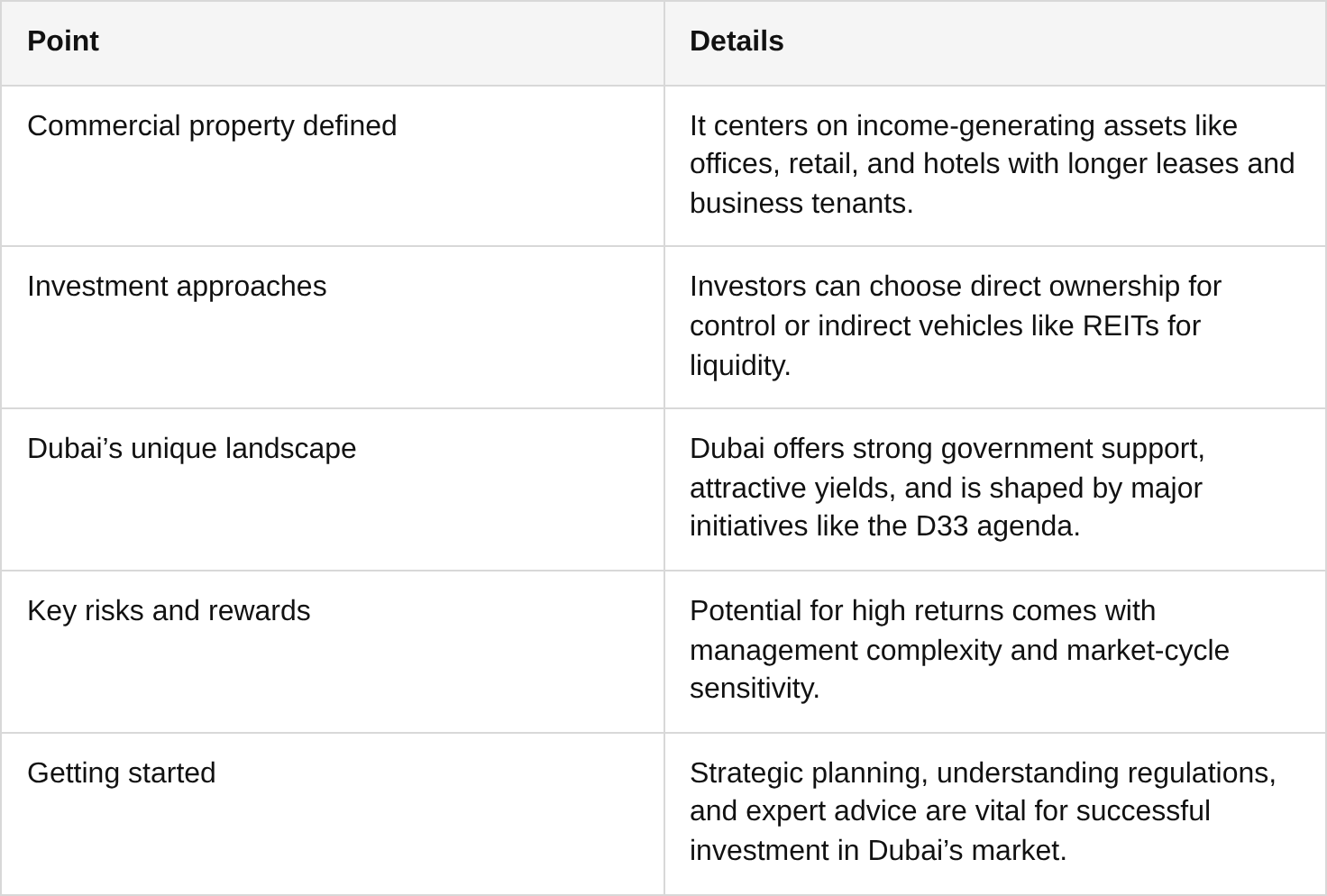
Most investors assume commercial real estate is a game reserved for institutional players with deep pockets and decades of experience. That assumption is costing them. Dubai’s commercial property market has quietly become one of the most accessible and rewarding arenas for international investors, driven by zero corporate tax on most income, a government-backed growth agenda, and yields that outpace almost every comparable global city. This article breaks down what commercial property investment actually means, how it works in Dubai specifically, and what you need to know before making your first move.
Table of Contents
- What is commercial property investment?
- Core mechanics: How commercial property investing works
- Comparing commercial and residential property investment
- Opportunities and challenges in Dubai’s commercial property market
- How to start investing in Dubai commercial property
- Next steps: Explore Dubai commercial property opportunities
- Frequently asked questions
Key Takeaways
What is commercial property investment?
Commercial property investment involves acquiring income-generating properties used primarily for business purposes. That covers a wide range of asset classes, each with its own risk profile, tenant base, and return potential.
Understanding the real estate terminology before you invest is non-negotiable. The five main categories you’ll encounter in Dubai are offices, retail spaces, industrial warehouses, multifamily buildings with five or more units, and hotels. Each one behaves differently in a downturn, attracts different tenants, and requires a different management approach.
Here’s a quick breakdown of the main types of investment properties you’ll find in Dubai’s commercial sector:
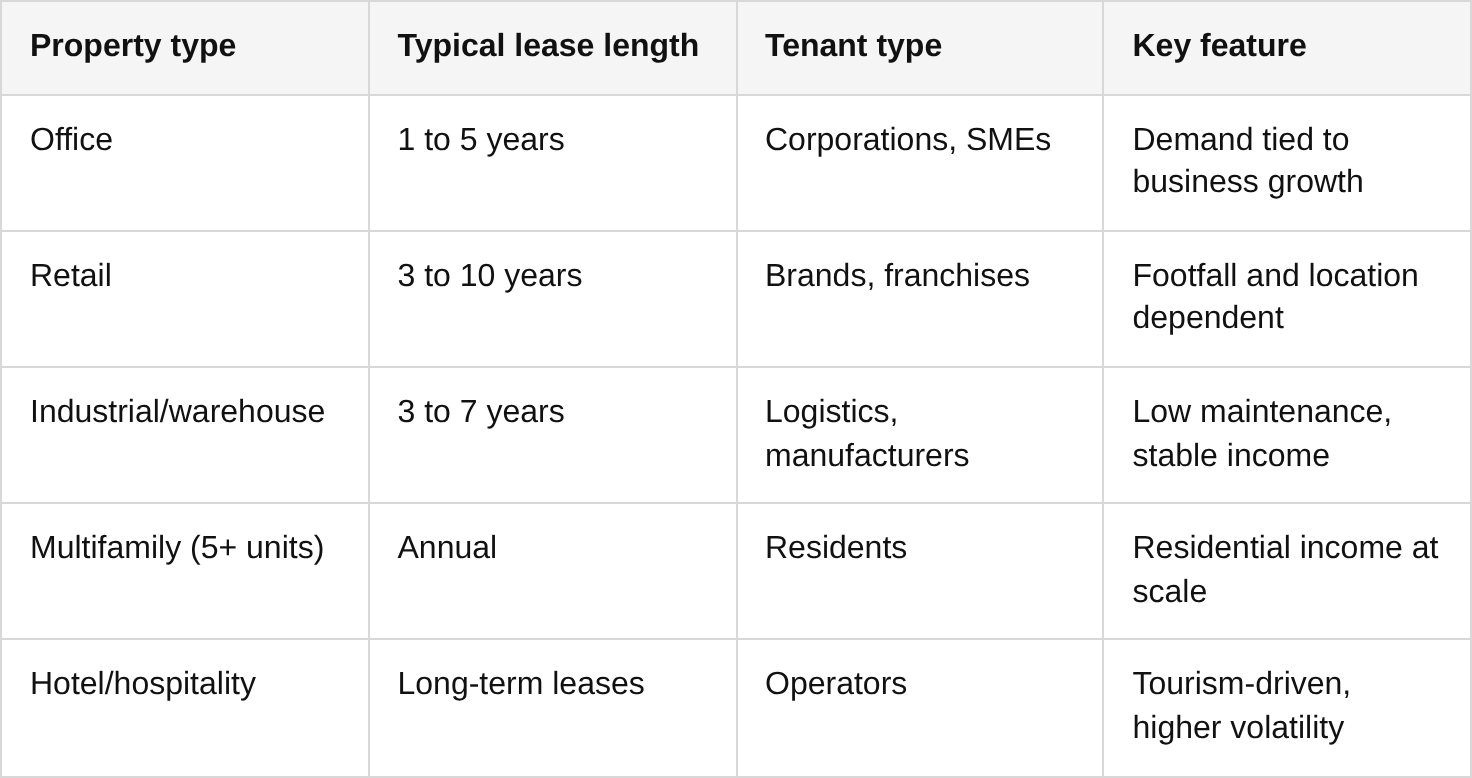
What separates commercial from residential is not just the tenant type. It’s the structure. Leases are longer, capital requirements are higher, and the income is tied to business performance rather than personal housing needs. Dubai adds another layer: as a regional business hub with a government-driven growth agenda, demand for quality commercial space is structurally supported in ways you won’t find in most markets. Applying effective investment strategies from the start gives you a meaningful edge.
Core mechanics: How commercial property investing works
There are two fundamental ways to invest in commercial property. Direct ownership means you buy the asset outright, control it, and collect the income. Indirect investing means you buy into a fund, REIT (Real Estate Investment Trust), or ETF that holds commercial assets on your behalf. Direct ownership offers higher returns and full control. Indirect options offer liquidity and lower entry costs.
For most high-net-worth investors targeting Dubai, direct ownership is the preferred route. Here’s how the process typically unfolds:
- Select your target market and submarket (Business Bay, DIFC, JLT, Dubai South)
- Define your investment thesis (yield-focused, capital appreciation, or both)
- Conduct due diligence on the asset, title, tenancy agreements, and service charges
- Secure financing or confirm equity position with your bank or private lender
- Complete the acquisition through the Dubai Land Department
- Implement property management to protect and grow your asset
The numbers matter enormously here. Three metrics drive every serious commercial property decision: Net Operating Income (NOI), Cap Rate, and DSCR (Debt Service Coverage Ratio). NOI is your annual rental income minus operating expenses. Cap rate is NOI divided by the purchase price, expressed as a percentage. DSCR measures whether your income covers your debt payments.

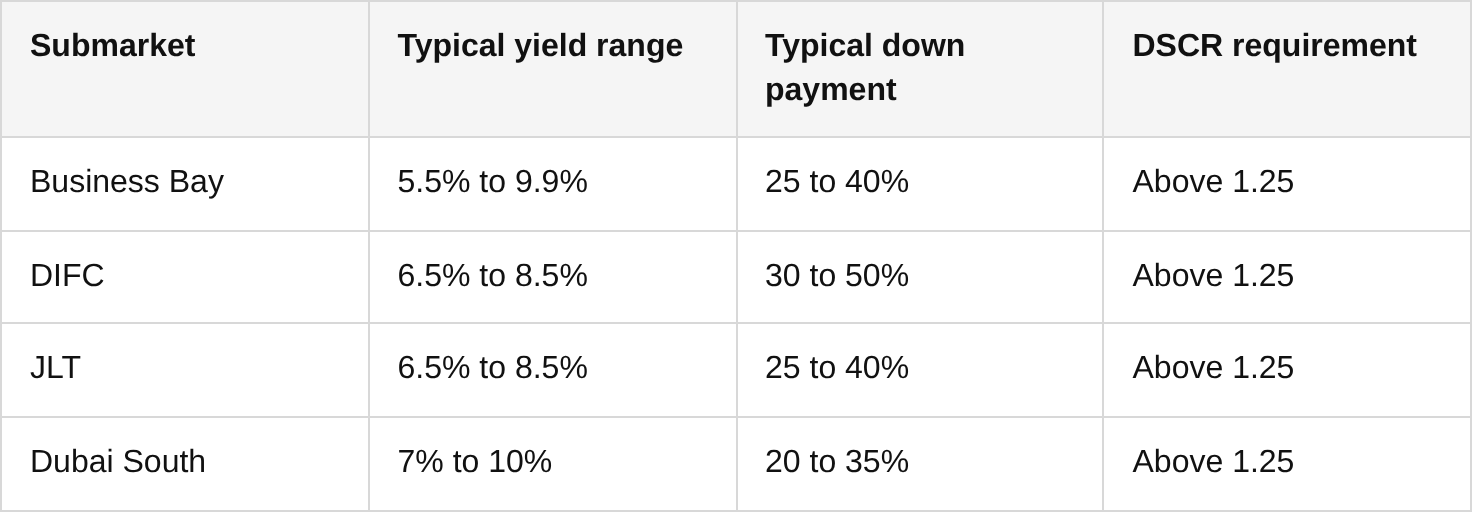
For Dubai commercial property essentials, understanding that banks require DSCR above 1.25 is critical before you approach any lender. International buyers also face additional documentation requirements, including proof of funds, source of wealth declarations, and in some cases, a UAE-registered entity.
Pro Tip: Never walk into a Dubai bank financing conversation without a pre-calculated DSCR. Lenders will stress-test your numbers, and showing up prepared signals credibility. Use conservative NOI estimates, not optimistic projections.
For investment tips that go beyond the basics, understanding how smart investment tips apply to Dubai’s unique financing environment will save you significant time and money.
Comparing commercial and residential property investment
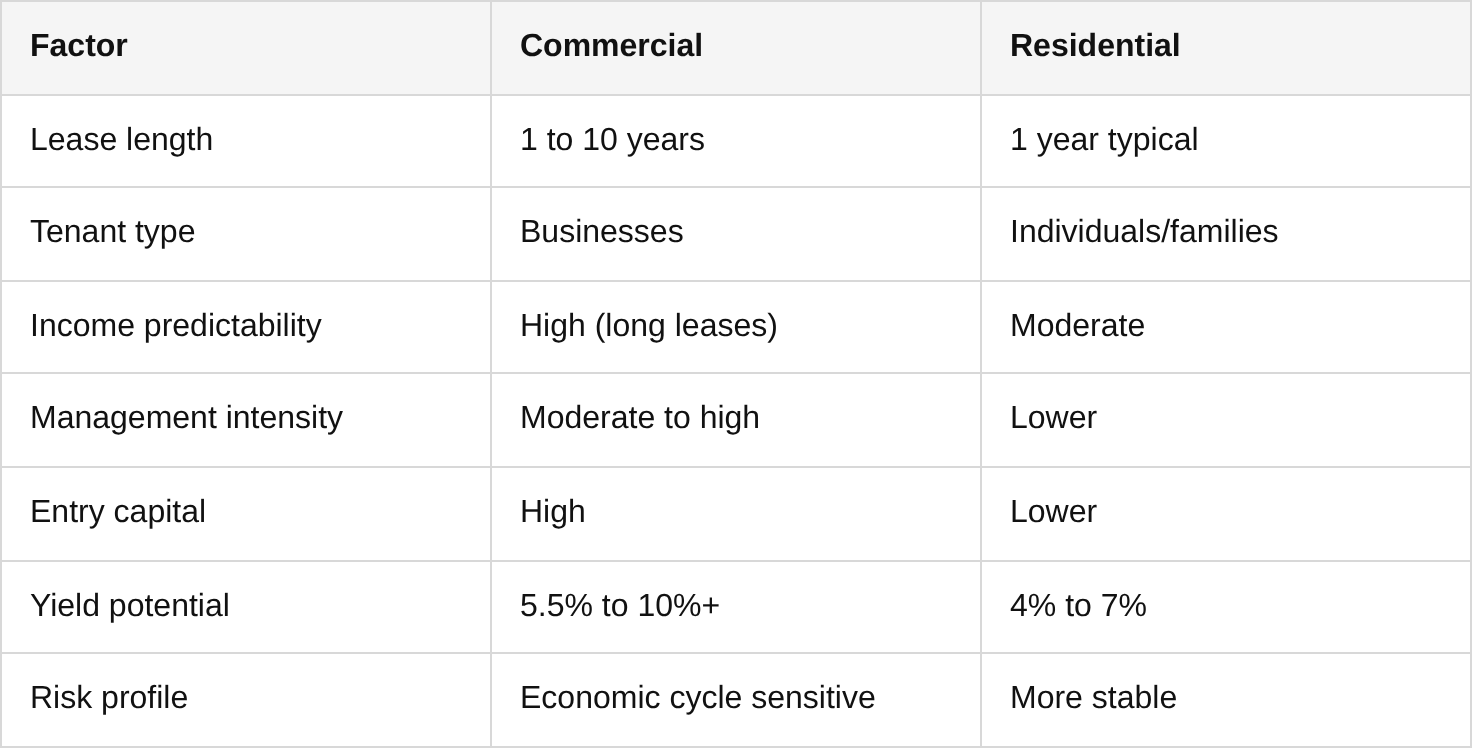
Most investors come to commercial real estate after building a residential portfolio. The shift requires a genuine mindset change. Commercial property features longer leases, higher capital requirements, greater yields, and more economic exposure. Residential offers lower entry costs, simpler management, and more stability.
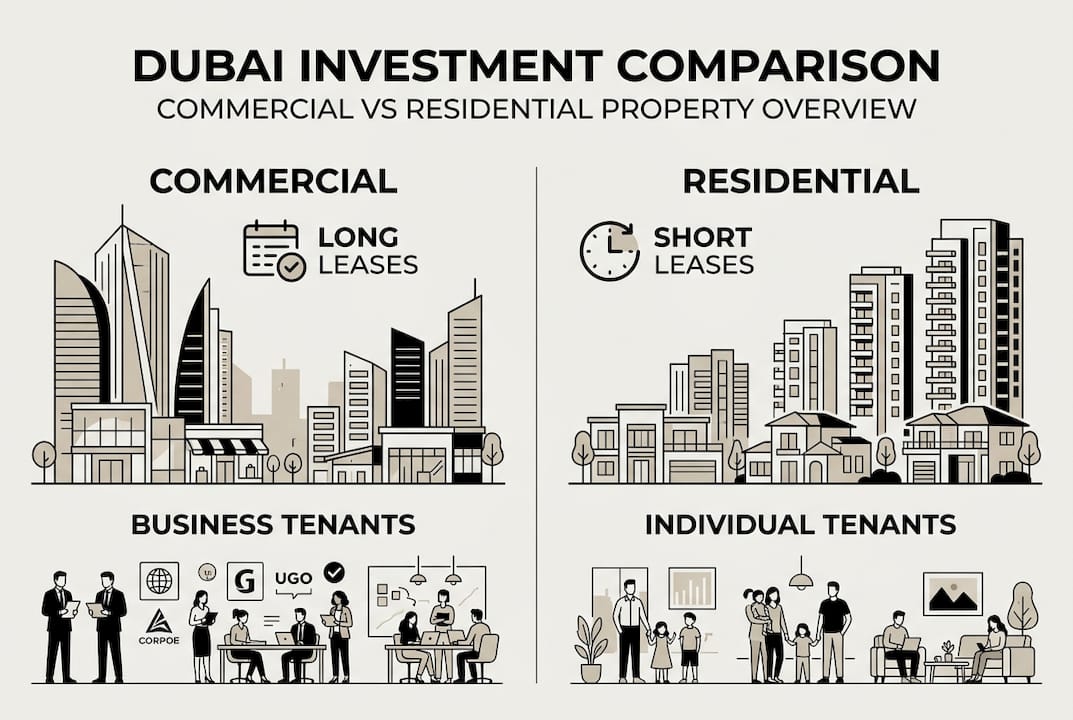
Here’s the side-by-side comparison that matters:
Advantages of commercial property in Dubai:
- Longer lease terms mean fewer vacancy gaps and more predictable cash flow
- Triple-net leases (where tenants pay operating costs) are common, reducing your expenses
- Business tenants treat the space as an operational asset, often maintaining it better
- Dubai’s zero personal income tax and zero capital gains tax amplify your net returns
Considerations to keep in mind:
- Vacancy periods between tenants can be longer and more costly
- Economic downturns hit commercial tenants harder than residential ones
- Requires deeper market knowledge and stronger local networks
For evaluating Dubai real estate correctly, the yield advantage of commercial over residential is real, but it comes with a higher knowledge premium. The investors who win in this market are those who treat due diligence as a competitive advantage, not a formality. Exploring Dubai property strategies tailored to your goals will sharpen your approach considerably.
Opportunities and challenges in Dubai’s commercial property market
Dubai’s commercial property market is not operating in a vacuum. It’s being actively shaped by government policy, global capital flows, and a supply pipeline that varies dramatically by submarket.
Why Dubai stands out for commercial investors:
- Zero corporate tax on most commercial income (outside of specific sectors)
- The D33 economic agenda targets doubling Dubai’s GDP by 2033, directly driving demand for office, retail, and industrial space
- World-class infrastructure connecting Dubai to global trade routes
- Strong international tenant demand from multinationals setting up regional headquarters
- Transparent legal framework with freehold ownership available in designated zones
According to Dubai’s commercial market data, prime submarkets like Business Bay are delivering yields between 5.5% and 9.9%, while DIFC and JLT consistently sit in the 6.5% to 8.5% range. These are not outlier numbers. They reflect structural demand.
Risks you cannot ignore:
- Emerging areas with heavy new supply can tip quickly into tenant-favorable markets
- Capital requirements are significant, and overleveraging in a rising rate environment is dangerous
- Local expertise is not optional. Navigating free zone rules, RERA regulations, and lease structures without a specialist is a costly mistake
Pro Tip: Track Dubai’s quarterly supply pipeline reports from CBRE or JLL. When new completions in a submarket spike, negotiate harder on price or shift your focus to established, supply-constrained areas like DIFC.
The Dubai real estate trends heading into 2026 show continued momentum in Grade A office space and last-mile logistics. Understanding the Dubai investment process in detail will help you move faster when the right asset appears. For a broader view of long-term investment strategies, aligning your Dubai commercial play with a multi-year horizon consistently outperforms short-term speculation. Also review the Dubai commercial leasing guide to understand how lease structures affect your returns.
How to start investing in Dubai commercial property
Knowing the theory is one thing. Executing in Dubai’s fast-moving market is another. Here’s a practical framework for getting started:
- Research your target submarket using transaction data, vacancy rates, and supply pipeline reports
- Align your investment objectives (yield, capital growth, portfolio diversification, or residency benefits)
- Set up the right legal structure (mainland company, free zone entity, or individual ownership depending on the asset)
- Arrange financing or confirm equity before approaching sellers to strengthen your negotiating position
- Engage a specialist broker with verifiable commercial transaction history in Dubai
- Conduct thorough due diligence on title deed, service charges, existing tenancy, and building condition
- Complete the transaction through the Dubai Land Department with proper legal representation
- Implement professional property management from day one to protect your yield
Dubai-specific requirements you must address:
- Ownership rules: Freehold zones allow 100% foreign ownership. Outside these zones, structures vary.
- Documentation: Passport copies, proof of funds, source of wealth, and sometimes a UAE trade license
- Due diligence: Always verify the title deed directly with the Dubai Land Department
- Partner selection: Choose advisors with RERA certification and a track record in commercial deals
- Language: All official documents are in Arabic. Certified translation is legally required for foreign buyers
Pro Tip: Work with advisors who understand DIFC, JAFZA, and free zone regulations specifically. The rules governing ownership, leasing, and dispute resolution differ significantly between free zones and mainland Dubai.
Understanding why invest in Dubai goes beyond the tax benefits. It’s the combination of legal clarity, global connectivity, and government-backed growth that makes this market genuinely different. For practical investment assistance tips, working with specialists who know the direct ownership mechanics in Dubai will compress your learning curve significantly.
Next steps: Explore Dubai commercial property opportunities
Dubai’s commercial property market rewards investors who move with knowledge and the right local support. Understanding the mechanics is the first step. Executing with precision is what separates strong returns from costly mistakes.

At anthonyjosephaj.com, we work directly with international investors and high-net-worth individuals to identify, evaluate, and acquire commercial properties across Dubai’s most active submarkets. Whether you’re exploring your first commercial asset or expanding an existing portfolio, a personalized consultation will map your objectives to the right opportunities. For a detailed, step-by-step roadmap covering every stage from market selection to acquisition, explore the full Dubai investment process guide and take your next move with confidence.
Frequently asked questions
What types of commercial properties can I invest in Dubai?
You can invest in offices, retail, industrial, hotels, or multifamily buildings, each serving business tenants and offering different risk-return profiles depending on location and lease structure.
How much capital is required to invest in Dubai commercial property?
Most investors need a 20 to 50% down payment depending on the submarket and asset type, with lenders requiring a DSCR above 1.25 to approve financing.
What is the D33 agenda and how does it impact commercial property?
The D33 agenda is Dubai’s economic roadmap targeting GDP doubling by 2033, which directly drives demand for office, retail, and industrial space across the emirate.
Are there indirect ways to invest in Dubai commercial real estate?
Yes, REITs and ETFs offer exposure to Dubai commercial assets without direct ownership, providing more liquidity and lower entry thresholds for global investors.


