
How Arbitration Resolves Real Estate Disputes in Dubai
TL;DR:
- Most high-value Dubai real estate disputes are now settled through confidential, expert-led arbitration rather than court litigation, offering faster and more predictable outcomes. The process is contract-driven, with key decisions about arbitration seat, rules, and enforcement strategy significantly affecting results. Strategic contract review and expert guidance are vital for investors to effectively navigate Dubai’s arbitration landscape and enforce favorable awards.
Most investors believe that taking a dispute to court is the only serious path when a Dubai real estate deal goes wrong. In reality, the majority of high-value property cases are now settled through confidential, expert-led arbitration, frequently delivering faster outcomes and more predictable results than traditional litigation. Whether you are navigating an off-plan cancellation, a payment default, or a contractual disagreement with a developer, understanding arbitration is not optional knowledge for serious investors. This guide walks you through the process, the rules, the strategic choices, and the enforcement realities you need to know.
Table of Contents
- Arbitration’s rising importance in Dubai real estate
- How the arbitration process actually works
- Key choices: Arbitration rules, seat, and legal upgrades
- Enforcing arbitration awards: What investors need to know
- A seasoned investor’s take: Arbitration beyond the fine print
- Connect with experts for strategic arbitration guidance
- Frequently asked questions
Key Takeaways
Arbitration’s rising importance in Dubai real estate
With the stage set, let’s ground this with hard numbers and real investor experience in Dubai’s arbitration landscape.
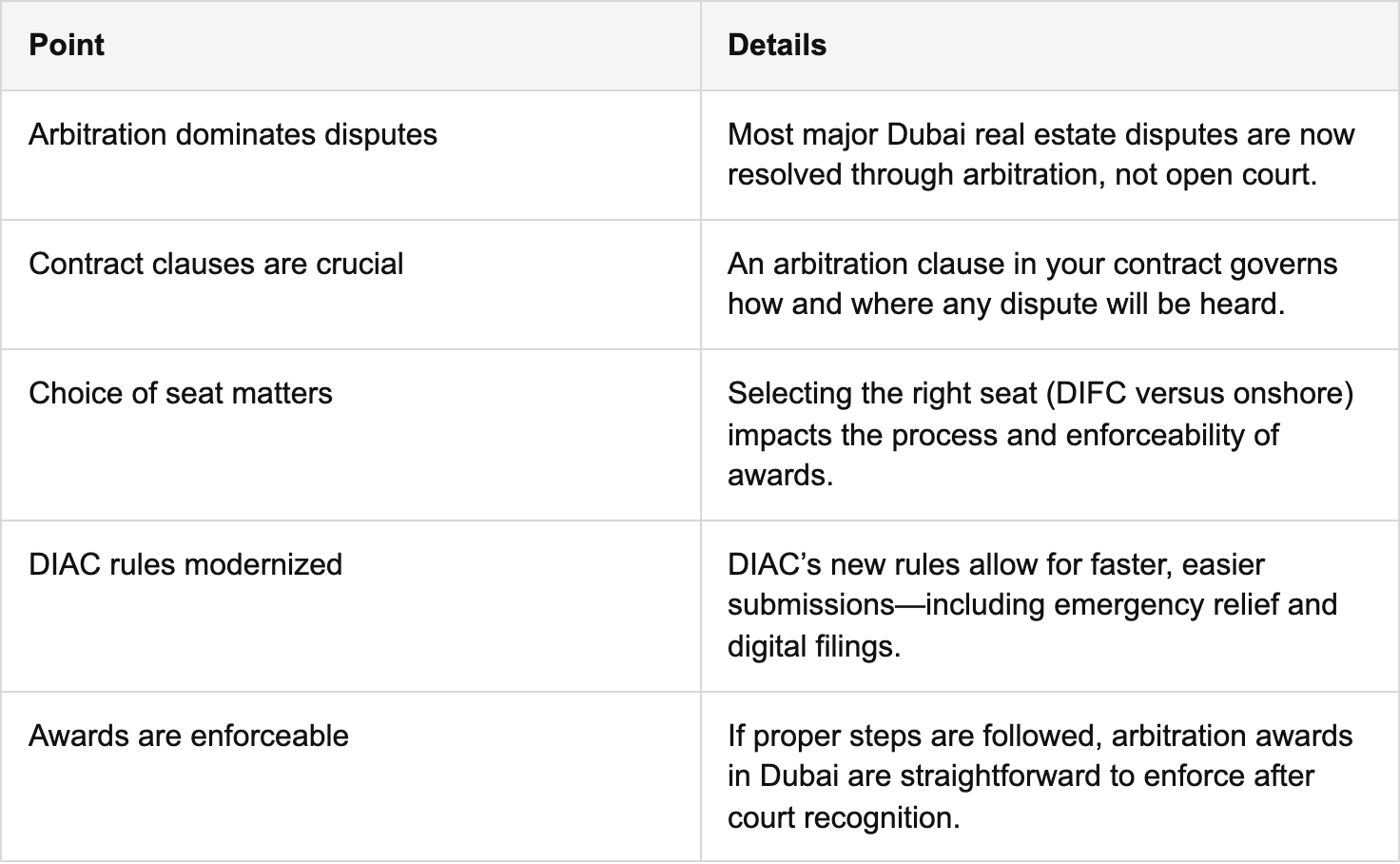
Dubai’s real estate sector generates a significant volume of contract disputes every year, and the institutional framework for resolving them has matured considerably over the past decade. The Dubai International Arbitration Centre (DIAC) sits at the center of this framework. Arbitration plays a central role in resolving real estate and construction disputes in Dubai, with DIAC’s caseload largely driven by these two sectors. This is not a marginal trend. It reflects a deliberate structural shift in how sophisticated parties protect and enforce their contractual rights.
The types of disputes most commonly channeled through DIAC include:
- Off-plan purchase agreement breaches, including delayed handovers and abandoned projects
- Developer-initiated cancellations and refund disputes
- Construction defects and quality claims on completed or near-complete units
- Payment defaults by buyers or developers
- Joint venture and co-investment disagreements on development projects
Institutional DIAC arbitration is commonly used for investor-relevant real estate issues such as off-plan disputes and project cancellations. Understanding Dubai rental laws provides additional context for the regulatory environment surrounding these disputes.
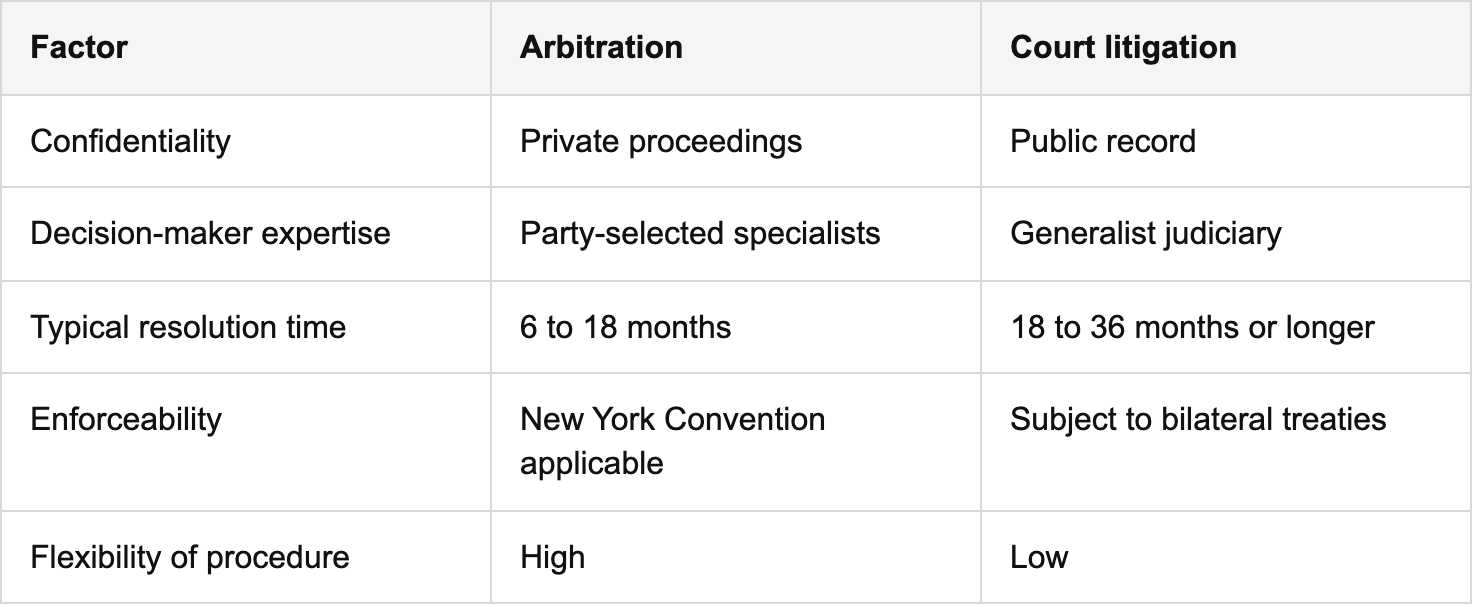
Investors increasingly favor arbitration for three concrete reasons. First, proceedings are private, which means sensitive financial information and reputational details stay out of public court records. Second, parties can select arbitrators with specialized expertise in real estate and construction, rather than relying on a generalist judge. Third, when contracts and procedures are properly structured, arbitration tends to move faster than court litigation. These advantages make arbitration a practical tool rather than a fallback option.
“The growing caseload at DIAC signals that Dubai’s real estate market has embedded arbitration as a standard risk management tool, not just an alternative to be considered after a dispute arises.”
For investors evaluating dispute resolution options across international markets, Dubai’s institutional maturity in this area is a genuine competitive advantage.
How the arbitration process actually works
Understanding arbitration’s scale raises the next question: how does the process unfold for the average investor with a contractual dispute?
The starting point is almost always your contract. Arbitration is typically contract-driven in Dubai; if the sale and purchase agreement (SPA) or any related contract includes an arbitration clause, disputes must go to arbitration rather than court. This means the agreement you sign at purchase defines your dispute resolution path from day one.
Here is how a standard arbitration proceeding unfolds:
-
Notice of dispute: One party issues a formal notice to the other, identifying the nature of the claim and referencing the arbitration clause. This triggers the process and starts key procedural timelines.
-
Filing with DIAC: The claimant files a request for arbitration with DIAC, including the contract, the arbitration clause, a summary of the claim, and the requested relief. DIAC reviews the filing for administrative completeness.
-
Tribunal formation: Depending on the contract and the amount in dispute, either a sole arbitrator or a three-member panel is appointed. Parties may nominate arbitrators, subject to DIAC’s confirmation process. This stage typically takes four to eight weeks.
-
Preliminary proceedings: The tribunal issues a procedural timetable covering document submissions, witness statements, expert reports, and hearing dates. Both parties exchange written arguments and supporting evidence.
-
Hearing: The tribunal conducts a formal hearing where legal representatives present arguments, witnesses are examined, and expert evidence is tested. DIAC facilities in Dubai can accommodate complex, multi-day hearings.
-
Final award: The tribunal deliberates and issues a written award, setting out its findings and the relief granted. This is legally binding on both parties.
-
Enforcement: The award is submitted to the UAE courts for ratification, after which it can be executed against assets in the UAE or, where applicable, in other jurisdictions through international treaty frameworks.
Understanding your investor rights under UAE law is essential at every stage of this process. Skilled real estate negotiation at the contract stage can also influence how favorable your arbitration clause terms are before a dispute ever arises.
Pro Tip: Arbitration tribunals, once formally constituted, generally cannot grant urgent interim relief such as asset freezes or injunctions. If you need emergency measures while the tribunal is being formed, you may need to apply to the UAE courts directly. Plan for this possibility when structuring your dispute strategy.

Key choices: Arbitration rules, seat, and legal upgrades
After grasping the process, it’s crucial to realize that not all arbitration is created equal. Key contract decisions can profoundly affect the outcome.
DIAC administration and rules are the central practical mechanism for most Dubai real estate arbitrations. DIAC updated its rules in 2022, introducing electronic filings, modernized timelines, and an expedited procedure for lower-value claims. These upgrades make the institutional process considerably more efficient than it was even five years ago.
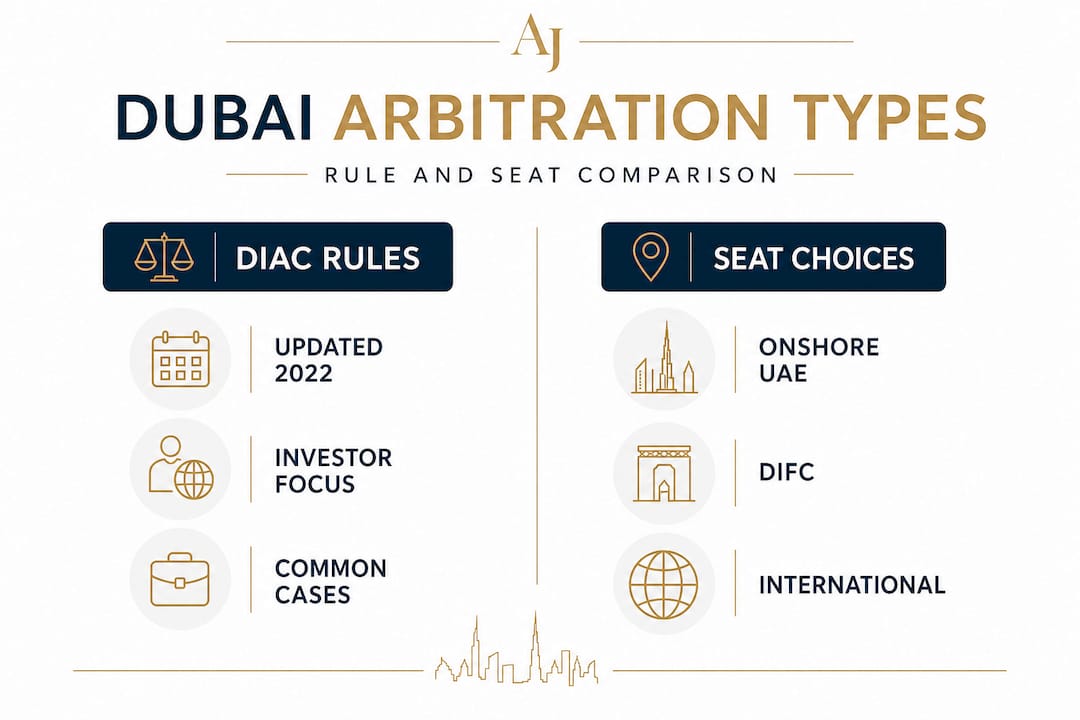
One of the most consequential and often overlooked decisions in your contract is the choice of “seat” of arbitration. The seat determines which legal system governs the arbitration procedure itself, which courts have supervisory jurisdiction, and which courts handle enforcement or challenges to awards. In the UAE, you have three primary options:
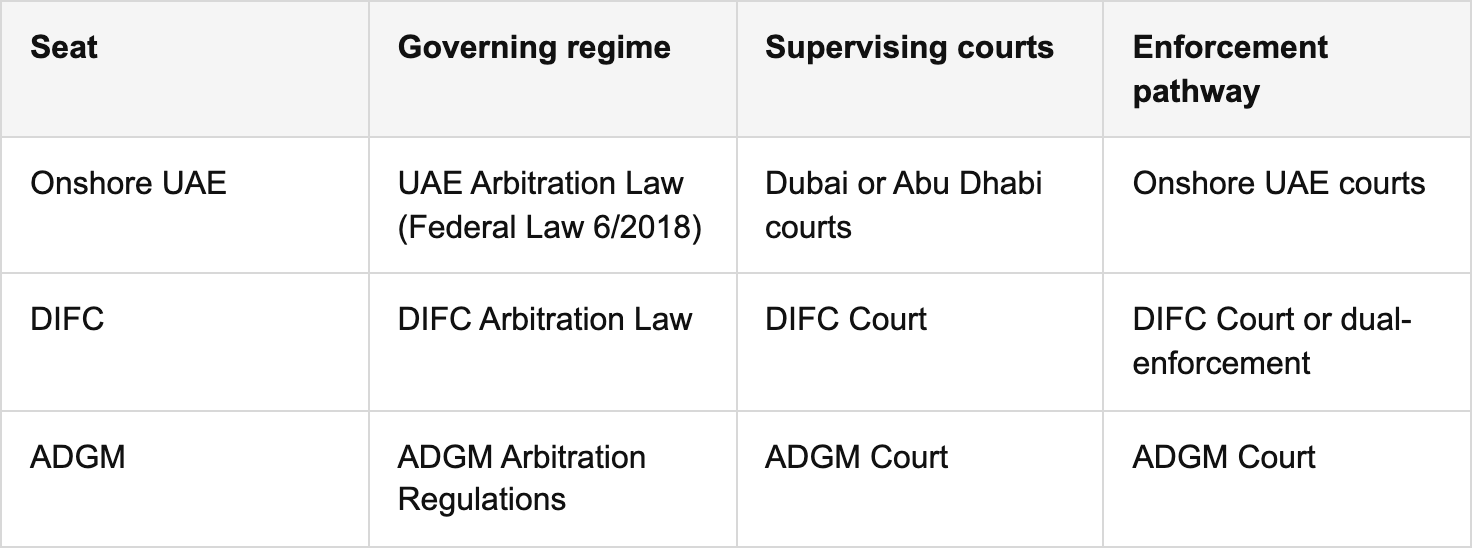
Seat choice materially affects which arbitration regime and courts supervise the process, creating important considerations around enforcement and setting-aside strategy. DIFC-seated arbitrations, for example, benefit from a Common Law court system that many international investors find more familiar and predictable.
A critical development that every investor with older contracts must address is Decree 34/2021. This decree abolished the DIFC-LCIA Arbitration Centre and transferred all pending and future matters to DIAC. If your existing contract names DIFC-LCIA as the arbitration institution, those cases are now administered by DIAC. The clause remains technically valid, but operational and procedural gaps can arise if it has not been updated. Reviewing contract language after any major regulatory change is not just good practice. It is a necessary part of protecting your investment.
Working with the Dubai real estate regulator requirements in mind is also important when structuring contracts, since RERA-registered agreements must comply with broader regulatory standards. For comparative lease negotiation insights from other international markets, understanding seat and institutional choice remains a theme across jurisdictions.
Pro Tip: Every time you enter or renew a real estate contract in Dubai, treat the arbitration clause as a living document. Review it against the current institutional landscape, check that the named institution still operates as expected, and confirm the seat aligns with your enforcement preferences.
Enforcing arbitration awards: What investors need to know
Of course, a win in arbitration only matters if you can enforce the decision. Here’s how enforcement works and what to watch out for.
Arbitration awards in the UAE can be challenged in limited ways, but the overall framework is designed for enforceability after court ratification and recognition steps. This means that once you have an award in your favor, the system generally supports you in turning that award into tangible recovery.
Here is what the enforcement and challenge process looks like in practice:
- Ratification filing: Submit the arbitration award, tribunal’s appointment documents, and the underlying contract with arbitration clause to the competent UAE court. The Dubai courts or DIFC courts handle this depending on the seat.
- Court review: The court does not re-examine the merits of the dispute. It checks only procedural compliance, including whether the arbitration clause was valid, whether proper notice was given, and whether the award violates public policy.
- Ratification order: Once ratified, the award has the same standing as a court judgment and can be enforced against the respondent’s assets within the UAE.
- International enforcement: The UAE is a signatory to the New York Convention on the Recognition and Enforcement of Foreign Arbitral Awards, making UAE-seated arbitration awards enforceable in over 170 countries.
- Grounds for challenge: Awards can be set aside only on narrow grounds, including lack of a valid arbitration agreement, tribunal composition irregularities, procedural fairness failures, or violations of UAE public policy. Commercial disagreements with the outcome are not valid grounds.
- Timing: Challenge applications must typically be filed within defined limitation periods after the award is issued. Missing these deadlines can foreclose your challenge options entirely.
“The enforceability of arbitration awards is one of the most investor-friendly features of Dubai’s arbitration framework. When the process is followed correctly, award enforcement is generally reliable and efficient.”
Understanding how to protect your arbitration enforcement rights from the contract stage forward is one of the highest-value actions you can take as an investor in this market.
A seasoned investor’s take: Arbitration beyond the fine print
Having mapped out the process and complications, let’s step back for a candid look at what truly works in the Dubai investor’s real-world playbook.
Most guides on arbitration focus on procedure, and procedure matters. But what separates investors who navigate disputes successfully from those who find themselves in prolonged, expensive deadlocks is not procedural knowledge alone. It is strategic preparation before any dispute arises.
Confidentiality is frequently cited as a benefit of arbitration, and it genuinely is. But its practical value goes deeper than privacy. When a dispute stays out of public court records, it does not contaminate your broader portfolio reputation or create a public signal that undermines ongoing negotiations with other developers, lenders, or co-investors. For high-net-worth investors with multiple active positions in the Dubai market, this matters enormously.
Subject-matter expertise in the tribunal is similarly underappreciated. Arbitrators with deep knowledge of off-plan contract structures, construction defect standards, and developer financial obligations make decisions that reflect commercial reality. Investors must still plan for interim relief needs such as asset preservation measures while the tribunal is being formed, and this is where many investors are caught unprepared. Having a legal advisor who can move quickly to the courts for emergency relief, in parallel with initiating arbitration, can be the difference between recovering assets and watching them disappear.
The real cost equation is also worth examining honestly. Arbitration involves institutional filing fees, arbitrator fees, and legal costs that can be substantial in complex cases. However, compare this against the direct and indirect costs of prolonged court litigation, including management time, delayed capital recovery, and the opportunity cost of locked-up funds. In most scenarios involving disputes over AED 5 million or more, arbitration delivers better value on a total cost basis, not just on speed.
One persistent weakness we see with investors who struggle in arbitration is stale contract language. The common investor pitfalls often trace back to contracts signed years ago with institutions that no longer exist or seats that no longer reflect the investor’s enforcement needs. Building a check-in on your arbitration clauses whenever UAE arbitration law or DIAC rules update is not extra work. It is routine risk management for a serious portfolio.
Pro Tip: Engage your legal advisor before a dispute arises to conduct a one-time audit of all active contracts for arbitration clause validity, institutional alignment, and seat suitability. The cost of this audit is a small fraction of what misaligned clauses can cost in a real dispute.
Connect with experts for strategic arbitration guidance
For readers wanting to implement these insights, a trusted expert can turn complex procedures into real investor advantages.
At anthonyjosephaj.com, we work with real estate investors and high-net-worth individuals who need more than general market knowledge. They need strategic guidance on contracts, dispute preparedness, and the specific decisions that protect their portfolios in Dubai’s evolving legal environment. Whether you are reviewing an existing SPA for arbitration clause alignment, evaluating seat options for a new acquisition, or seeking a second opinion before a dispute escalates, our team brings the market depth and regulatory awareness you need.

Reach out directly through our platform for a tailored consultation. The right guidance at the contract stage costs far less than resolving a poorly structured dispute later.
Frequently asked questions
Is arbitration mandatory for real estate disputes in Dubai?
Arbitration is typically contract-driven in Dubai, meaning it is only mandatory if your real estate contract specifically includes a binding arbitration clause. Without such a clause, parties can pursue court litigation.
What happens if my Dubai real estate contract names DIFC-LCIA as arbitrator?
Decree 34/2021 abolished DIFC-LCIA and transferred all matters to DIAC; your clause remains technically valid but is now administered by DIAC, making it important to update the language to avoid procedural gaps.
How long does it take to resolve a real estate dispute via arbitration in Dubai?
Most cases are resolved within 6 to 18 months, though highly complex cases involving multiple parties or large evidentiary records can extend beyond that range.
Can an arbitration award in Dubai be challenged?
Awards can only be challenged on narrow procedural or public policy grounds; disagreeing with the commercial outcome of an award is not a valid basis for setting it aside.
Why do investors prefer arbitration over Dubai courts for real estate disputes?
DIAC institutional arbitration is preferred for its privacy, specialized decision-makers, and procedural efficiency compared to public court proceedings, particularly for off-plan and high-value developer disputes.


