
Dual Agency in Dubai Real Estate: An Investor's Guide
TL;DR:
- Most investors in Dubai’s property market mistakenly believe their agent works solely for them, which can be costly. Dual agency, where one broker represents both buyer and seller, is more common than many realize and can pose significant risks to fair representation. Understanding how dual agency operates, its legal requirements, and when it benefits or harms your interests is essential for making informed investment decisions.
Most investors entering Dubai’s property market assume their agent is working entirely for them. That assumption can cost you significantly. Dual agency, where one agent or brokerage represents both the buyer and the seller in the same transaction, is more common in Dubai than many investors realize. Understanding how it works, when it benefits you, and when it puts your interests at risk is not optional knowledge. It is foundational to making sound investment decisions in one of the world’s most competitive and fast-moving real estate markets.
Table of Contents
- What is dual agency in real estate?
- How dual agency works in Dubai’s property market
- Legalities and risks of dual agency in Dubai
- When dual agency makes sense, and when to avoid it
- A fresh perspective: The real impact of dual agency for Dubai investors
- Take your next steps with expert Dubai property guidance
- Frequently asked questions
Key Takeaways
What is dual agency in real estate?
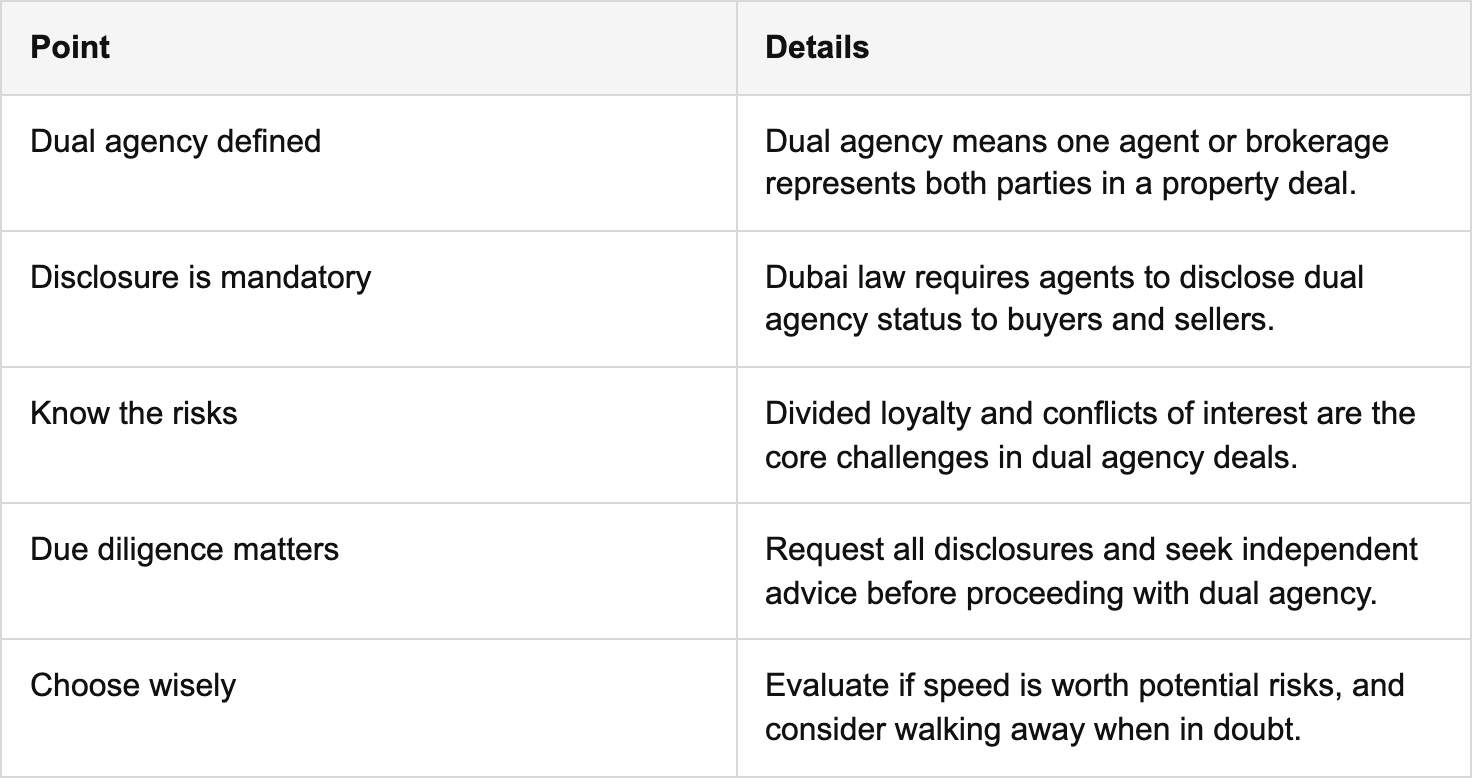
To make smart decisions in Dubai’s market, you first need a precise definition. Dual agency involves a single agent or brokerage representing both the buyer and the seller in the same real estate transaction. Rather than each party having their own dedicated advocate, one agent sits in the middle, managing the interests of both sides simultaneously.
This is fundamentally different from single agency, where each party has their own independent broker working exclusively on their behalf. It also differs from designated agency, where a brokerage assigns separate agents internally to each party, even if they work for the same firm.
How the three agency models compare
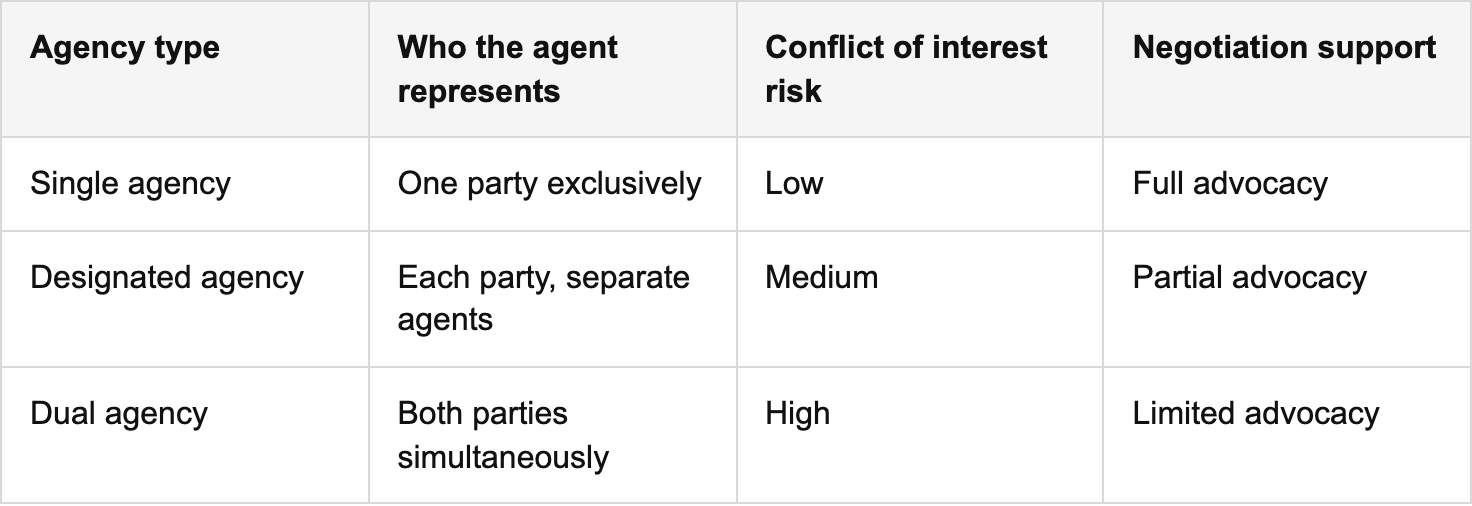
The comparison is important because Dubai’s property market moves fast. Off-plan launches sell out within hours, and secondary market deals can close within days. In that environment, some buyers and sellers are drawn to dual agency for speed and simplicity. But speed should never override your right to proper representation.

Here is why dual agency demands more attention in Dubai specifically. The market attracts international investors who may not be familiar with local agency norms. Some investors from the UK, US, or Europe assume the same disclosure protections exist in Dubai that exist back home. That assumption can create real vulnerability, particularly in high-value transactions.
Understanding the real estate brokerage basics before you enter any deal will help you ask the right questions from day one.
Key distinctions to understand:
- Single agency: Your agent’s full loyalty belongs to you.
- Designated agency: Your brokerage has you covered, but another agent within the same firm handles the other side.
- Dual agency: One agent juggles both sides, creating a structural conflict of interest.
Pro Tip: Watch closely for undisclosed dual agency. This occurs when an agent represents both parties without clearly telling either one. It is one of the most common and costly mistakes investors make. Always ask, in writing, before any negotiation begins.
How dual agency works in Dubai’s property market
Having established what dual agency is, let’s walk through how it actually unfolds during real-world transactions in Dubai.
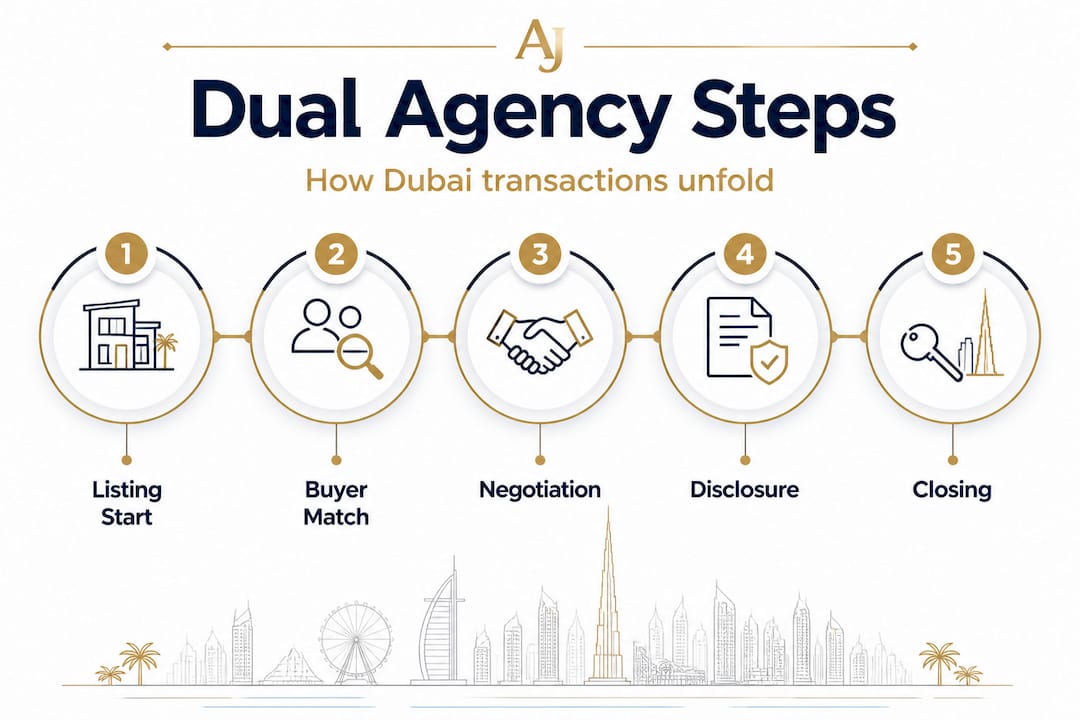
The Dubai sales workflow involves several critical stages where the dual agency dynamic becomes most significant. Knowing these stages helps you spot potential conflicts before they affect the outcome of your deal.
Step-by-step: How a dual agency deal typically unfolds
- Initial listing: A seller lists a property with a broker. The same broker also maintains a database of active buyers. When an internal buyer matches the listing, a dual agency situation begins.
- Buyer introduction: The agent introduces the buyer to the property, often without explicitly clarifying that they also represent the seller.
- Offer facilitation: The agent relays the buyer’s offer to the seller and handles negotiations. At this stage, the conflict of interest is sharpest, since the agent cannot fully advocate for a lower price on the buyer’s behalf while also protecting the seller’s pricing expectations.
- Disclosure requirement: Ethically and legally, the agent should disclose the dual agency arrangement before this point. In practice, this does not always happen proactively.
- Memorandum of Understanding (MOU): Both parties sign the MOU, locking in the deal terms. A dual agency situation that goes undisclosed until this stage leaves the buyer with little room to renegotiate.
- Transfer and registration: The deal moves toward transfer at the Dubai Land Department, where title deeds change hands.
Risk and opportunity at each stage
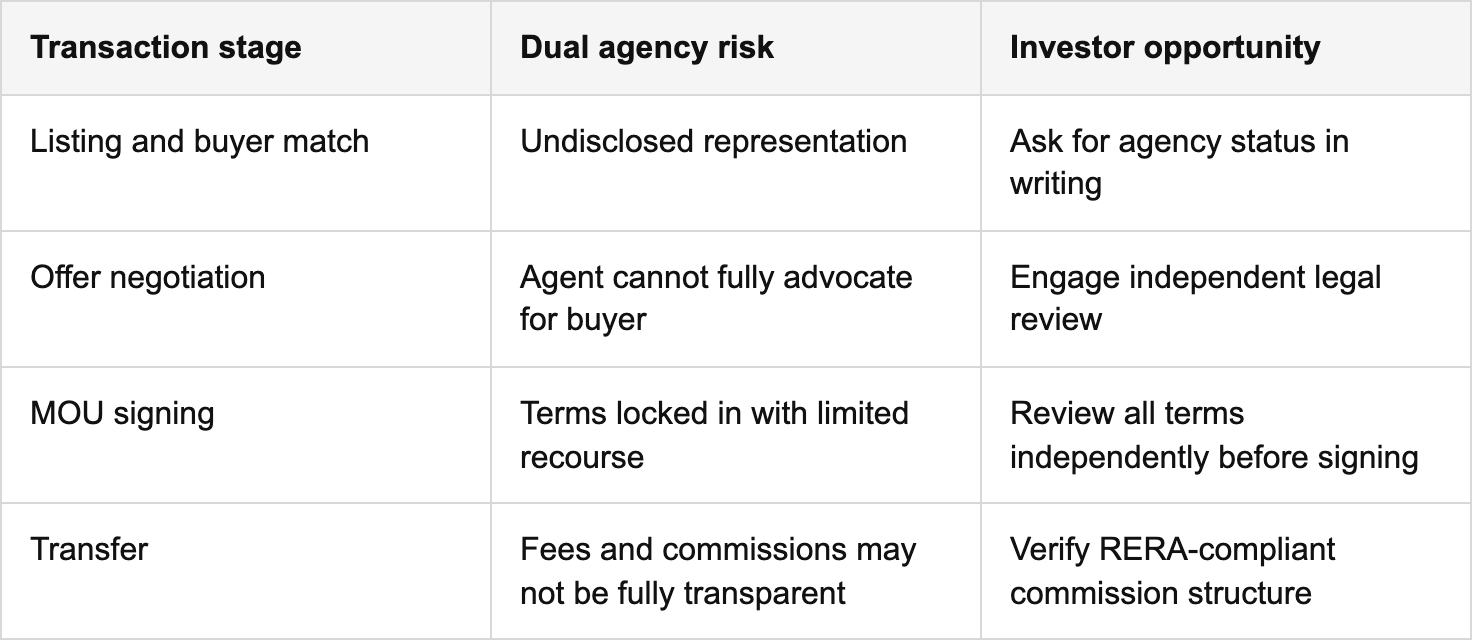
Pro Tip: Always request written confirmation of the agent’s agency status before any negotiations begin. A simple written question, “Are you representing the seller as well?” puts the agent on notice that you are a knowledgeable buyer. It also creates a paper trail if any dispute arises later.
The disclosure environment in Dubai is improving. Regulatory bodies have been tightening expectations around transparency. However, enforcement is not uniform across every transaction, and sophisticated investors are the ones who consistently protect themselves by demanding clarity.
Legalities and risks of dual agency in Dubai
Understanding the mechanics brings you to the next critical question: what does the law say, and what risks do you actually face?
Dual agency is subject to strict disclosure rules under Dubai’s real estate regulatory framework. The Real Estate Regulatory Agency (RERA), which operates under the Dubai Land Department, sets standards for how agents must conduct themselves and what they must disclose. Agents in Dubai must be RERA-certified, and their conduct is governed by a code of ethics that explicitly addresses conflicts of interest.
Key regulatory point: Under Dubai’s real estate regulations, agents are required to disclose any dual agency arrangement before a transaction proceeds. Failure to disclose constitutes a breach of professional obligations and can expose the agent to regulatory action. As a buyer or seller, you have the right to request this disclosure at any stage.
Despite these rules, due diligence is vital for identifying potential conflicts in dual agency contexts. Regulations provide a framework, but they do not eliminate risk entirely. You need to act as your own first line of defense.
Core risks investors face in dual agency transactions
- Conflict of interest: An agent cannot simultaneously negotiate the highest price for the seller and the lowest price for the buyer. One side will inevitably receive less vigorous representation.
- Reduced negotiation power: When the agent represents both sides, your leverage in negotiation is limited. The agent may push for a fast close rather than the best possible terms for you.
- Split loyalty: Even a well-intentioned agent faces impossible choices in a dual agency scenario. Their loyalty is diluted by design, not by malice.
- Information asymmetry: The agent may possess information about the seller’s motivation, financial situation, or timeline that would benefit you in negotiation but cannot ethically share it.
- Commission incentives: The dual agent typically earns both sides of the commission, creating a financial incentive to close the deal at almost any terms, rather than to secure the best outcome for you.
How to protect yourself
- Demand written disclosure before any negotiation begins.
- Engage an independent solicitor or secondary agent to review contract terms.
- Check the agent’s RERA license number and verify their registration status on the Dubai Land Department portal.
- Review the Dubai investor protections framework to understand your rights before signing anything.
- Conduct independent property valuation to verify you are paying a fair market price.
One frequently overlooked protection tool is independent Dubai real estate due diligence. This process helps you verify title status, check for encumbrances, confirm developer credentials for off-plan purchases, and assess market pricing independently of any agent’s guidance.
When dual agency makes sense, and when to avoid it
Now that you know how to spot the risks, let’s explore the specific situations where dual agency can benefit or harm Dubai investors.
The truth is that dual agency is not always a deal-breaker. There are scenarios where it genuinely works to your advantage, particularly in a market as competitive as Dubai. Some investors choose dual agency for speed and simplicity, but must monitor closely for fair representation throughout the process.
Situations where dual agency can work in your favor
- Off-plan developments with in-house agents: Many Dubai developers use in-house sales agents who technically represent the developer. In this case, dual agency is the default, and the pricing is typically fixed, so the conflict of interest is reduced.
- Time-sensitive deals: If you are competing for a high-demand property and speed is essential, a dual agent with direct access to the seller can compress the timeline meaningfully.
- Transparent disclosure and agreeable terms: If the agent proactively discloses the dual agency, the deal terms are clearly documented, and you have independently verified the property’s market value, the arrangement may be acceptable.
- Straightforward transactions: For lower-complexity deals, such as a resale unit in an established community with clear title, a dual agency arrangement may not expose you to significant risk.
Situations where you should walk away or seek independent representation
- The agent does not disclose dual agency proactively or resists putting it in writing.
- The transaction involves a high-value luxury property or off-plan investment where negotiation terms carry significant financial weight.
- You are a first-time investor in Dubai with limited local market knowledge.
- The agent is pushing urgency without clear justification, a common tactic used to prevent buyers from seeking independent advice.
- There is any ambiguity about commission structure or who is paying the agent.
Investor checklist for evaluating a dual agency proposal
- Has the agent disclosed dual agency in writing before negotiations began?
- Is the asking price consistent with independent market comparables?
- Has an independent solicitor reviewed the MOU or sale and purchase agreement?
- Is the agent’s RERA license active and verifiable?
- Do you fully understand all fees, commissions, and transfer costs?
- Are you comfortable proceeding without a dedicated advocate on your side?
Understanding the agent’s role for investors is the foundation of evaluating whether any agency arrangement serves your interests. Agents who are transparent about their role from the start are almost always the ones worth trusting.
A fresh perspective: The real impact of dual agency for Dubai investors
Here is what years of working in Dubai’s market consistently reveals: investors who lose out in dual agency transactions almost never do so because the agent was dishonest. They lose because they assumed the agent’s professionalism would naturally protect their interests. That assumption is the vulnerability.
Dual agency does not require malice to harm you. A competent, well-meaning agent who represents both sides is still structurally prevented from giving you full advocacy. They cannot reveal the seller’s price floor. They cannot advise you to walk away if the seller’s terms are unfair. They cannot strategically delay your offer to test the seller’s resolve. These are the tools of genuine buyer representation, and they disappear the moment dual agency begins.
The conventional wisdom says to simply demand disclosure and move forward with caution. That is sound advice, but it misses a deeper point. Disclosure tells you the situation exists. It does not resolve it. What experienced investors do is treat disclosure as the starting point of a more rigorous evaluation, not as a green light.
One habit that consistently protects investors is reviewing advanced sales strategies specific to Dubai before entering high-value deals. Understanding how seasoned agents structure negotiations, manage timing, and use information asymmetry puts you in a stronger position regardless of agency structure.
The most underrated move in any dual agency scenario? Being willing to walk away. The moment an agent knows you are prepared to end the transaction rather than accept unfavorable terms, the entire dynamic shifts. Sellers become more flexible. Agents who prioritize closing over fair outcomes quickly reveal themselves. Your willingness to disengage is, in many cases, the single most powerful negotiation tool available to you.
Take your next steps with expert Dubai property guidance
Navigating dual agency requires more than awareness. It requires the right advisor in your corner before a deal reaches the table.

Whether you are evaluating your first Dubai acquisition or adding to an existing portfolio, having expert Dubai property guidance from a broker who operates with full transparency makes the difference between a good deal and a great one. At anthonyjosephaj.com, you gain access to personalized advice, market intelligence, and representation that is always clearly structured around your interests. From off-plan opportunities to secondary market transactions, the goal is always to protect your position and maximize your returns. Reach out today to schedule a consultation and approach your next Dubai investment with the clarity and confidence you deserve.
Frequently asked questions
Is dual agency legal in Dubai real estate?
Dual agency is fully legal in Dubai but requires complete disclosure and compliance with RERA regulations. Agents who fail to disclose a dual agency arrangement breach their professional obligations and may face regulatory consequences.
How can investors protect themselves in a dual agency deal?
Demand written disclosure before negotiations start and consider engaging an independent solicitor to review contract terms. Thorough due diligence in Dubai is your most reliable tool for identifying conflicts before they affect your deal.
What’s the main risk of dual agency for buyers and sellers?
The primary risk is divided loyalty, which directly limits your negotiation power and the quality of advice you receive. Because fair representation is structurally compromised, the deal terms may not reflect your best interests.
What documents should I request in a dual agency transaction?
Request a formal written disclosure confirming the agent’s dual role, along with clear documentation of the commission structure and the agent’s responsibilities to both parties. The Dubai sales workflow involves specific stages where these disclosures are legally required and should be provided before the MOU is signed.
Recommended
- Role of Real Estate Agent – Impact on Dubai Investors
- Complete Guide To Dubai Property Investment
- How to invest in Dubai: a strategic guide for global investors
- Dubai Real Estate Investment: Complete Guide
- Tokenizing Real Estate: A Framework for Institutional Investors | CR Equity AI
- Real estate underwriting: steps, strategies, and insights


