

Secure Your Dubai Entrepreneur Visa: A Step-by-Step Guide
TL;DR:
- The Dubai entrepreneur visa is part of the UAE Golden Visa system offering up to 10 years of renewable residence.
- Applicants must qualify through one of three tracks: SME ownership, incubator approval, or prior project sale, with specific document requirements.
- Thorough preparation and accurate documentation are crucial; strategic compliance enhances chances of approval.
The Dubai entrepreneur visa sits at the intersection of ambition and legal precision. Thousands of international business founders and investors pursue it every year, drawn by the UAE’s zero income tax environment, world-class infrastructure, and its reputation as a global business hub. Yet many applicants arrive unprepared, submitting incomplete documentation or misunderstanding the official eligibility pathways. This guide cuts through that confusion and gives you a clear, compliance-focused roadmap for securing your Dubai entrepreneur visa, so you can focus on building your business rather than navigating bureaucratic dead ends.

Table of Contents
- Understanding the Dubai entrepreneur visa
- Key requirements and documents for Dubai entrepreneur visa
- Step-by-step process: How to secure your Dubai entrepreneur visa
- Common mistakes and troubleshooting tips
- Expert perspective: Why strategic preparation trumps a great idea
- Accelerate your Dubai venture with expert support
- Frequently asked questions
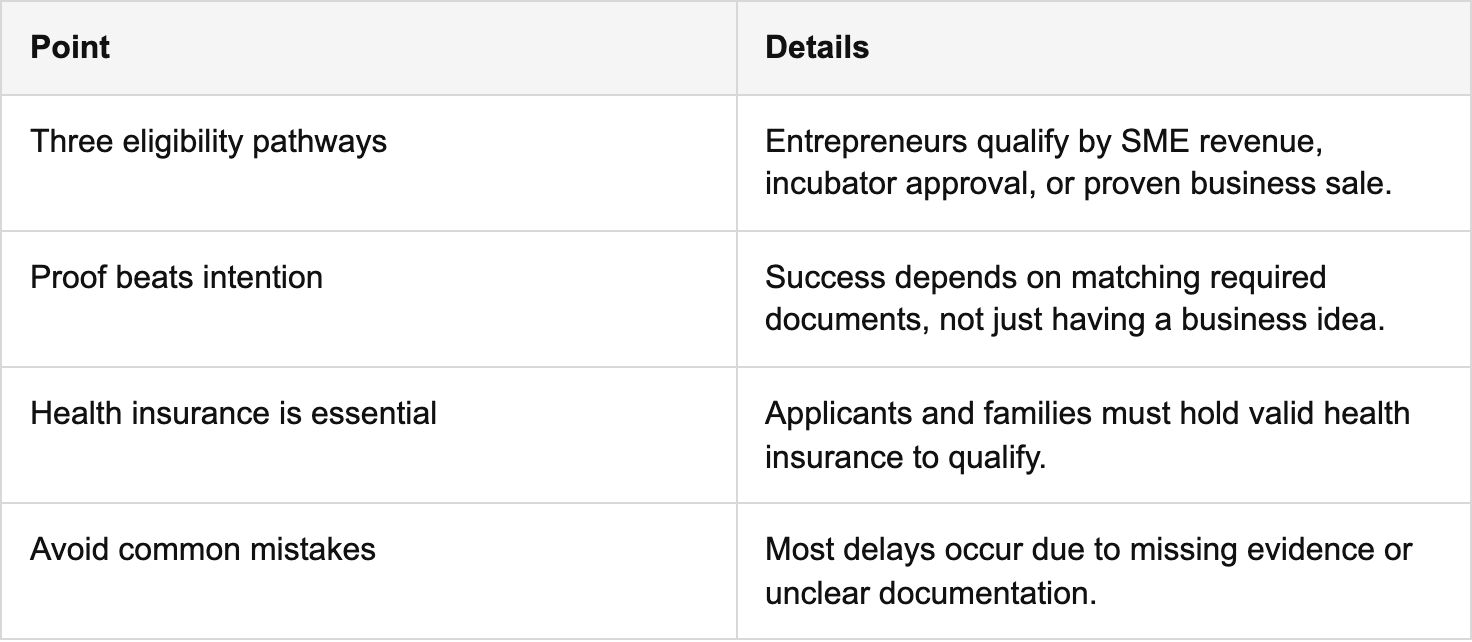
Key Takeaways
Understanding the Dubai entrepreneur visa
The UAE Golden Visa is the primary long-term residence route for entrepreneurs and investors looking to establish themselves in Dubai. Unlike a standard employment visa tied to an employer’s sponsorship, the Golden Visa grants you up to 10 years of renewable residence. It is self-sponsored, meaning you control your own status. That independence is one of the most powerful features it offers.
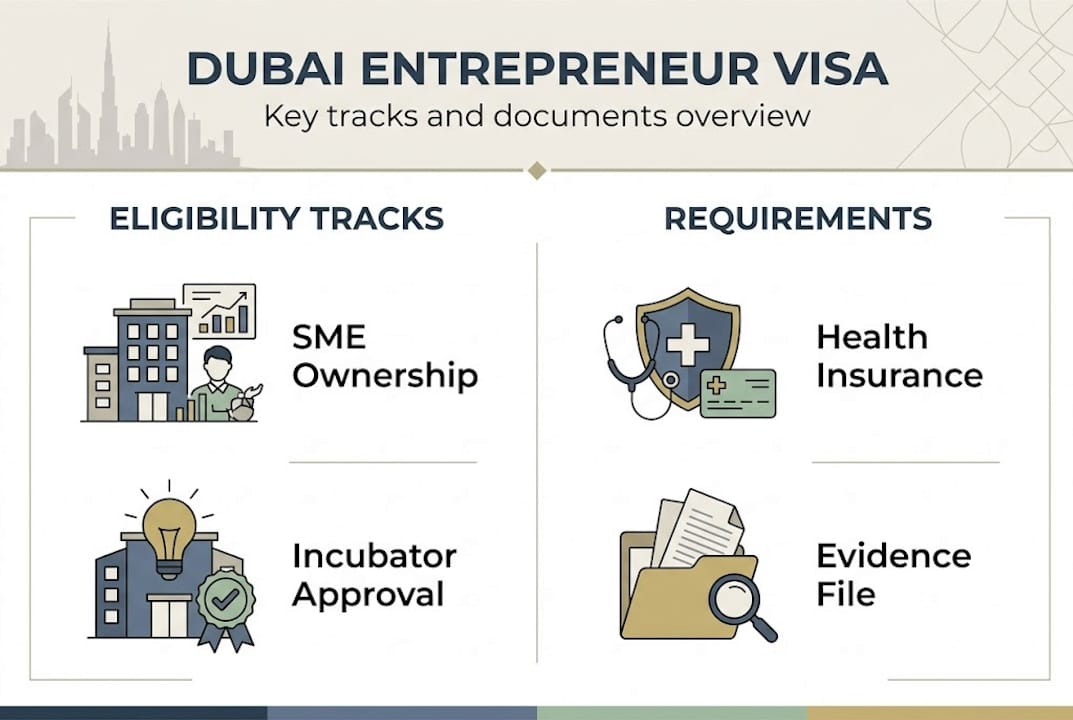
The visa operates across several categories: investors, real estate purchasers, skilled professionals, and entrepreneurs. If you are a business founder or startup operator, the entrepreneur category is the most direct path for you. To understand who qualifies for a Golden Visa at a foundational level, it helps to think of eligibility not as a single gate but as three separate doors, each requiring a different key.
The three entrepreneur eligibility tracks
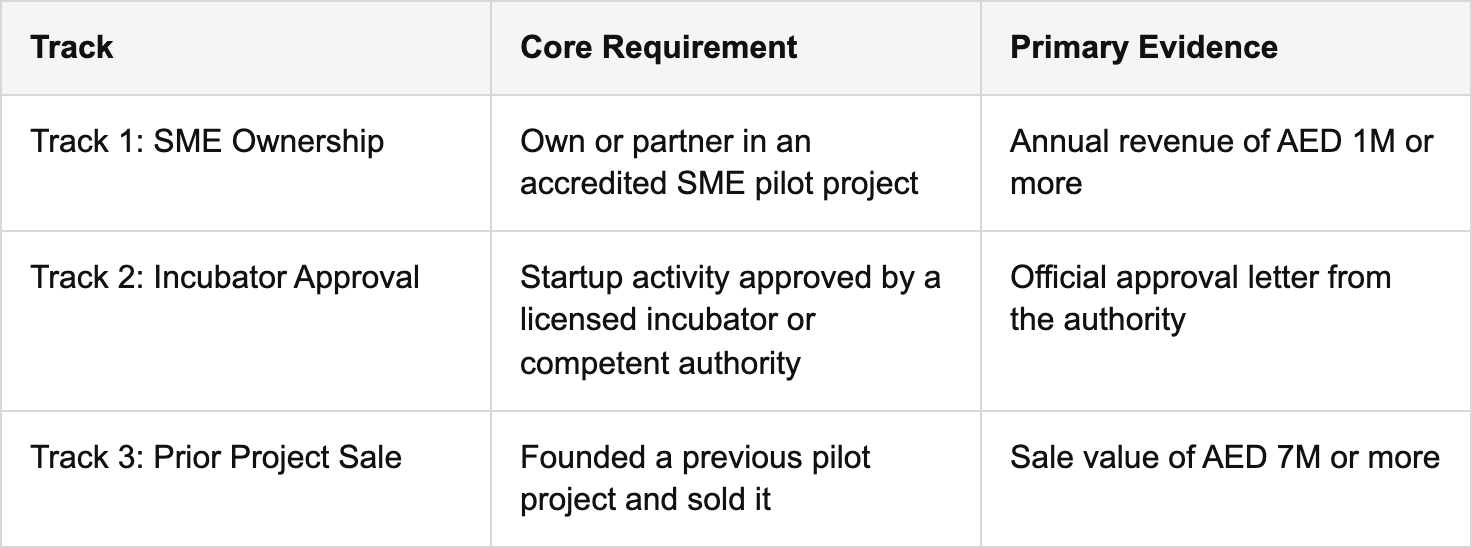
Each track comes with its own documentation burden, its own evidence standards, and its own review criteria. Choosing the wrong track or conflating requirements across tracks is one of the most common compliance errors applicants make.
Here is what you need to keep in mind as you start evaluating your eligibility:
- The Golden Visa is not an intention-based visa. Authorities evaluate proof, not potential.
- Your business activity must be formally recognized within the UAE’s regulated commercial framework.
- Supporting evidence must be current, certified, and precisely matched to the track you choose.
- Family members can be included in your application, which adds both value and documentation requirements.
“The entrepreneur category under the UAE Golden Visa exists to attract genuine value-creators. The system rewards those who have already demonstrated commercial traction, not those who plan to achieve it in the future.”
For a broader view of how this visa compares to other pathways, reviewing the main types of Dubai visas will help you confirm you are targeting the most appropriate route for your situation.
Key requirements and documents for Dubai entrepreneur visa
With the big picture in mind, let’s break down the official eligibility pathways and the exact documents you’ll need. The UAE Ministry of Economy and Technology specifies clear conditions for Golden Visa entrepreneur eligibility, and understanding those conditions in precise terms is the foundation of a successful application.
Option 1: SME ownership or partnership
To qualify under this track, you must own or hold a formal partnership stake in a pilot project registered in an accredited Small and Medium Enterprise (SME) sector. The business must generate annual revenues of at least AED 1 million. The revenue threshold is not a projection or a forecast. It must be demonstrated through audited financial statements or certified accounting records.
Your supporting documents for this track typically include:
- Trade license showing ownership or partnership stake
- Audited financial statements from a UAE-approved auditor confirming AED 1M+ annual revenue
- SME accreditation or classification certificate from the relevant authority
- Memorandum of Association (MOA) or partnership agreement
Option 2: Incubator or competent authority approval
If you are a startup founder whose business has not yet generated AED 1 million in revenue, this track gives you a viable pathway. You need formal written approval from a UAE-accredited business incubator or a competent government authority confirming that your proposed activity is endorsed. Programs under entities like Hub71, Area 2071, or licensed free zone accelerators frequently qualify.
Documents required here include:
- Official approval letter from the accredited incubator or authority
- Business plan or project proposal submitted to and endorsed by the approving entity
- Proof of the incubator’s own accreditation with the UAE government
- Personal identification and background documentation
Option 3: Previous pilot project sold for AED 7M or more
This is the track for serial entrepreneurs. If you previously founded a startup or pilot project in the UAE and exited via a sale valued at AED 7 million or more, you qualify under this category. The sale must be formally documented with a notarized or government-recognized sale agreement.
Pro Tip: If your previous company sale occurred abroad but was structured under UAE law or involved UAE-registered entities, consult a legal advisor to determine whether the transaction qualifies under UAE regulatory standards before submitting your application.
Health insurance: a non-negotiable requirement
Across all three tracks, the official conditions require comprehensive health insurance for yourself and all family members you include in the application. This is not optional. Missing health insurance at the time of submission will result in your application being returned or rejected outright.
For a complete picture of the Dubai investor legal requirements that apply alongside the visa process, it is worth reviewing these before you begin assembling your file.
Step-by-step process: How to secure your Dubai entrepreneur visa
Once you have your documents ready, here’s how to move confidently through the application process itself. The steps below are sequential. Skipping ahead or submitting incomplete stages will create delays that are difficult to reverse.
Step 1: Select your eligibility track
Review the three tracks against your current business situation. Be honest about which one you actually qualify for today, not which one you hope to qualify for in six months. If you are between tracks, prioritize the one where your existing evidence is strongest.
Step 2: Build your evidence file
Gather every document required for your chosen track. Do not substitute one document type for another. If the requirement calls for audited financials, an internal spreadsheet will not suffice. If you need an incubator approval letter, a letter of interest from an incubator does not fulfill the requirement. Precision here is everything.
Your file should contain:
- Trade license or equivalent business registration document
- Financial evidence (audited statements, sale agreements, or incubator letters depending on track)
- Health insurance certificates for all applicants
- Passport copies and existing UAE visa documentation if applicable
- Proof of Emirates ID if you already reside in the UAE
Step 3: Submit through the official UAE portal or a licensed service center
Applications are processed through the ICP (Federal Authority for Identity, Citizenship, Customs and Ports Security) portal or through licensed typing centers and authorized government service agents. Ensure your submission is complete before you finalize it. Partial submissions create processing gaps that can extend your Golden Visa application timeline significantly.
Step 4: Complete health and security screening
All applicants are required to undergo a UAE government health examination, typically conducted at an approved medical testing center. Security background checks are processed alongside this stage. Both are standard and straightforward for applicants with clean records and valid documentation.
Step 5: Receive your e-approval and finalize residence documents
Once approved, you will receive an electronic notification of your visa status. You will then need to complete your Emirates ID registration, complete your entry permit activation if you are applying from outside the UAE, and collect your residency stamp. The full process typically runs 12 to 25 business days once all documents are in order.
Pro Tip: Apply during business days in the UAE (Monday through Friday) and avoid submitting right before public holidays. Processing timelines can stretch during high-volume periods such as Ramadan or the end of the fiscal year. Planning your application timing around these windows saves weeks.
Connecting your visa setup to a broader business strategy, such as understanding Dubai real estate investment tips, can help you position your visa as part of a longer-term wealth and residency plan.
Common mistakes and troubleshooting tips
Even with the right pathway, many entrepreneurs slip at the compliance stage. Here’s how to avoid the most common mistakes and what to do if you hit a snag.
The official position is clear: a good business idea alone is not enough without the specific documentary proofs tied to the chosen category. That principle is where most rejections originate.
Most common compliance mistakes
- Missing health insurance at submission. This is the single most avoidable rejection reason. Health insurance must be in place before you apply, not after approval.
- Mismatching documents to the wrong track. If you apply under Track 1 (SME revenue) but only submit documents that would qualify for Track 2 (incubator approval), your application will fail on its own evidence.
- Using non-certified financial statements. Revenue figures must come from a licensed UAE auditor. Bank statements alone do not substitute for audited accounts.
- Outdated business registrations. Your trade license must be current and active at the time of application. Expired licenses will invalidate your submission.
- Ignoring authority follow-up requests. If the processing authority requests additional information or clarification, you typically have a limited response window. Missing that window restarts the process.
“Compliance is not a formality. It is the entire application. Every document you submit is a statement of fact that the authority will verify independently. If your documents tell one story and the official records tell another, your application ends.”
What to do if your application is returned or rejected
First, request the specific reason for return in writing if it is not clearly stated. UAE government portals typically include a remarks field explaining the issue. Match the rejection reason precisely to your document file and identify the gap. Then correct only the issue raised before resubmitting. Do not assume that adding more documents without addressing the specific deficiency will improve your outcome.
If your business situation has genuinely changed since your initial submission, for example if your revenue has now crossed the AED 1 million threshold, a reapplication on updated evidence is often stronger than an appeal. Check that all residency requirements remain current and in compliance before you resubmit.
Expert perspective: Why strategic preparation trumps a great idea
Working with entrepreneurs across a wide range of industries and nationalities, one pattern stands out consistently. The applicants who succeed are almost never the ones with the most impressive business concept. They are the ones who prepared their documentation with the same rigor they applied to their business strategy.
The authority reviewing your application cannot evaluate your market vision or your long-term revenue projections. It can only evaluate what is in the file in front of it. That means your visa outcome is almost entirely determined before you submit a single form. The preparation stage is where the application is won or lost.
Many entrepreneurs make the mistake of treating the visa as a finishing step after their business is running. In reality, structuring your business activity, revenue documentation, and incubator relationships with the visa criteria in mind from the outset gives you a significant compliance advantage. Think of it as building your business with two goals in parallel: commercial success and visa eligibility.
Clients who approach strategic Dubai investing with this dual-focus mindset consistently navigate the visa process with fewer complications and faster timelines. The lesson is straightforward: strategy and compliance are not separate workstreams. They are the same conversation.
Accelerate your Dubai venture with expert support
Navigating the Dubai entrepreneur visa process is significantly easier when you have experienced, on-the-ground guidance from the start. Whether you are still evaluating which eligibility track fits your situation or you are ready to submit your application and want a professional review of your document file, getting the right support early prevents costly delays and rejections down the line.

Anthony Joseph’s platform offers tailored Dubai entrepreneur visa support alongside a full suite of business setup, investment, and company formation services designed specifically for international entrepreneurs and investors entering the UAE market. From reviewing your eligibility evidence to connecting you with licensed compliance professionals, the goal is to get your application right the first time. Book a consultation today and take the guesswork out of your Dubai business launch.
Frequently asked questions
Can I apply for the Dubai entrepreneur visa without business ownership in the UAE?
Yes, you can apply if you receive formal approval from a UAE-accredited business incubator or a competent authority to establish your proposed activity, even without current UAE business ownership.
Do I need health insurance when applying for the Dubai entrepreneur visa?
Yes, comprehensive health insurance coverage for yourself and all family members included in your application is a mandatory condition for Golden Residence approval.
What happens if my business proof or documentation is incomplete?
Incomplete or mismatched documentation will result in delays or outright rejection; a good business idea does not substitute for the specific documentary proof required under your chosen eligibility track.
Is there a minimum revenue requirement for the entrepreneur visa?
Yes, under the SME ownership track, your business must demonstrate annual revenues of at least AED 1 million through certified financial documentation submitted with your application.


