

Maximize ROI in Dubai real estate: proven strategies
TL;DR:
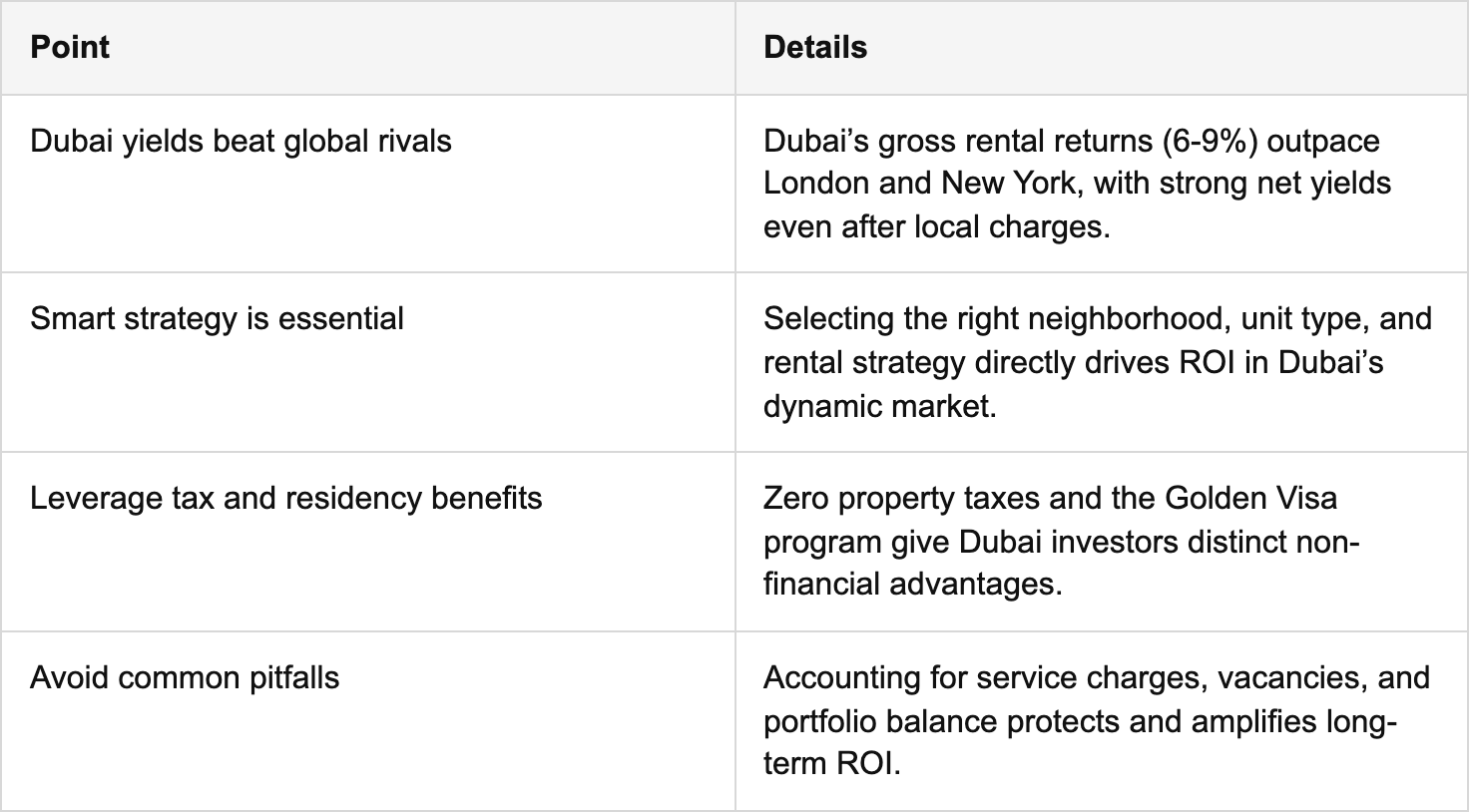
- Dubai offers gross rental yields of 6-9%, outpacing London and New York.
- Strategic property selection and legal structuring maximize investment returns and facilitate residency.
- Tax advantages and targeted rental strategies enhance net income and long-term wealth growth.
Dubai’s property market delivers gross rental yields of 6-9% in 2026, outpacing established markets like London and New York by a significant margin. Yet many high-net-worth investors fail to capture this full potential, not because the opportunity isn’t there, but because they overlook the strategies that separate average returns from exceptional ones. Whether you’re evaluating your first Dubai acquisition or optimizing an existing portfolio, this guide walks you through the exact approaches that experienced investors use to maximize ROI, from property selection and rental strategy to tax advantages and legal structuring.
Table of Contents
- Understand Dubai’s real estate ROI landscape
- Select the right property and location for maximum yield
- Optimize your investment structure and rental strategy
- Leverage local regulations, tax benefits, and residency programs
- Avoid common investor mistakes and ensure sustainable ROI
- Why conventional wisdom leaves ROI on the table in Dubai real estate
- Unlock your Dubai real estate ROI with expert guidance
- Frequently asked questions
Key Takeaways
Understand Dubai’s real estate ROI landscape
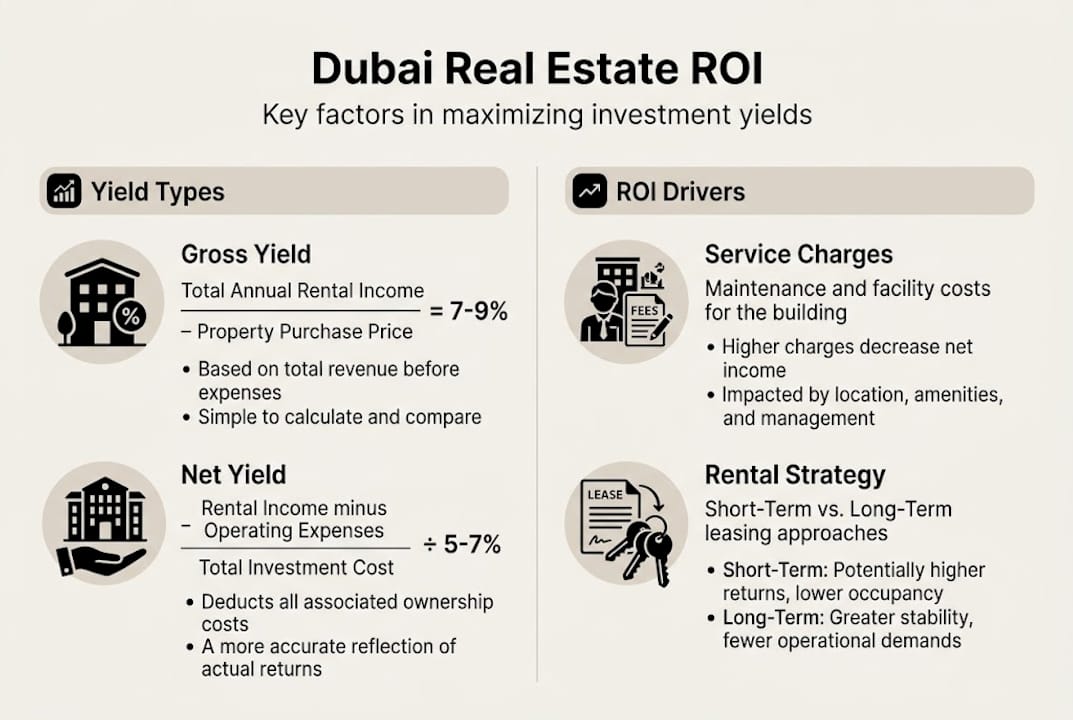
Before you commit capital, you need a clear picture of what ROI actually looks like in Dubai’s market. The headline numbers are compelling, but the real insight lies in understanding the difference between gross and net yields.
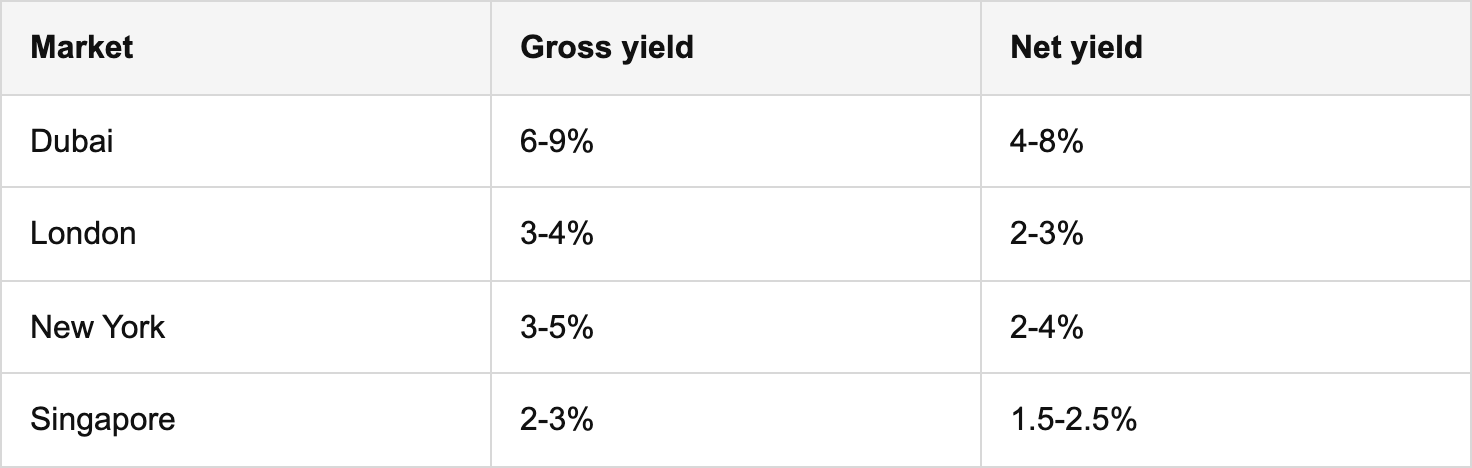
Gross yields range from 6-9%, while net yields, after accounting for service charges, fall between 4-8%. Service charges in Dubai typically run between AED 8 and AED 40 per square foot annually, depending on the building and location. That spread matters. A property yielding 8% gross in a high-service-charge building could net you closer to 5.5%, while a well-chosen unit in a lower-cost community might net 7% or more.
For context, London prime residential yields average around 3-4%, and New York hovers near 3-5% gross. Dubai’s figures aren’t just competitive, they’re in a different category.
Key ROI metrics every Dubai investor should track:
- Gross rental yield: Annual rent divided by purchase price
- Net rental yield: Annual rent minus service charges and management fees, divided by purchase price
- Capital appreciation rate: Year-over-year price growth by district
- Occupancy rate: Percentage of time the unit is tenanted
- Vacancy cost: Lost income during untenanted periods
Short-term rentals, particularly in tourist-heavy districts, can push yields to 8-12% annually. However, this comes with higher management intensity and regulatory requirements. You can explore a detailed breakdown of Dubai rental market yields to benchmark your target properties before committing.
Select the right property and location for maximum yield
With the financial landscape clear, let’s consider how to select properties that outperform. Location is the single most powerful variable in your ROI equation, and not every Dubai district performs equally.

Target high-demand locations like JVC or Dubai South for 1BR properties yielding 6-8% net. Jumeirah Village Circle (JVC) consistently ranks among the highest-yielding communities due to its affordable entry price, strong tenant demand, and improving infrastructure. Dubai South benefits from proximity to Al Maktoum International Airport and Expo City, making it a long-term growth play with solid near-term yields.
Steps to identify the right property:
- Define your yield target: Are you optimizing for rental income, capital appreciation, or both?
- Screen by entry price: Units in the AED 800K to AED 1.2M range in JVC, Dubai South, and similar districts often yield 6-8% net
- Compare unit types: Studios typically yield higher percentages but attract shorter tenancies; 1BR units offer a balance of yield and tenant stability
- Assess off-plan vs. resale: Off-plan properties in growth corridors can deliver 20% or more in capital appreciation before handover
- Check Golden Visa eligibility: Properties valued at AED 2M or more qualify investors for the 10-year residency program
Pro Tip: Off-plan entry in emerging districts like Dubai South or Ras Al Khor can lock in today’s prices while benefiting from infrastructure-driven appreciation over 2-4 years. The key is buying in projects from established developers with a strong delivery record.
When you evaluate Dubai real estate opportunities, factor in planned government infrastructure projects, school catchment areas, and metro connectivity. These variables drive tenant demand and long-term price growth. For a full framework, the Dubai real estate investment guide covers due diligence from first screening to final purchase.
Optimize your investment structure and rental strategy
Having picked the right property, maximize its returns through strategic structuring and smart rental methods. The way you hold and operate your asset matters as much as what you buy.
A proven portfolio split allocates 40-50% of capital to high-yield rental assets and 50-60% to appreciation-focused properties. This balance ensures you generate consistent cash flow while building long-term wealth through capital growth. Concentrating entirely in one category limits your upside.
Rental strategy options and their trade-offs:
- Long-term rental: Stable income, lower management burden, yields typically 5-7% net
- Short-term rental (holiday homes): Higher yields of 8-12%, but requires a DTCM (Dubai Tourism and Commerce Marketing) license and active management
- Furnished vs. unfurnished: Furnished units command 15-25% rental premiums in high-demand areas
- Corporate leasing: Multinational tenants offer reliability and often pay annual rents in advance
Steps to calculate your true net yield:
- Start with annual gross rent
- Subtract annual service charges (AED 8-40/sqft based on your building)
- Subtract property management fees (typically 5-8% of annual rent)
- Account for vacancy: Apply a conservative 90% occupancy rate for your first projection
- Divide the result by your total acquisition cost, including DLD (Dubai Land Department) transfer fees of 4%
Pro Tip: If you’re entering the short-term rental market, consider properties in Dubai Marina, Downtown Dubai, or Palm Jumeirah. These districts command premium nightly rates and maintain high occupancy through tourism and business travel year-round.
For investors considering off-plan property strategies, the payment plan structure itself becomes a yield lever. Many developers offer post-handover payment plans, allowing you to rent out the property while still completing installment payments. Additional Dubai real estate investment tips can help you refine your approach based on your specific capital position.
Leverage local regulations, tax benefits, and residency programs
Smart structuring is only part of the picture. Local policies can further boost your returns in ways that many international investors simply don’t utilize.
Dubai’s tax environment is one of the most investor-friendly in the world. The city imposes 0% income, capital gains, and inheritance tax on property earnings, and an AED 2M or more investment enables Golden Visa eligibility. For investors based in high-tax jurisdictions, this creates a meaningful net return advantage that doesn’t show up in yield comparisons alone.
Key regulatory and residency benefits for property investors:
- Zero income tax on rental earnings
- Zero capital gains tax on property sales
- Zero inheritance tax on transferred assets
- 10-year Golden Visa application for AED 2M or more in qualifying property
- Freehold ownership rights for foreign nationals in designated zones
- Transparent title registration through the Dubai Land Department
“Dubai’s tax-free framework doesn’t just improve your yield on paper. It changes the entire calculus of international portfolio allocation. Investors who factor in the tax drag from their home country often find Dubai’s effective return advantage is even larger than the headline yield difference suggests.”
Understanding the full picture of Dubai real estate tax facts helps you position your investment correctly from a legal and financial standpoint. The Dubai property tax guide covers transfer fees, registration costs, and ongoing charges in detail. For compliance specifics, reviewing the Dubai investor legal requirements for 2026 is a practical step before any acquisition.
Avoid common investor mistakes and ensure sustainable ROI
To achieve lasting success, avoid these common mistakes and focus on risk management. Even experienced investors can leave significant returns on the table by overlooking a few critical factors.
Service charges and occupancy rates affect net ROI by up to 2.5%, yet many investors build projections using gross yield figures alone. That gap between gross and net is where deals that look attractive on paper become disappointing in practice.
The most common ROI-limiting mistakes:
- Using gross yield as the decision metric: Always model net yield with realistic service charges and a 90% occupancy assumption
- Overleveraging: Taking on excessive debt to acquire multiple units simultaneously increases exposure during market corrections
- Skipping legal due diligence: Verify developer track records, check for encumbrances on resale properties, and confirm freehold status in the target zone
- Failing to diversify: Concentration in a single district or asset class amplifies risk without proportional reward
- Ignoring market cycles: Dubai’s market has distinct cycles. Buying at peak pricing in a saturated segment compresses both yield and appreciation potential
Pro Tip: Build your investor network actively. Connecting with other high-net-worth investors, local brokers, and property managers gives you access to off-market deals and real-time occupancy data that public listings don’t show. Structured ROI networking strategies can open doors to joint ventures and co-investment opportunities that multiply your effective capital deployment.
Risk mitigation also means staying current. Dubai’s regulatory environment evolves, and policy changes around short-term rental licensing, visa eligibility thresholds, and developer escrow requirements can all affect your investment thesis.
Why conventional wisdom leaves ROI on the table in Dubai real estate
Most investment guides focus on yield percentages and location rankings. That’s useful, but it’s the floor, not the ceiling. The investors I’ve seen consistently outperform aren’t just chasing the highest gross yield number. They’re thinking in systems.
Concentrating only on rental yield means you can miss major appreciation upside. A property in JVC yielding 7.5% net is excellent, but an AED 2M off-plan property in a growth corridor can achieve both Golden Visa eligibility and 20% or more in capital appreciation before handover. That combination of income, appreciation, and residency value is what separates elite portfolio performance from average returns.
Many international investors also underutilize Dubai’s tax-free and residency advantages. They calculate ROI the same way they would in London or Singapore, without adjusting for the zero-tax environment. When you account for what you’d pay in capital gains or income tax elsewhere, Dubai’s effective return advantage grows substantially.
The advanced strategies, timing your off-plan entry, structuring your portfolio split deliberately, and optimizing legal residency, are what separate top performers. Explore advanced off-plan strategies to see how timing and developer selection interact to drive outsized returns. The playbook exists. The question is whether you’re using it.
Unlock your Dubai real estate ROI with expert guidance
You now have a clear roadmap for maximizing returns in Dubai’s property market, from yield benchmarks and location selection to tax structuring and risk management. The next step is translating this knowledge into a personalized investment strategy that fits your capital position, risk profile, and residency goals.

At anthonyjosephaj.com, Anthony Joseph and his team provide data-driven Dubai real estate advisory services tailored specifically to high-net-worth investors. From off-plan acquisition to portfolio structuring and Golden Visa guidance, you get expert support at every stage. Reach out today for a custom ROI analysis and market entry plan built around your objectives.
Frequently asked questions
What is the average ROI for Dubai real estate in 2026?
Gross yields range from 6-9% and net yields from 4-8% in 2026, both significantly higher than comparable markets like London or New York.
Which Dubai locations deliver the best rental yields?
Areas like JVC, Dubai South, and Dubai Marina consistently offer the strongest returns, with AED 800K-1.2M units in JVC and Dubai South achieving 6-8% net yield on 1BR and studio units.
What are the main costs that impact net ROI in Dubai?
Service charges running AED 8-40 per square foot, vacancy periods, and property management fees are the primary cost factors, with service charges and vacancies reducing net yields by 1-2.5% compared to gross figures.
Is Dubai real estate income tax-free for foreign investors?
Yes. Dubai imposes zero income, capital gains, or inheritance taxes on property earnings, making it one of the most tax-efficient markets globally for foreign investors.
How can I qualify for a Golden Visa via property investment?
Purchasing AED 2 million or more in qualifying Dubai property makes you eligible for the 10-year Golden Visa, which provides long-term UAE residency for you and your immediate family.


