

Dubai real estate due diligence checklist: secure your investment
TL;DR:
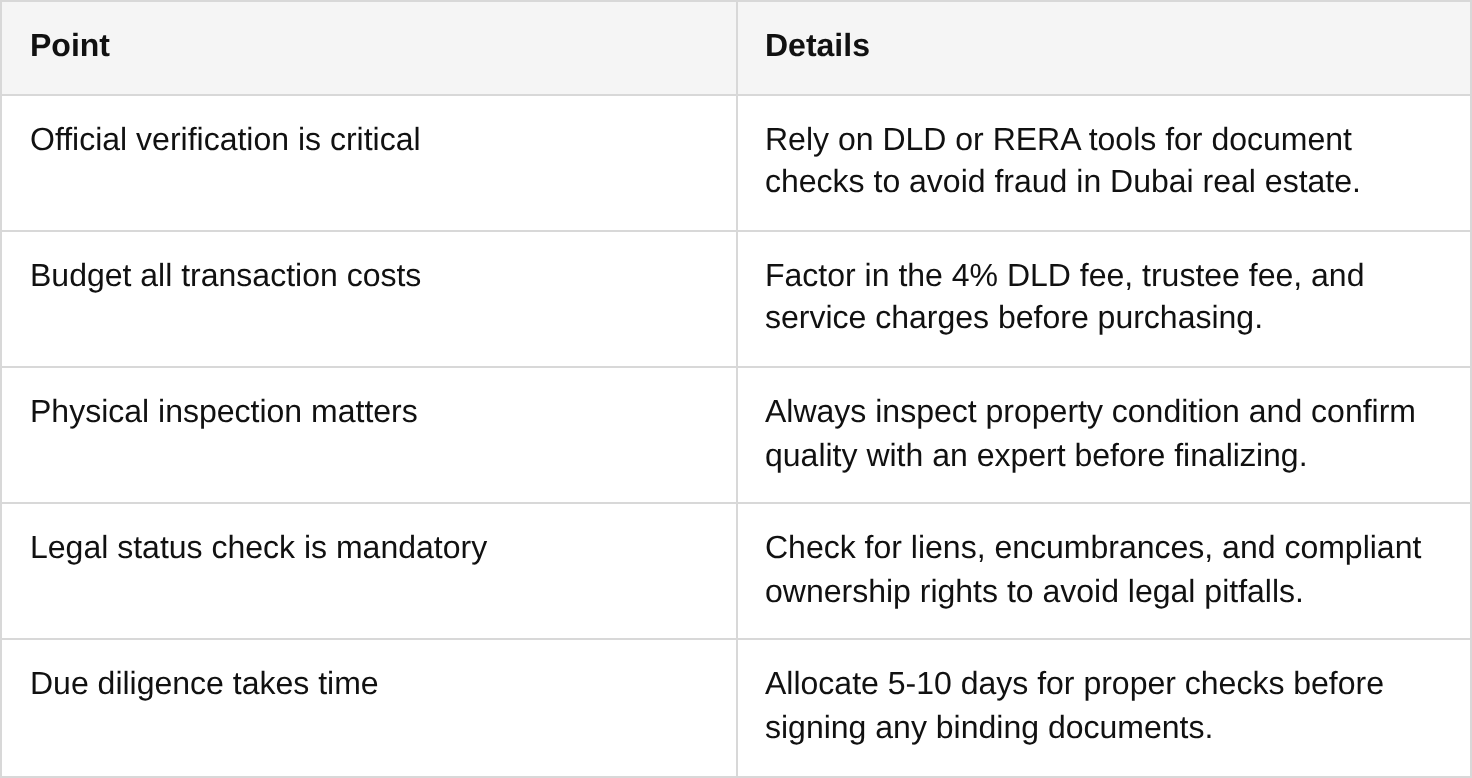
- Thorough due diligence using official documents and verification tools is essential to avoid costly mistakes.
- Legal, regulatory, and financial checks safeguard investments and ensure compliance with Dubai property laws.
- In-person inspections and local knowledge help assess property quality and neighborhood dynamics for better ROI.
Dubai’s property market draws capital from every corner of the globe, and for good reason. Rental yields regularly outperform comparable markets in London, Singapore, and New York, and the city’s regulatory framework has matured significantly over the past decade. Yet every year, international investors lose money on deals that looked flawless on paper. The difference between a profitable acquisition and a costly mistake almost always comes down to one thing: how thoroughly you conduct due diligence before signing anything. This checklist gives you a precise, step-by-step framework to verify every layer of a Dubai property deal, from official documents to physical inspections.
Table of Contents
- Key documents and verification steps
- Legal and regulatory checks
- Financial due diligence and costs
- Physical inspection and property quality
- Why checklists aren’t enough: The art of real due diligence
- Take the next step in Dubai real estate
- Frequently asked questions
Key Takeaways
Key documents and verification steps
Now that you know what you’ll gain from this checklist, let’s start with the basic documents and how to verify their authenticity. Every property transaction in Dubai rests on a foundation of official paperwork, and each document serves a specific protective function for the buyer.
The core documents you must review and verify include:
- Title Deed: Issued by the Dubai Land Department (DLD), this is the definitive proof of ownership. Confirm it matches the seller’s identity exactly.
- No Objection Certificate (NOC): The developer issues this to confirm no outstanding payments or disputes on the unit before transfer.
- Recent service charge statement: Confirms no unpaid community fees that would transfer to you as the new owner.
- DLD-approved sale contract (Form F): The standard Memorandum of Understanding used in Dubai transactions, which must be signed by both parties and a registered agent.
Verifying these documents means going directly to official sources. Prioritize DLD/RERA official tools like the Dubai REST app over any broker-provided copies. The Dubai REST app lets you check ownership status, encumbrances, and property details in real time, directly from the DLD database. Never accept scanned PDFs as final confirmation.
You should also conduct Dubai due diligence steps that include checking for mortgages or liens registered against the property. A property with an active mortgage requires the seller to discharge it before or at the point of transfer. Outstanding service charges become your liability the moment you take ownership, so request a clearance letter from the developer or owners’ association.
Fraud in Dubai’s property market takes several forms, including forged title deeds, sellers misrepresenting ownership, and properties listed by parties who have no legal right to sell. Using DLD verification tools directly eliminates most of these risks before you invest a single dirham.
Pro Tip: Always cross-reference the seller’s Emirates ID or passport against the name on the Title Deed through the DLD portal. A mismatch, however small, is a red flag that warrants immediate investigation before you proceed.
Legal and regulatory checks
After verifying documents, the next priority is making sure the property passes all legal and regulatory hurdles. A clean title deed does not automatically mean the property is free of legal complications.
Follow these steps in sequence before you sign any binding agreement:
- Confirm freehold eligibility. Not all areas in Dubai allow foreign ownership. Check whether the property sits in a designated freehold zone. Understanding property ownership types in Dubai, including freehold versus leasehold distinctions, is critical for international buyers.
- Search for active litigation. Ask your legal advisor to run a court records search to confirm no active disputes, injunctions, or ownership claims are attached to the property.
- Verify building approvals. Confirm the building has received all required DLD and RERA (Real Estate Regulatory Agency) completion certificates. Unauthorized construction or unapproved modifications can create legal liability for buyers.
- Check for regulatory compliance. Dubai’s property regulations have evolved in 2026, and some older buildings may not yet comply with updated standards. Your legal advisor should confirm the property meets current requirements.
- Schedule your legal review before the MOU. Due diligence takes 5 to 10 days before the Memorandum of Understanding is signed. Rushing this window to close faster is one of the most expensive mistakes an investor can make.
Familiarizing yourself with standard Dubai real estate terms before entering negotiations also gives you a significant advantage. Knowing the difference between a usufruct right and full freehold title, or understanding what an escrow account means in an off-plan context, prevents costly misunderstandings.
Pro Tip: Engage a RERA-registered legal advisor rather than relying solely on the agency’s in-house counsel. Independent legal review protects your interests without the conflict of interest that can arise when one party represents both sides of a transaction.
Financial due diligence and costs
With the legal risk addressed, you’ll need to get clear on all the numbers that affect your total investment. Many buyers focus on the purchase price and overlook the full cost stack, which can add 7 to 10 percent on top of what you agreed to pay.

Here is a breakdown of the mandatory transaction costs you must budget for:
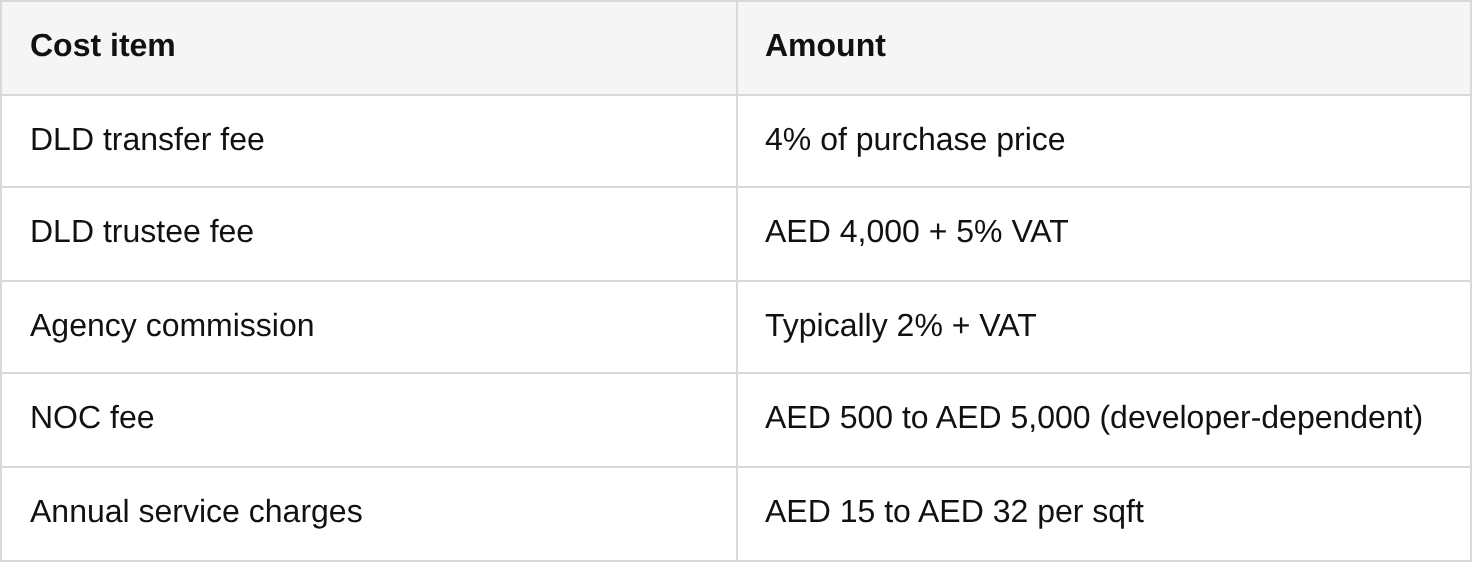
The 4% DLD transfer fee is paid by the buyer at the point of transfer and is non-negotiable. Since 2025, the UAE Central Bank prohibits financing these fees through a mortgage, meaning you must have the full amount available in cash at closing. Budget accordingly.
For ongoing costs, use the DLD/RERA Service Charge Index to verify the exact rate for your specific community. Service charges range from AED 15 to 32/sqft annually, and premium developments in areas like Downtown Dubai or Dubai Marina sit at the higher end of that range.
Key financial checks to complete before committing:
- Model your net rental yield after deducting all service charges, management fees, and vacancy periods
- Review the Dubai transfer fee costs in detail to avoid surprises at closing
- Use a structured method for evaluating ROI that accounts for capital appreciation potential alongside rental income
- Understand the full picture of Dubai property taxes and levies, even in a low-tax environment
Stat to know: Dubai’s average gross rental yield sits between 6% and 8% annually, which compares favorably to London (3 to 4%) and Hong Kong (2 to 3%). But net yield after fees can drop significantly if service charges are high and the unit sits vacant.
Physical inspection and property quality
Numbers tell part of the story, but nothing replaces an in-person or video property inspection. A unit that looks polished in listing photos can conceal serious structural or maintenance issues that erode your investment value quickly.
Follow this inspection sequence to protect yourself:
- Hire a qualified surveyor. A RICS-accredited (Royal Institution of Chartered Surveyors) professional can assess structural integrity, snagging issues, and build quality with a level of objectivity that a casual walkthrough cannot provide.
- Look for water damage and illegal modifications. Water infiltration is one of the most common and costly issues in Dubai apartments, particularly in older towers. Illegal internal modifications can also void building warranties and create regulatory problems.
- Evaluate MEP systems. MEP stands for mechanical, electrical, and plumbing. Aging or poorly maintained systems in these areas are expensive to replace and can affect habitability and rental appeal.
- Compare the unit to similar listings. Developer quality varies widely across Dubai. Comparing finishes, ceiling heights, and amenity standards against comparable units in the same community gives you realistic leverage in price negotiations.
- Request maintenance logs. Ask the facility management company for recent maintenance records. A building with a history of deferred maintenance is a risk that should be priced into your offer.
For buyers who cannot travel to Dubai, a detailed video inspection conducted by a trusted local professional is the minimum acceptable standard. You can find guidance on the full process of buying property in Dubai to understand exactly where the physical inspection fits within the broader transaction timeline.
Pro Tip: Request the unit’s original handover report from the developer. This document details the condition of the property at the time of first sale and can reveal whether existing issues predate the current owner’s tenure.
Why checklists aren’t enough: The art of real due diligence
Here is the uncomfortable truth most guides won’t tell you: a checklist protects you from beginner mistakes, but it does not guarantee a great investment. Checklists are backward-looking tools. They help you confirm what has already happened, not predict what will.
The investors who consistently outperform in Dubai’s market do something different. They combine structured verification with local intelligence, developer relationships, and a genuine understanding of neighborhood-level supply and demand dynamics. They know which developers have a track record of delivering on time and which ones do not. They know which communities are oversupplied and which are quietly gaining traction.
Approach any deal that seems priced too far below market with serious skepticism. In a market as transparent as Dubai’s, genuine bargains are rare. When something looks too good, the checklist is your first filter, but your judgment and local network are your second.
Building relationships for Dubai ROI is not just a soft skill. It is a research strategy. A disciplined checklist combined with hands-on, creative investigation is what separates investors who close great deals from those who simply close deals.
Take the next step in Dubai real estate
Ready to invest with confidence? The right guidance can transform your due diligence process from a stressful exercise into a strategic advantage.

At anthonyjosephaj.com, you get access to expert-led guidance built on years of experience in Dubai’s property market. Whether you need help interpreting a Title Deed, understanding a Dubai cost breakdown, or identifying the right community for your investment goals, Anthony Joseph and his team are positioned to help you move forward with clarity. Reach out today for a one-on-one consultation and put a trusted local expert in your corner before you sign anything.
Frequently asked questions
What is the DLD transfer fee for property purchases in Dubai?
The DLD transfer fee is 4% of the property’s purchase price, paid by the buyer at the point of transfer. This fee is mandatory and applies to all property transactions registered with the Dubai Land Department.
Which documents should I verify before buying Dubai real estate?
You should verify the Title Deed, NOC, DLD-approved sale contract, and a recent service charge statement directly with the DLD. Prioritize official DLD/RERA tools like the Dubai REST app rather than relying on broker-provided copies.
Are Dubai property purchase fees mortgage-financeable?
No. Since 2025, the UAE Central Bank prohibits mortgage financing for DLD transfer fees and trustee fees, meaning buyers must pay these costs entirely in cash at closing.
How long does property due diligence take in Dubai?
Due diligence typically takes 5 to 10 days before the Memorandum of Understanding is signed. Compressing this timeline to close faster significantly increases your risk exposure.
What ongoing costs should foreign buyers expect in Dubai?
Foreign buyers should budget for annual service charges ranging from AED 15 to 32 per sqft depending on the community, plus property management fees, maintenance reserves, and any applicable utility connection costs.
Recommended
- What is due diligence in Dubai real estate: guide 2026
- Dubai Real Estate Investment: Complete Guide
- How to Evaluate Dubai Real Estate for Smart Investments
- Dubai Commercial Property Process: Secure Profitable Investments
- What Is a Due Diligence Questionnaire? A Comprehensive Guide to Informed Investment Decisions


