

Why property valuation matters for Dubai investors 2026
Professional property valuations can shift perceived property value by up to 20% in Dubai’s dynamic real estate market, directly impacting your investment returns and risk exposure. For international investors navigating Dubai’s fast-paced property landscape, understanding valuation fundamentals separates profitable decisions from costly mistakes. This guide clarifies how property valuation drives pricing, financing, and portfolio strategy specifically for Dubai’s unique market conditions.
Table of Contents
- Introduction To Property Valuation
- Key Property Valuation Methods In Dubai
- Why Property Valuation Matters For Investors
- Market Dynamics And Regulatory Influences On Valuation
- Common Misconceptions About Property Valuation
- Real-World Impact: Case Studies And Investor Insights
- Applying Property Valuation Knowledge: Practical Investor Guide
- Enhance Your Dubai Property Investments With Expert Guidance
- FAQ
Key takeaways
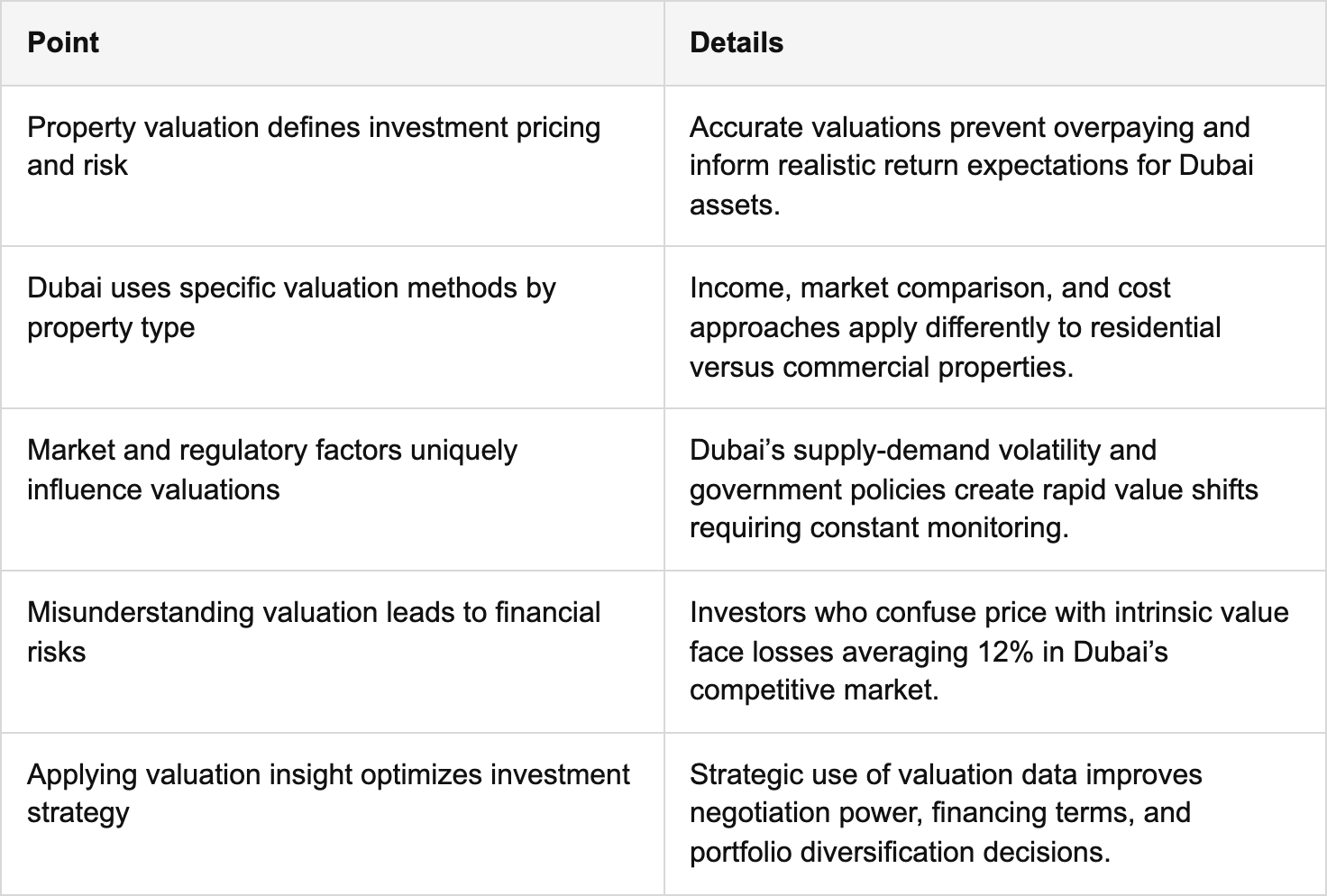
Introduction to property valuation
Property valuation establishes the economic worth of real estate assets through systematic analysis of market data, property characteristics, and income potential. For Dubai investors, this process determines whether a property trades at fair value or represents overpriced risk. Dubai’s real estate market operates at exceptional speed compared to global markets, with prices responding rapidly to supply additions, regulatory changes, and economic shifts.
Accurate valuation serves three critical functions for international investors. First, it anchors pricing negotiations with objective market evidence rather than seller aspirations. Second, it quantifies investment risk by revealing how current asking prices compare to sustainable value drivers. Third, it enables portfolio optimization by identifying which Dubai submarkets and property types offer the strongest risk-adjusted returns.
Dubai’s market complexity demands specialized valuation expertise. The city’s property landscape spans freehold zones, leasehold arrangements, off-plan projects, and completed units across diverse communities. Property values respond to factors ranging from metro line extensions to free zone business policy updates. This dynamic environment makes outdated valuations dangerous. A property fairly priced six months ago may be significantly overvalued today due to new supply entering its submarket.
International investors face additional valuation challenges. Currency fluctuations affect real returns. Unfamiliarity with Dubai’s neighborhoods creates information gaps. Distance from the market makes ongoing monitoring difficult. Professional valuation bridges these gaps by providing independent, evidence-based assessments that protect against overpaying or misjudging market timing.
The valuation process examines multiple factors:
- Physical property attributes including size, condition, views, and amenities
- Location characteristics such as accessibility, community reputation, and nearby developments
- Market trends affecting supply, demand, and pricing in specific Dubai areas
- Regulatory environment including ownership rules, fees, and taxation
- Income potential for investment properties through rental yield analysis
Key property valuation methods in Dubai
Dubai valuers apply three primary approaches, each suited to different property types and investment objectives. Understanding these valuation methods helps investors interpret reports and question assumptions.
The market comparison approach dominates residential valuations. This method analyzes recent sales of comparable properties in the same community or similar Dubai neighborhoods. Valuers adjust for differences in size, condition, floor level, and view quality. Dubai’s transparent transaction data through the Dubai Land Department makes this approach highly reliable for apartments and villas in established communities.
The income approach values properties based on rental cash flow potential. This method suits buy-to-let investors and commercial properties. Valuers calculate net operating income by subtracting operating expenses from gross rental income, then apply a capitalization rate reflecting Dubai market conditions and property-specific risk. This approach reveals whether a property’s price aligns with its income-generating capacity.
The cost approach estimates value by calculating replacement cost for the structure plus land value. Dubai valuers use this method primarily for unique properties lacking comparable sales or when valuing land for development. This approach works well for specialized commercial properties or custom villas where market comparison data proves sparse.
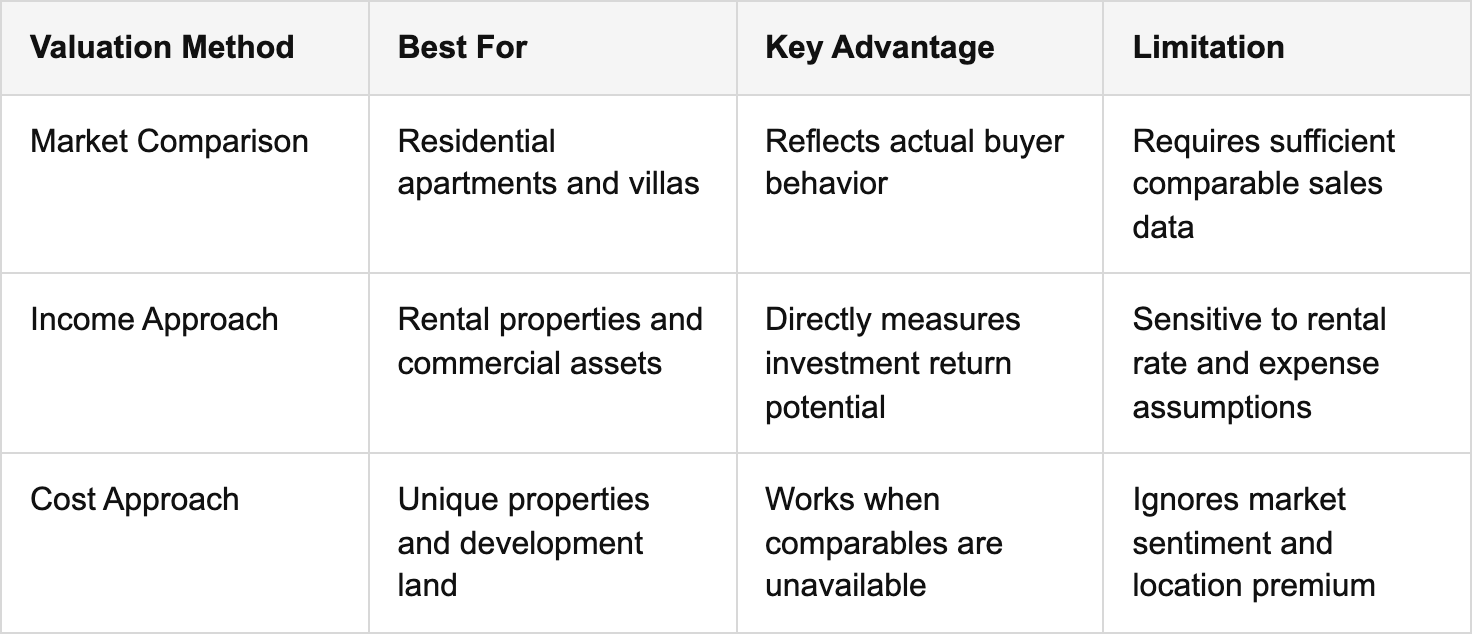
Method selection significantly impacts valuation outcomes. A luxury villa might show different values under market comparison versus cost approach if recent comparable sales are limited. Commercial properties valued solely through market comparison miss income potential insights.
Pro Tip: Always verify which valuation method your report uses and whether it matches your investment objective. Rental investors should insist on income approach analysis alongside market comparison to understand cash flow sustainability.
Dubai’s mortgage lenders typically require valuations using market comparison for residential financing. Commercial lenders often demand both market comparison and income approach to assess loan risk comprehensively. Understanding Dubai real estate valuation terms helps investors communicate effectively with valuers and lenders.
Why property valuation matters for investors
Valuation directly shapes every major investment decision. For Dubai investors, accurate property assessment determines whether transactions create or destroy wealth.

Pricing strategy begins with valuation. Armed with professional assessment, investors make informed offers rather than accepting seller asking prices. Dubai’s market includes properties listed 15-20% above fair value. Valuation evidence strengthens negotiation position and prevents emotional overpaying.
Risk evaluation relies on valuation accuracy. When purchase price exceeds intrinsic value, investors face immediate unrealized losses and extended breakeven timelines. Dubai’s market cycles make this risk acute. Properties bought at peak valuations during boom periods required years to recover value during subsequent corrections.
Financing optimization depends on valuation outcomes. Lenders base loan-to-value ratios on independent valuations, not purchase prices. Higher valuations unlock more favorable financing terms and lower equity requirements. Conversely, low valuations force larger down payments or deal termination.
Portfolio strategy uses valuation to guide capital allocation. Comparing valuations across Dubai submarkets reveals which areas offer better value relative to fundamentals. Investors can shift capital from overvalued to undervalued segments, improving risk-adjusted returns.
“Understanding property valuation transformed our Dubai investment approach. We avoided three overpriced deals and identified two undervalued opportunities that delivered 23% returns within 18 months. Valuation isn’t optional; it’s your primary defense against market hype.”
Key investment decisions valuation supports:
- Purchase price determination and offer strategy
- Hold versus sell decisions for existing portfolio assets
- Refinancing timing to capture equity gains
- Portfolio rebalancing across Dubai communities
- Exit strategy planning based on value appreciation trends
Pro Tip: Schedule valuation updates annually for portfolio properties and before any major transaction. Dubai’s rapid market shifts make valuations stale quickly, and Dubai real estate investment tips emphasize ongoing monitoring as a core success factor.
Valuation also protects against regulatory compliance issues. Dubai requires accurate valuations for certain corporate real estate holdings and trust structures. Incorrect valuations can trigger audit complications or regulatory scrutiny.
Market dynamics and regulatory influences on valuation
Dubai’s property valuations respond dramatically to market forces and government policies. International investors must monitor these external factors to interpret valuation changes correctly.
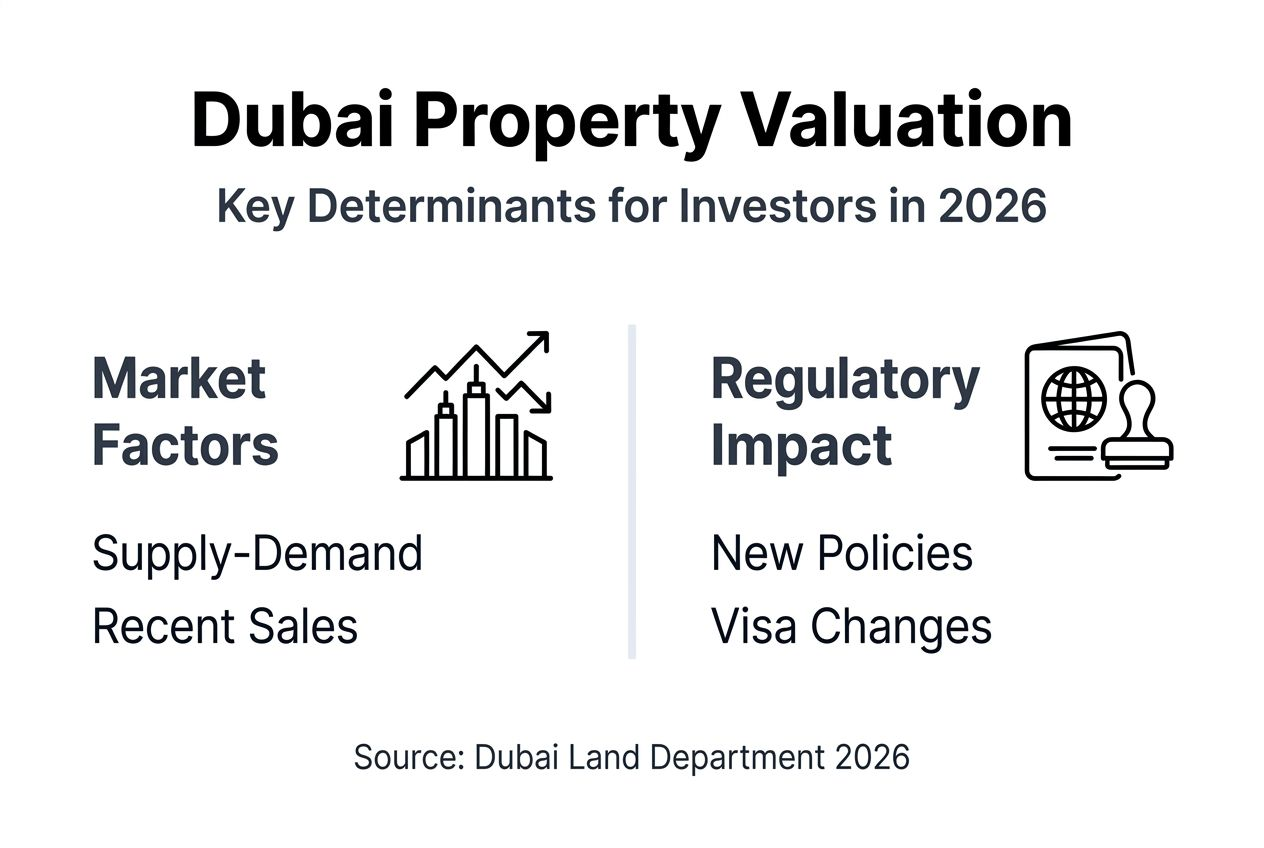
Supply-demand imbalances drive significant valuation swings. When Dubai adds thousands of units in popular communities like Dubai Marina or Downtown, valuations adjust downward as competition for tenants and buyers intensifies. Conversely, undersupplied areas with strong demand see valuation appreciation. Recent data shows communities with more than 15% supply growth experienced valuation declines averaging 8-12% over 12 months.
Government initiatives directly impact property values. Dubai’s golden visa program increased demand for properties meeting investment thresholds, lifting valuations in relevant price segments. Changes to foreign ownership zones expanded buyer pools for previously restricted areas. Service charge regulations affected net operating income calculations for investment properties.
Economic factors create valuation pressure. Oil price volatility influences Dubai’s broader economy and employment levels, affecting residential demand. Interest rate changes alter investment return requirements and financing costs. Currency movements impact international buyer purchasing power, particularly for investors from India, Pakistan, and European markets.
Infrastructure development triggers localized valuation changes. Metro line extensions, new road connections, and community amenity upgrades enhance property desirability. Communities near Expo 2020 sites saw valuations rise during development phases. Understanding how to evaluate Dubai real estate includes tracking infrastructure projects affecting target areas.
Regulatory compliance costs affect valuations through several channels:
- Dubai Land Department transaction fees impact net proceeds from sales
- Service charge increases reduce net operating income for rental properties
- Ejari registration requirements add administrative costs
- Community-specific regulations limit property use flexibility
To monitor valuation influences effectively, investors should track:
- Quarterly supply completion data from Dubai Land Department
- Rental index movements in target communities
- Government policy announcements affecting property ownership or taxation
- Infrastructure project timelines near portfolio assets
- Economic indicators including employment trends and business sentiment
Staying current with Dubai real estate trends 2026 provides context for understanding whether valuation changes reflect property-specific factors or broader market movements. This distinction matters because market-wide corrections require different responses than property-specific value deterioration.
Common misconceptions about property valuation
Valuation misunderstandings cost Dubai investors millions annually. Recognizing these errors protects your investment capital.
Confusing price with value represents the most dangerous misconception. Price reflects what sellers demand or buyers pay at a specific moment. Value represents what a property should trade for based on fundamental worth. Dubai’s market includes properties priced 25% above fair value, particularly in newly launched off-plan projects with aggressive marketing. Investors who buy based on price alone without valuation analysis frequently overpay.
Assuming valuations stay static creates timing risks. Dubai’s market moves faster than most global cities. A valuation valid today may be outdated within three months if significant supply enters the market or economic conditions shift. Investors using six-month-old valuations for current decisions operate with flawed data.
Ignoring qualitative factors leads to incomplete analysis. Two identical apartments in the same building can have significantly different values based on floor level, view quality, and condition. Dubai properties with Burj Khalifa views command premiums that pure square footage analysis misses. Community reputation and management quality affect long-term value retention but don’t appear in basic valuation metrics.
Relying exclusively on developer valuations creates bias risk. Off-plan projects include developer-commissioned valuations supporting asking prices. Independent valuations frequently show 10-15% lower values for the same properties. Smart investors commission independent assessments before committing to off-plan purchases.
Misconceptions that reduce returns:
- Believing all properties in a community have identical value per square foot
- Assuming rental yields quoted by agents reflect achievable income
- Thinking valuation and appraisal serve different purposes (they’re interchangeable terms)
- Expecting valuations to predict future price movements (they assess current worth)
- Assuming higher price automatically means better quality or location
Pro Tip: Always commission independent valuations from RERA-registered professionals rather than accepting developer or agent valuations. The cost of professional assessment is negligible compared to the protection it provides against overpaying.
Dubai’s international buyer base creates additional confusion. Investors from markets with different valuation standards may misinterpret Dubai reports. Understanding local valuation conventions and disclosure requirements prevents costly misunderstandings.
Real-world impact: case studies and investor insights
Actual Dubai investment outcomes demonstrate valuation’s crucial role. These examples show how proper valuation analysis separates successful investors from those who struggle.
Consider two investors who purchased similar two-bedroom apartments in Dubai Marina during 2025. Investor A relied on agent recommendations and bought at asking price without independent valuation. Investor B commissioned professional valuation revealing the property was overpriced by 18%. Investor B negotiated a 12% price reduction and purchased a comparable unit in the same building.
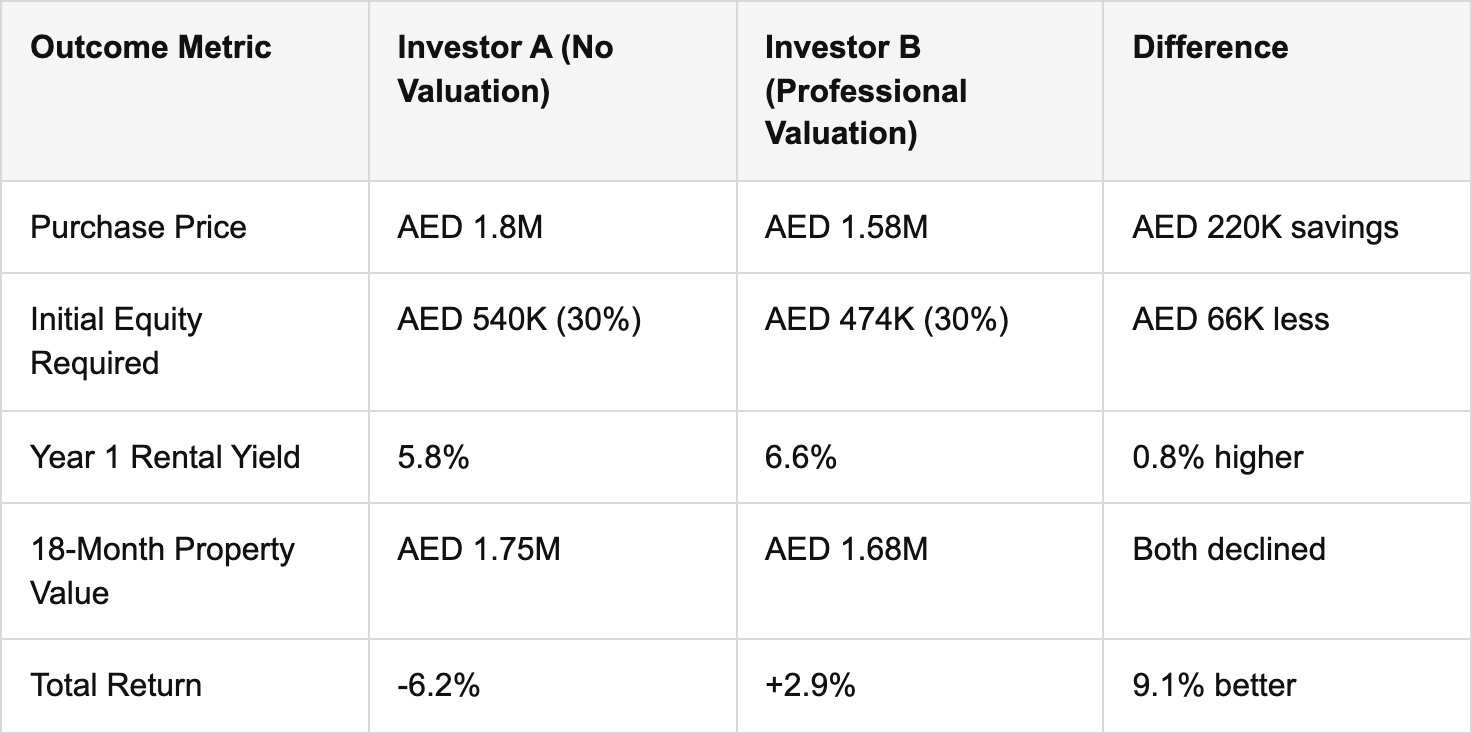
Investor testimonials from Dubai reveal consistent themes. Successful investors emphasize valuation as their primary risk management tool. Those who struggled often skipped valuation to save costs or relied on interested party assessments.
A European investor shared how professional valuation prevented a costly mistake. Attracted to a newly launched villa project, he nearly committed based on developer projections. Independent valuation revealed comparable completed villas traded 22% below the off-plan asking price. He waited for project completion and purchased a similar villa at substantial savings.
Conversely, investors who overpaid due to inadequate valuation faced extended holding periods and capital losses. Several Dubai Marina investors from 2014-2015 purchased without proper valuation during peak pricing. When the market corrected through 2016-2019, they held underwater assets for years. Professional valuation would have revealed overpricing and prevented these losses.
Key lessons from real investor experiences:
- Professional valuation typically costs 0.05-0.15% of property value but prevents losses averaging 8-15%
- Independent assessment identifies overpricing that interested parties (agents, developers) miss or hide
- Valuation provides negotiation leverage that reduces purchase prices by 5-12% in most cases
- Regular portfolio valuations help investors time sales to capture peak values before corrections
Understanding the global impact of Dubai real estate investment includes recognizing how valuation practices differ from other markets. Dubai’s transparency and data availability support reliable valuations, giving investors confidence in assessment accuracy.
Applying property valuation knowledge: practical investor guide
Translating valuation concepts into investment action requires systematic approach. Follow these steps to leverage valuation effectively.
First, commission independent RERA-registered valuers for every significant transaction. Verify credentials and request sample reports before engagement. Quality valuers provide detailed methodology explanations and comparable sales analysis, not just final numbers.
Second, review valuation reports critically. Examine the comparable properties selected. Verify adjustments made for differences in size, condition, and location. Question any assumptions that seem optimistic or unsupported. Strong valuers welcome questions and provide additional analysis when requested.
Third, use valuation insights to structure offers strategically. If valuation shows 10% overpricing, start negotiations 15% below asking. Use the professional report as evidence supporting your position. Most Dubai sellers negotiate when confronted with independent valuation showing fair market value below their asking price.
Fourth, optimize financing through valuation timing. Commission valuations after property improvements or market appreciation to capture equity gains. Higher valuations support refinancing at better loan-to-value ratios and improved interest rates.
Fifth, integrate valuations into portfolio management. Schedule annual valuations for all investment properties. Track value changes relative to Dubai market indices. Identify underperforming assets requiring attention or disposition.
Steps investors should follow:
- Identify target property and gather basic information
- Commission independent RERA-registered valuation before making offers
- Review report thoroughly and question unclear assumptions
- Use valuation evidence to negotiate purchase price reductions
- Structure financing based on valuation outcomes
- Schedule annual updates to monitor portfolio performance
- Adjust investment strategy based on relative valuations across Dubai submarkets
Pro Tip: Build relationships with two to three quality valuers who understand your investment criteria. Ongoing relationships produce better insights as valuers learn your portfolio and objectives, plus you gain priority access during busy market periods.
Incorporate valuation into comprehensive investment frameworks. Combine valuation analysis with location research, rental market assessment, and development pipeline monitoring. This integrated approach, detailed in Dubai property investment strategies, produces superior long-term results.
Valuation should also guide exit timing. When portfolio property valuations reach your target returns or show significant premiums to recent sales, consider selling before market corrections eliminate gains. Dubai’s cyclical market rewards investors who use valuation to time exits strategically.
Enhance your Dubai property investments with expert guidance
Navigating Dubai’s complex valuation landscape becomes significantly easier with professional support. Understanding property valuation provides a strong foundation, but applying these insights within Dubai’s dynamic market requires local expertise and ongoing monitoring.
International investors benefit from working with experienced Dubai real estate professionals who combine valuation knowledge with market intelligence and negotiation skills. Expert consulting services help investors avoid common valuation pitfalls, identify undervalued opportunities, and structure transactions that maximize returns while minimizing risks.

Professional guidance proves especially valuable for portfolio strategy development. Experienced advisors help investors interpret valuation trends across Dubai’s diverse submarkets, allocate capital efficiently, and time transactions to capture optimal pricing. This support transforms valuation from an isolated assessment into a strategic advantage driving consistent investment success.
FAQ
What is the most common valuation method used for Dubai residential properties?
The market comparison approach dominates residential valuations because Dubai’s transparent transaction data provides extensive comparable sales information. This method accurately reflects actual buyer behavior and current market conditions across different communities.
How does property valuation affect financing options for investors in Dubai?
Accurate valuations directly inform lenders about collateral value, which determines maximum loan amounts and influences interest rates offered. Higher valuations enable investors to access better financing terms and reduce required equity contributions.
Can valuation misunderstandings really cause financial losses?
Yes, investors who confuse price with intrinsic value or skip independent valuations have experienced return reductions averaging 12% in Dubai’s market. Professional valuation is essential protection against overpaying and misjudging market timing.
How often should Dubai investors update property valuations?
Annual valuations for portfolio properties and fresh assessments before any major transaction provide adequate monitoring. Dubai’s rapid market changes make valuations older than six months potentially unreliable for decision making.
Do off-plan properties require different valuation approaches?
Off-plan valuations require specialized analysis comparing similar completed projects while adjusting for construction risk and time value. Independent valuations frequently show 10-15% lower values than developer assessments for the same properties.


