

Residency by Investment: Key Pathways for Investors
Every high-net-worth investor eyeing Dubai faces complex decisions when pursuing legal residency through property investment or business establishment. With residency by investment programs growing in popularity, understanding the clear distinction between residency and citizenship is essential. Proper due diligence and legal transparency are key to avoiding common pitfalls, as Dubai’s stringent requirements ensure that only qualified investors benefit from these exclusive pathways.
Table of Contents
Residency by Investment Explained and Debunked
Residency by investment (RBI) programs allow foreign investors to obtain legal residency in a country through financial contributions, typically property purchases or business investments. These pathways operate differently from traditional immigration routes, offering expedited processing and tangible benefits for wealthy individuals seeking second residences or business expansion.
However, RBI programs carry misconceptions. Many investors believe they automatically grant citizenship—they don’t. Residency and citizenship are distinct legal statuses. Residency permits you to live, work, and conduct business in a jurisdiction. Citizenship grants political rights like voting and diplomatic protection. Dubai’s residency programs fall squarely into the first category.
How RBI Programs Actually Work
Residency by investment schemes operate by streamlining migration processes for investors, creating a direct exchange: your capital in exchange for legal residency status. Governments use these programs to attract foreign direct investment and stimulate economic growth.
The structure typically involves three components:
Investment threshold: A minimum capital amount required (property purchase, business establishment, or financial deposit)
Processing timeline: Expedited approval compared to standard visa applications
Residency duration: Multi-year permits renewable based on maintaining investment or meeting renewal requirements
Dubai’s approach emphasizes property and business investments as the primary pathways, making it accessible to investors across various sectors.
Common Myths Debunked
Myth 1: RBI means automatic citizenship.
False. Residency permits you to live legally in a jurisdiction. Citizenship remains a separate status requiring different processes and timelines. You can hold residency for decades without obtaining citizenship.
Myth 2: Your investment is risk-free.
No investment is risk-free. Property values fluctuate. Business ventures face market challenges. Investors must conduct thorough due diligence and understand local market dynamics before committing capital.
Myth 3: RBI programs lack oversight.
Incorrect. Well-structured RBI programs incorporate due diligence and anti-money laundering safeguards to prevent misuse. Dubai’s programs include background checks and source-of-funds verification for all applicants.
Myth 4: You can work anywhere globally with RBI residency.
Not automatically. Your residency permit specifies employment rights within that jurisdiction. Working elsewhere requires separate work authorizations from those countries.
The Reality Check
RBI programs benefit genuine investors seeking legitimate business opportunities. They provide structure, clarity, and legal certainty for establishing your presence in a jurisdiction. However, they require active management and compliance with ongoing obligations.
RBI programs are investment vehicles with residency benefits—not shortcuts to citizenship or global work permits. Success depends on understanding what you’re actually purchasing and managing your investment actively.
Investors often overlook renewal requirements. Many residency permits require maintaining your investment threshold or meeting specific compliance standards annually. Failing to do so can result in permit cancellation.
The distinction between RBI and other visa categories matters significantly for tax planning, estate planning, and long-term business strategy. When exploring Dubai residency strategies for investors, clarify exactly which visa category supports your specific goals.
Pro tip: Before committing to any RBI program, engage a legal advisor familiar with both UAE regulations and your home country’s tax laws—residency often triggers tax obligations you must plan for.
Types of Residency Programs for Investors
Residency programs vary significantly across jurisdictions, each designed to attract capital while offering distinct benefits. Understanding the differences between program types is crucial for selecting the right pathway for your financial goals and lifestyle preferences.
Investors pursue residency through different motivations. Some seek safety, economic opportunity, and quality of life improvements. Others prioritize global mobility or tax planning advantages. Your motivations directly influence which program structure best serves your needs.
Real Estate Investment Programs
Property investment represents the most accessible residency pathway for many investors. You purchase residential property, typically meeting a minimum threshold, and receive residency eligibility in return. This approach combines investment returns with residence benefits.
Real estate programs offer tangible advantages:
Physical asset ownership: You own actual property generating rental income
Appreciation potential: Property values historically increase over time
Leverage opportunities: Financing options amplify investment capacity
Residency flexibility: Some programs allow property rental while you reside elsewhere
Dubai’s property market exemplifies this model. When evaluating property investments, understanding Dubai real estate fundamentals and market dynamics directly impacts your long-term returns and residency eligibility maintenance.

Business Investment Programs
Some jurisdictions grant residency when you establish and operate a business, investing capital through company formation. This pathway suits entrepreneurs seeking active business involvement combined with residency status.
Business programs typically require:
Minimum capital investment: Direct funding into your business venture
Employment requirements: Creating local jobs (varies by jurisdiction)
Operational management: Active business participation, not passive investment
Annual compliance: Maintaining business registration and financial reporting
Financial Contribution Programs
Direct financial programs bypass property or business requirements. You contribute capital through government bonds, fixed deposits, or investment funds, receiving residency without owning physical assets.
This option provides simplicity but different characteristics:
Passive investment: No operational management required
Guaranteed returns: Often specified interest rates on government instruments
Liquidity constraints: Capital typically locked for program duration
Portfolio diversification: Lower integration with local economy
Comparative Framework
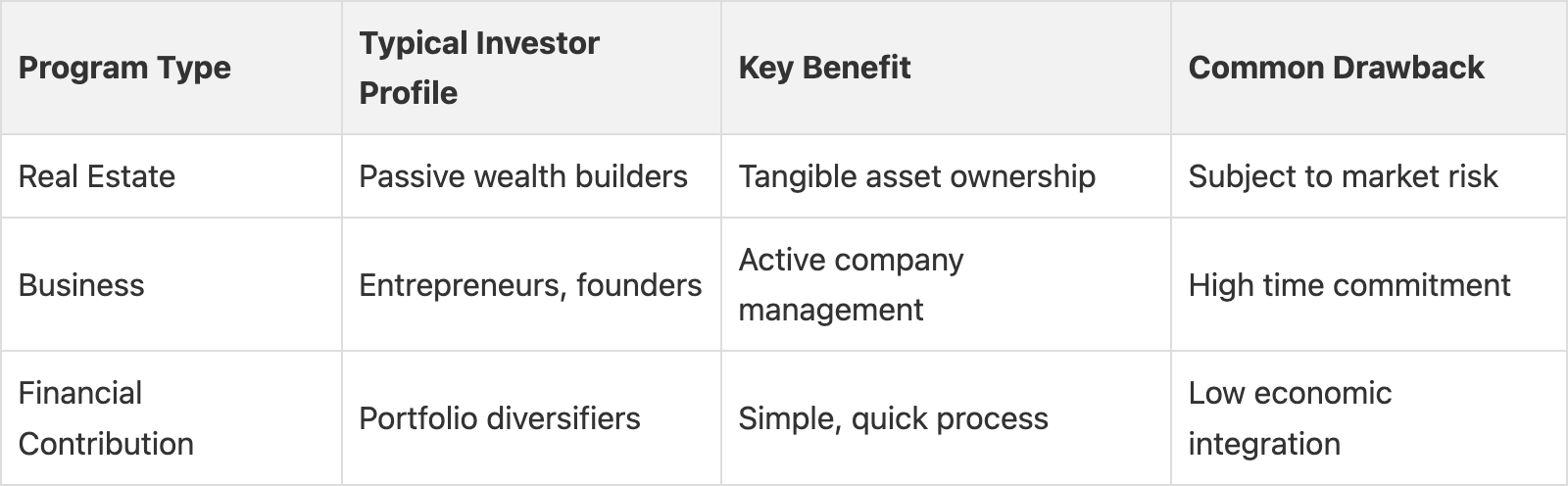
Each program type serves different investor lifestyles and mobility needs based on capital availability, risk tolerance, and long-term planning goals. Real estate offers tangible assets and income generation. Business programs emphasize active entrepreneurship. Financial contributions prioritize simplicity and passive returns.
Program selection fundamentally depends on matching investment structure to your financial strategy, time commitment capacity, and residency duration objectives.
Dubai combines multiple pathways, allowing property investment as the primary route, with business establishment options for entrepreneurs. This flexibility accommodates diverse investor profiles and capital sources.
Here’s a concise comparison of the main types of residency by investment programs and their investor profiles:
Pro tip: Before selecting a program type, calculate total capital requirements including property purchases, legal fees, and annual compliance costs—the cheapest entry price often becomes expensive when renewal obligations and hidden expenses emerge.
Qualifying Investments and Application Process
Qualifying investments form the foundation of any residency by investment application. You must meet specific financial thresholds and direct your capital into approved investment vehicles. The process is straightforward but demands precision and thorough documentation.
Investment requirements vary by jurisdiction and program type. Most programs specify minimum capital amounts, acceptable investment categories, and timeframes for capital deployment. Meeting these requirements exactly protects your application from rejection or delays.
Investment Thresholds and Categories
Each residency program establishes clear financial minimums. These thresholds typically range from modest amounts for emerging markets to substantial sums for premium programs. Your investment category—property, business, or financial instruments—determines eligibility pathways.
Common qualifying investments include:
Real estate purchases: Residential or commercial property meeting minimum value
Business establishment: Capital invested in company formation and operations
Government bonds: Direct contributions to national development funds
Bank deposits: Fixed deposits or investment accounts with specified terms
Investment thresholds and compliance checks intensify globally as programs tighten regulation and selectivity. You must understand exact amounts required before committing capital.
The Application Workflow
Residency applications follow structured processes. Most jurisdictions require meeting legal criteria, submitting documentation, and demonstrating economic contribution. This systematic approach ensures compliance and protects investor legitimacy.
The typical sequence involves:
Pre-application consultation: Confirm eligibility and investment options with authorized representatives
Investment setup: Execute property purchase, business registration, or fund transfer
Documentation preparation: Gather proof of investment, financial records, identification documents
Application submission: File official application with supporting materials
Due diligence review: Background checks and source-of-funds verification
Approval and residency issuance: Government authorization and permit processing
Documentation Requirements
Applying authorities require extensive documentation proving investment legitimacy and source of funds. Prepare bank statements, property deeds, business contracts, and identity verification documents. Missing or incomplete documentation delays processing substantially.
Essential documentation typically includes:
Proof of investment: Purchase agreements, transfer confirmations, bank receipts
Financial records: Bank statements demonstrating fund origins (usually 6-12 months)
Identification: Passports, birth certificates, marriage certificates (if applicable)
Background checks: Police clearances from current and previous residences
Tax compliance: Income tax returns and clearance certificates
Due Diligence and Background Verification
Governments conduct thorough background investigations before granting residency. These checks verify your identity, assess financial legitimacy, and ensure no criminal or sanctions history exists. Transparency throughout this process protects your application.
Due diligence intensifies during application review—hidden financial issues or undisclosed background problems surface regardless of how careful you appear initially.
Source-of-funds verification proves your investment capital originated legally. Prepare clear documentation tracing money from its original source through your accounts into the investment vehicle. Unexplained wealth transfers or questionable origins trigger application rejection.
Timeline Expectations
Processing timelines vary significantly. Some programs complete approval within 3-4 months. Others require 6-12 months depending on complexity and due diligence depth. Plan accordingly and maintain realistic expectations.
Pro tip: Work with qualified legal advisors familiar with both Dubai requirements and your home country’s tax obligations from application start—fixing documentation errors mid-process costs thousands in delays and corrections.
Legal, Tax, and Compliance Requirements
Residency by investment programs operate within strict legal frameworks designed to prevent abuse while facilitating legitimate investment. Understanding your obligations prevents costly penalties and protects your residency status long-term.
Three critical areas demand your attention: legal compliance in the host country, tax obligations in both jurisdictions, and ongoing reporting requirements. Neglecting any one area can jeopardize your residency or trigger significant financial consequences.
Legal Framework and Host Country Requirements
Each jurisdiction establishes specific legal requirements governing residency programs. These rules outline investment obligations, renewal procedures, and conditions for maintaining your status. Violating these conditions results in permit cancellation and potential deportation.
Key legal obligations typically include:
Maintaining your investment: Keeping capital in approved vehicles throughout permit duration
Compliance documentation: Submitting annual reports or renewal applications on schedule
Residency presence: Meeting minimum days-in-country requirements (varies by program)
Criminal conduct avoidance: Maintaining a clean legal record during residency tenure
Robust legal safeguards and compliance protocols prevent program abuse and protect investor legitimacy. Dubai’s legal framework requires strict adherence to investment terms and regular permit renewal.
Tax Obligations and Double Taxation
Obtaining residency triggers tax considerations in both your home country and Dubai. Most countries tax residents on worldwide income, meaning you may owe taxes in multiple jurisdictions simultaneously.
Critical tax planning areas include:
Income reporting: Filing requirements in both jurisdictions on earned and investment income
Capital gains: Tax liability when selling property or closing investments
Wealth taxes: Annual taxes on net worth (if applicable in your home jurisdiction)
Treaty benefits: Double taxation agreements reducing overlapping tax obligations
Understand legal requirements for Dubai expats including tax residency status determination. UAE offers tax advantages, but your home country may still claim taxing rights on certain income categories.
Anti-Money Laundering and Source-of-Funds Verification
Governments worldwide implement strict anti-money laundering controls in residency programs. You must prove investment capital originated from legitimate sources. Enhanced compliance measures address money laundering and tax evasion risks through rigorous documentation requirements.
Expect authorities to:
Trace fund origins: Track capital from source through multiple accounts into investment
Request explanations: Provide context for large transfers or unusual financial activity
Verify employment: Confirm income sources match capital available for investment
Document timing: Explain timing relationships between income and investment transfers
Ongoing Compliance and Renewal
Residency permits require active management beyond initial approval. Annual compliance obligations vary by program but typically demand investment maintenance and periodic reporting.
Common renewal requirements include:
Annual financial reporting: Submitting investment account statements or property valuations
Insurance maintenance: Keeping mandatory coverage active throughout permit period
Permit renewal applications: Submitting updated paperwork on specified intervals
Sponsor or employer confirmation: Obtaining sponsor letters confirming continued relationship status
Non-compliance with renewal requirements terminates residency automatically—missed deadlines trigger cancellation regardless of good intentions.
Many investors overlook renewal obligations, assuming initial approval provides indefinite residency. Permits expire and require explicit renewal. Calendar these dates immediately after approval.
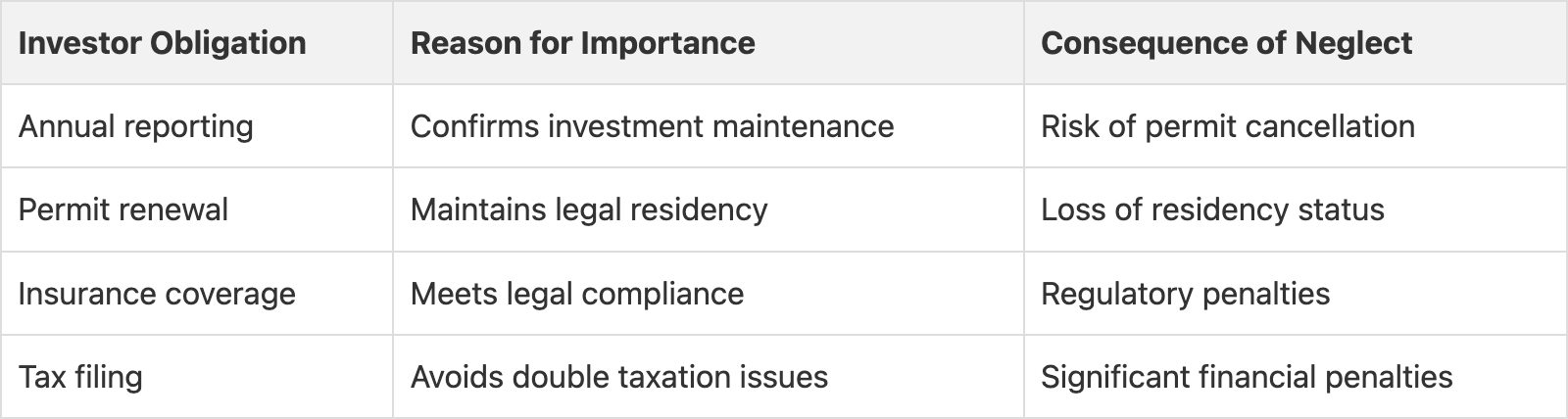
The following table highlights the most overlooked ongoing obligations RBI investors face:
Pro tip: Hire a local compliance advisor familiar with both UAE regulations and your country’s tax laws from day one—the cost of professional guidance ($2,000-5,000 annually) saves tens of thousands in missed filings, penalties, and remediation.
Risks, Costs, and Key Considerations
Residency by investment programs carry real risks alongside genuine benefits. Understanding financial costs, regulatory changes, and potential downsides protects you from costly mistakes and unrealistic expectations.
Three major risk categories demand attention before committing capital: financial costs that exceed initial estimates, regulatory changes that eliminate programs or increase requirements, and reputational considerations affecting your personal and professional standing.
Financial Costs Beyond Investment
Investors often focus solely on the investment threshold while overlooking substantial additional expenses. Legal fees, due diligence costs, property valuations, and compliance management accumulate quickly, sometimes exceeding the initial investment amount itself.
Typical hidden costs include:
Legal and consulting fees: $5,000-$15,000 for application processing and documentation
Due diligence and background checks: $2,000-$5,000 depending on complexity
Property transaction costs: Transfer taxes, registration fees, agent commissions (typically 4-6% of purchase price)
Annual compliance and renewal: $1,500-$3,000 annually for ongoing legal support
Insurance and maintenance: Property insurance, property management, annual fees
Rising scrutiny and evolving regulations increase program costs and administrative burdens over time. Budget conservatively, planning for higher expenses than official minimums suggest.
Regulatory and Political Risks
Governments modify or eliminate residency programs based on political pressures, economic conditions, or international compliance requirements. Programs you invest in today may change dramatically within years, affecting your benefits or investment recovery.
Regulatory risks include:
Program modifications: Increased investment thresholds or stricter renewal requirements
Program elimination: Complete cancellation leaving existing residents in legal limbo
Rule changes: New restrictions on property ownership, employment, or residency renewal
Geopolitical shifts: International pressure forcing program restructuring or termination
Reputational and Professional Risks
Some industries and jurisdictions view residency by investment skeptically, associating programs with wealth hiding or questionable capital sources. High-profile individuals in finance, law, or government may face professional consequences.
Reputational considerations:
Professional scrutiny: Enhanced background checks or client vetting in sensitive industries
Public disclosure: Some countries publicize residency investor lists, affecting privacy
Family impact: Children’s educational or professional opportunities affected by parent’s residency status
Banking relationships: Some institutions view RBI residency negatively, complicating financial services
Investment Performance and Market Risks
Your investment doesn’t guarantee returns. Property markets fluctuate. Rental yields decline. Business ventures fail. Misuse of investment programs poses significant financial risks through improper administration and market volatility affecting investor capital.
Investment-specific risks include:
Property market downturns: Declining values eroding capital and affecting renewal eligibility
Rental income volatility: Vacancy periods or tenant defaults reducing expected returns
Currency fluctuations: Exchange rate changes affecting investment value in your home currency
Illiquidity challenges: Difficulty selling property quickly if you need capital elsewhere
Assessing Program Sustainability
Before committing capital, evaluate program viability. Research government commitment levels, international standing, and historical program stability. Programs with political support and transparent operations present lower risk than newer or politically controversial initiatives.
Financial costs combined with regulatory uncertainty mean successful residency by investment requires viewing your capital as illiquid long-term commitment—not a short-term investment vehicle.
Pro tip: Model worst-case scenarios: assume property values decline 20%, regulations tighten requiring higher annual spending, and residency gets eliminated within five years—if your plan still works under these conditions, you’re properly hedged against major risks.
Unlock Your Residency by Investment Journey with Expert Guidance in Dubai
Navigating the complex world of residency by investment programs requires more than just capital. This article highlights common challenges such as understanding investment thresholds, managing ongoing compliance, and distinguishing residency from citizenship. If you are searching for tailored solutions to overcome these hurdles while maximizing your Dubai property investment and business setup, expert support is critical. From ensuring your qualifying investments meet Dubai’s specific criteria to handling legal compliance and permit renewals, professional guidance eases your path to secure residency.

Discover how Anthony Joseph’s comprehensive services at https://anthonyjosephaj.com can empower you to confidently make strategic investments, benefit from Dubai’s thriving real estate market, and seamlessly navigate the residency application process. Whether you are investing in prime properties, launching a business, or managing your portfolio for long-term compliance, Anthony’s expertise and trusted mentorship turn complex residency by investment goals into achievable milestones. Act now to safeguard your investment and residency future. Visit Anthony Joseph Real Estate Solutions today and take the first step toward your Dubai residency success.
Frequently Asked Questions
What is Residency by Investment?
Residency by Investment (RBI) programs allow foreign investors to obtain legal residency in a country in exchange for financial contributions, such as property purchases or business investments.
Do RBI programs provide automatic citizenship?
No, RBI programs grant residency, not citizenship. Residency allows you to live and work in a country, while citizenship provides political rights, such as voting and diplomatic protection.
What are the common myths associated with RBI programs?
Common myths include the belief that RBI guarantees citizenship, that investments are risk-free, or that these programs lack oversight. It’s essential to conduct thorough research to understand the real implications.
What are the typical investment pathways available through RBI programs?
RBI programs typically include pathways like real estate investment, business establishment, and direct financial contributions. Each option comes with its own requirements and benefits based on your investment goals.


