

What Is MOU in Real Estate Transactions?
Securing luxury property in Dubai often starts long before any formal contract is signed. For high-net-worth investors navigating cross-border deals, a Memorandum of Understanding (MOU) becomes the first clear step toward aligning interests and building trust. Understanding how an MOU works gives you greater control over risk, negotiation timelines, and compliance with Dubai’s regulations, setting the stage for confident and well-protected investments.
Table of Contents
Defining MOU in Real Estate Deals
An MOU, or Memorandum of Understanding, is a formal document that outlines the intentions and preliminary terms between parties interested in a real estate transaction. Unlike a binding contract, an MOU expresses bilateral agreement without creating strict legal obligations.
For international investors targeting Dubai properties, an MOU serves a critical function. It documents mutual understanding before committing to expensive legal agreements or lengthy negotiations. This is especially valuable when dealing across borders, currencies, and different regulatory frameworks.
Key Components of an MOU
Your MOU should clearly establish:
Transaction scope: Property details, location, unit number, or land parcel identification
Proposed price and payment terms: Initial offer, payment schedule, and currency specifications
Timeline: Expected closing date, inspection periods, and contingency windows
Party identification: Legal names, passport numbers for international buyers, and representative contacts
Contingencies: Financing conditions, regulatory approvals, or inspection requirements
Good faith indicators: Earnest money or deposit amounts that signal serious intent
An MOU establishes transparency and cooperation without creating enforcement obligations, making it ideal for exploratory negotiations before formal contracts.
How MOUs Function in Dubai Real Estate
Dubai’s real estate market operates across multiple developer types—master-planned communities, private developments, and off-plan projects. An MOU provides a structured framework during your initial discussions with agents or developers.
When you express serious interest in a property, the developer or seller typically requests an MOU. This document clarifies agreed terms and sets preliminary framework before binding contracts are drafted. It protects both sides during due diligence.

International buyers particularly benefit from this stage. You can verify regulatory requirements, confirm financing availability, and assess legal implications without committing to expensive documentation costs upfront.
MOU vs. Binding Contract
The distinction matters significantly in Dubai transactions:
MOU: Non-binding, preliminary, flexible, shows intent
Binding contract: Legal obligation, enforceable, specific terms, financial consequences
An MOU might include language stating it’s “non-binding except for confidentiality and good faith provisions.” This means you can walk away without penalty, but you cannot disclose confidential property information to competitors.
Practical Steps for Your MOU
When negotiating an MOU on a Dubai property:
Request all property documentation from the developer or agent
Confirm financing capacity with your bank or mortgage broker
Review UAE real estate regulations affecting foreign ownership
Propose specific MOU terms in writing
Negotiate timeline and contingency windows
Have legal counsel review before signing
Maintain copies for your records
MOUs typically require 2-4 weeks to negotiate. During this period, you’re protected by non-disclosure agreements while exploring your investment seriously.
Pro tip: Specify a clear contingency period in your MOU—typically 14-21 days—that allows you to complete property inspections, verify regulatory status, and confirm financing without penalty if you need to withdraw.
Key Elements and Legal Standing in Dubai
Dubai’s real estate market operates under strict regulatory oversight. The MOU you sign isn’t a casual agreement—it carries real legal weight. Understanding the regulatory framework protects your investment from day one.
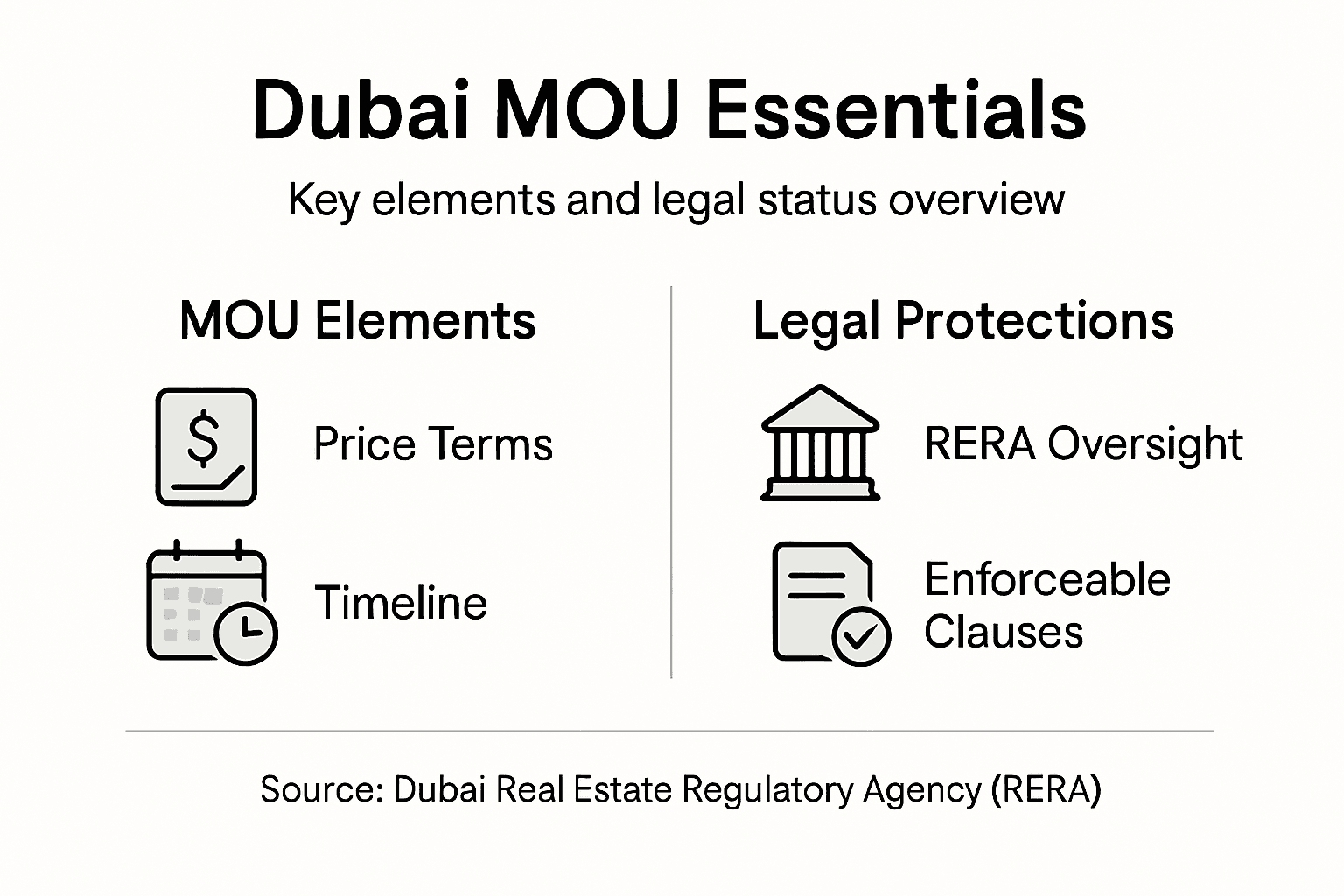
When you sign an MOU in Dubai, you’re entering a regulated contract. The Real Estate Regulatory Agency (RERA) oversees this process. MOUs are legally binding initial sale agreements that establish your rights and obligations as a buyer.
What the MOU Must Include
Your Dubai MOU requires specific elements by law:
Purchase price in AED: Exact amount without ambiguity
Payment plan with scheduled installments: Down payment percentage and due dates
Property identification: Plot number, building name, unit number, and location
Seller and buyer details: Legal names, contact information, and identification
Completion timeline: Expected handover date and registration deadline
Default consequences: What happens if either party fails to perform
Dispute resolution mechanism: Whether disputes go to court or arbitration
RERA Form F is the official template for MOUs in Dubai. This standardized document protects both parties and ensures compliance with local law.
In Dubai, an MOU is not preliminary—it creates binding obligations that require strict adherence to deadlines and payment schedules.
Legal Enforceability in Dubai Courts
Unlike MOUs in other jurisdictions, Dubai’s MOUs carry full legal enforceability. If you breach the MOU, the seller can pursue legal action in the Dubai Court System.
The seller can demand specific performance, requiring you to complete the purchase. Alternatively, they can claim damages if you withdraw. This is why clarity on contingencies matters significantly.
Legal requirements for Dubai expats include having proper visa status and bank authorization before signing. Verify your legal standing before committing.
Key Protections Built Into Dubai MOUs
The regulatory framework offers you protection:
Payment plan protection: Developers must hold funds in escrow accounts
Transparent pricing: No hidden fees beyond what’s stated in the MOU
Completion guarantees: Developers must complete within specified timelines
Registration deadlines: Clear requirements for transferring ownership
Dispute resolution: RERA mediation before court action
Failure to meet these deadlines can void the agreement entirely. This protects you from indefinite delays.
Timeline and Registration Requirements
Your MOU specifies exact dates for document submission and registration. Missing these deadlines creates liability. Most MOUs require registration within 30-90 days of signing.
You must submit documents like your passport copy, visa details, and bank statements within specified windows. Delays trigger penalties or potential deal cancellation.
Pro tip: Hire a local real estate attorney before signing your MOU to verify RERA compliance, clarify contingency language, and confirm all deadline dates align with your financing timeline—this prevents costly registration mishaps.
How MOUs Facilitate Real Estate Transactions
An MOU transforms a vague interest into a structured negotiation framework. It moves conversations from “maybe we can work something out” to concrete, documented terms that both parties understand and accept.
When you’re serious about a Dubai property, the MOU is your first major checkpoint. MOUs set clear expectations and responsibilities early in the transaction process, preventing costly misunderstandings later.
Creating Alignment Between Buyer and Seller
Before the MOU, buyer and seller operate on assumptions. The MOU eliminates guesswork by documenting exactly what each party will do.
For international investors, this alignment matters enormously. You might assume the developer will complete by year-end. The developer might assume you’ll secure financing by mid-year. The MOU captures these expectations in writing.
Specific benefits include:
Clear payment schedules: Exact dates when you pay installments
Defined roles: Who handles permits, inspections, and registrations
Transaction milestones: When ownership transfers, how disputes resolve
Contingency windows: How long you have to satisfy financing or inspection conditions
Reducing Risk Through Documentation
A documented agreement protects you from verbal promises that evaporate. If the developer claims they never agreed to a specific handover date, your MOU proves otherwise.
MOUs promote transparency and enhance trust between parties, which is critical when dealing with international time zone differences and language nuances. Everything is in writing, in English, signed by both parties.
This documentation also speeds up the next phase. Your legal team can draft the formal contract faster because the MOU has already settled major terms.
Streamlining Toward Final Contracts
Without an MOU, negotiating the formal contract becomes chaotic. You’d be revisiting payment terms, deadlines, and contingencies all over again.
The MOU gives negotiators a roadmap. The formal contract simply expands on what the MOU already established. This acceleration matters when market conditions shift or financing windows close.
Complex Multi-Party Transactions
If your purchase involves co-investors, family members, or corporate entities, the MOU clarifies everyone’s role. Who has decision-making authority? Who manages finances? Who communicates with the developer?
These questions get answered in the MOU before lawyers start drafting.
Building Confidence for Financing
Your lender won’t proceed without clear transaction documentation. An MOU demonstrates you’ve negotiated seriously and secured agreement from the seller on critical terms.
Banks review MOUs to confirm property details, purchase price, and payment schedule align with their lending criteria. The MOU essentially pre-approves your transaction structure.
Pro tip: Request a meeting with your real estate agent and legal counsel specifically to review the MOU draft before submitting it—catching ambiguous language, missing contingencies, or unfavorable terms at this stage costs nothing compared to renegotiating after signing.
Common Mistakes and How to Avoid Them
MOU mistakes cost money. And time. And sometimes entire deals fall apart because investors overlooked critical language or misunderstood what they actually signed.
You’re not the first international investor to make these errors. But learning from others’ mistakes saves you significant headaches during your Dubai property purchase.
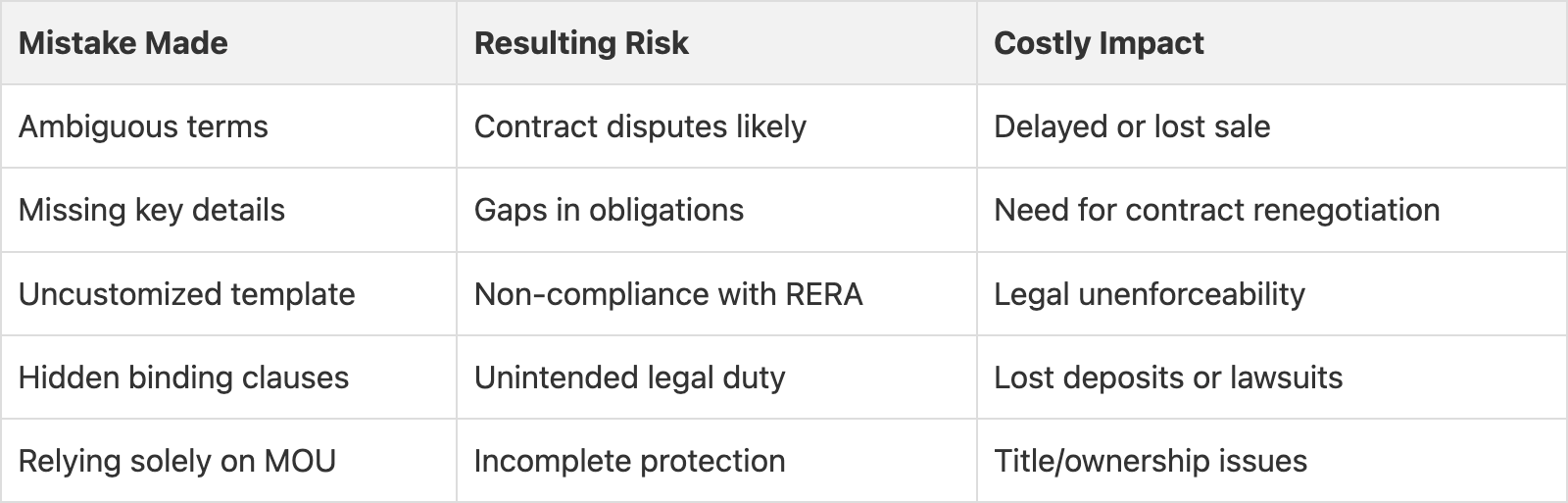
Mistake 1: Vague or Ambiguous Language
The worst MOUs use fuzzy terms. “Property shall be completed around year-end.” What does “around” mean? August? December? This ambiguity creates disputes.
Common MOU mistakes include vague terms and failure to detail key elements. Avoid this by insisting on specific dates, exact payment amounts in AED, and precise property descriptions.
For example, write “Handover by December 31, 2025” instead of “late 2025.” Write “AED 1,850,000” instead of “approximately AED 1.8 million.”
Mistake 2: Missing Critical Transaction Details
Your MOU must include every material term. Missing details create problems later when the formal contract gets drafted.
Essential elements you must document:
Property identification: Plot number, building name, unit type, exact location
Payment schedule: Down payment percentage, installment dates, final payment amount
Completion timeline: Specific handover date with buffer for delays
Contingency conditions: How financing approval affects your obligations
Default remedies: What happens if either party breaches
Dispute resolution: Mediation through RERA before court action
When details are missing, you’re negotiating them all over again in the formal contract stage.
Mistake 3: Using Generic Templates Without Customization
Downloading a generic MOU template from the internet and filling in blanks doesn’t work. Dubai real estate has specific regulatory requirements that templates don’t address.
Your MOU must comply with RERA Form F standards. Generic templates often miss local requirements or include clauses that conflict with UAE law.
Mistake 4: Accidentally Creating Binding Clauses
Some investors think they’re signing a preliminary document, then discover certain clauses are legally binding. Payment obligations, for instance, are often binding even in “non-binding” MOUs.
The solution is clarity. Your MOU should explicitly state which sections are binding and which are not. Typical binding sections include confidentiality, payment commitments, and earnest money deposits.
Mistake 5: Treating the MOU as a Final Contract
The MOU is a stepping stone, not a finish line. Some investors skip the formal contract stage, thinking the MOU is sufficient.
This creates massive problems. The MOU lacks the legal specificity, title guarantees, and regulatory disclosures that formal contracts require. You need both documents.
The table below highlights common mistakes with MOUs and their long-term consequences:
How to Avoid These Mistakes
Your defense strategy:
Hire a local real estate attorney familiar with RERA requirements
Request a customized MOU template, not a generic one
Document every material term with specific dates and amounts
Clearly label binding versus non-binding sections
Never sign without legal review, regardless of seller pressure
Confirm all contingencies align with your financing timeline
The time you invest reviewing your MOU before signing prevents costly disputes during the contract stage or after ownership transfers.
Pro tip: Budget 2-3 weeks for MOU negotiation and legal review instead of rushing through in days—investors who allocate proper time catch ambiguous language, missing contingencies, and unfavorable terms that otherwise create expensive complications later.
MOU Versus Other Property Agreements
Dubai’s real estate transactions involve multiple agreement types. Understanding the differences between them prevents confusion and protects your interests. Each document serves a distinct purpose at different transaction stages.
The MOU is your first formal agreement. But it’s not your last. You’ll encounter letters of intent, purchase agreements, and formal sale contracts before closing. Knowing when to use each one matters significantly.
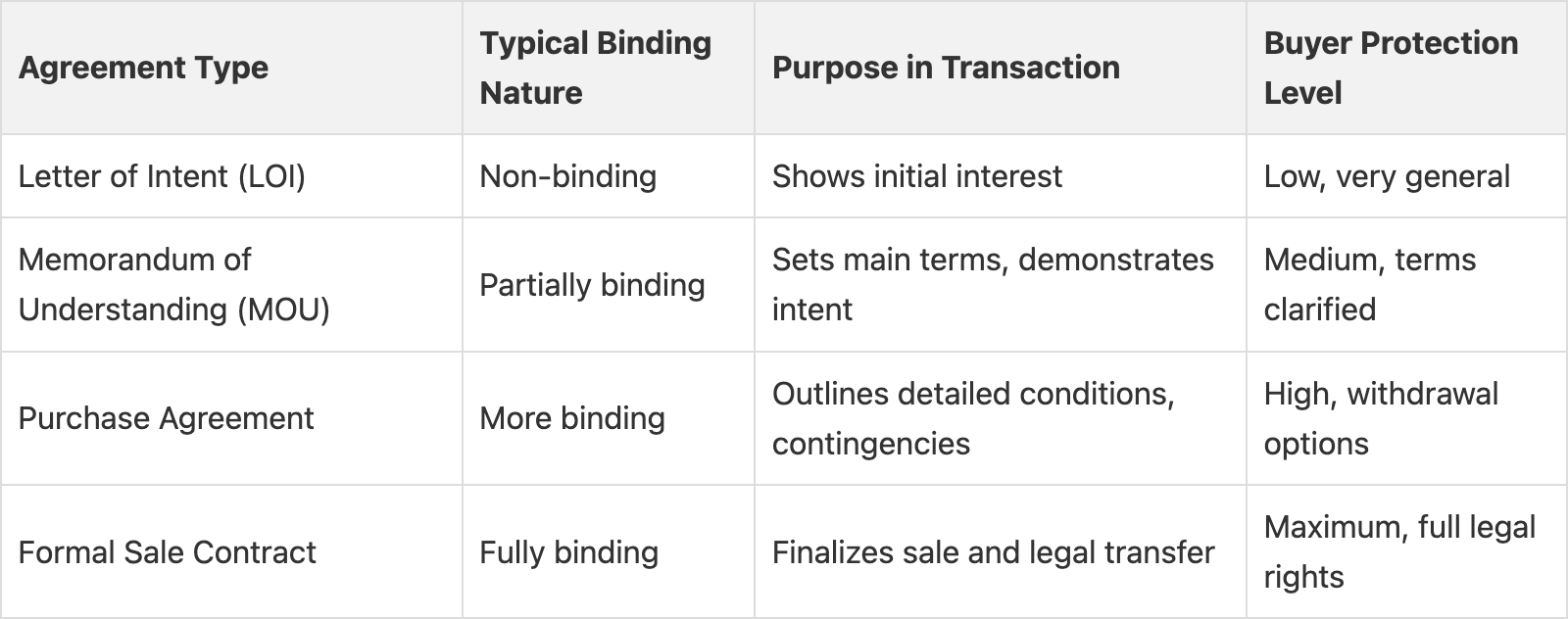
Here’s a quick comparison of the main real estate agreement types in Dubai:
MOU Versus Letter of Intent
A Letter of Intent (LOI) comes before an MOU. It’s even more preliminary. The LOI expresses general interest without committing to specifics.
An MOU, by contrast, documents agreed-upon terms. It’s more formal and detailed than an LOI. When a developer asks for an MOU, they want specifics: price, payment schedule, and timeline.
The LOI might say “I’m interested in purchasing a 2-bedroom apartment.” The MOU says “I agree to purchase Unit 5B for AED 1,850,000 with a 20% down payment by March 15, 2025.”
MOU Versus Binding Sales Contract
This distinction matters legally. The key difference lies in legal enforceability. An MOU outlines intentions and is typically non-binding. A sales contract is legally binding and enforceable.
In Dubai, however, the RERA-regulated MOU (Form F) has binding elements. Your payment obligations and earnest money deposit are enforceable. But contingency clauses and exit conditions may not be.
The formal sales contract, by contrast, binds every provision. Miss a payment date, and the developer can sue. Fail to complete, and you lose your deposit plus damages.
Key Differences in Enforceability
Understanding enforceability prevents costly surprises:
MOU: Binding on payment terms, non-binding on contingencies (typically)
Sales contract: Binding on all terms, every date, every condition
Purchase agreement: Binding framework, more flexible on specific performance
MOUs provide a base for early-stage discussion while contracts solidify duties. This is why you need both documents in the transaction sequence.
MOU Versus Purchase Agreement
A Purchase Agreement sits between the MOU and the formal contract. It’s more detailed than an MOU but less formal than a notarized contract.
Purchase agreements typically include financing contingencies, inspection periods, and title verification timelines. They’re more protective for buyers because they allow you to withdraw if conditions aren’t met.
In Dubai transactions, you might see Purchase Agreement language incorporated into the MOU itself, especially for off-plan purchases.
MOU Versus Formal Sale Contract
The Formal Sale Contract is your final, legally definitive document. Once signed and registered, you own the property. This contract includes:
Complete property description and ownership history
Title guarantees and disclosure of any encumbrances
Payment schedule with specific due dates
Consequences for breach or default
Dispute resolution procedures
Regulatory compliance certifications
You cannot back out of a formal sale contract without losing your deposit and facing legal claims.
Why You Need Multiple Documents
Each document protects different interests at different stages:
MOU: Confirms serious intent and preliminary terms
Purchase Agreement: Adds buyer protections and contingency windows
Formal Contract: Creates binding obligation and legal remedies
Registration: Transfers legal ownership
Each agreement type serves a purpose—rushing to formal contracts without an MOU leaves key terms unresolved, while staying in MOU stage too long delays your investment.
Pro tip: Never skip the MOU stage to save time, and never assume the MOU replaces the formal contract—structure your transaction with all three documents, with legal review at each stage, to ensure protection and compliance with RERA requirements.
Navigate Your Dubai Real Estate Journey with Confidence Using Expert MOU Guidance
Understanding the critical role of a Memorandum of Understanding in Dubai’s real estate transactions is essential to protect your investment and avoid costly mistakes. Whether you are dealing with binding terms, contingency windows, or payment schedules, the complexities can overwhelm even seasoned investors. Key challenges include deciphering legal obligations, ensuring regulatory compliance, and aligning timelines perfectly with your financing plans. If you want to confidently negotiate your MOU and secure your property under Dubai’s strict Real Estate Regulatory Agency rules you need expert guidance.

Don’t let unclear MOUs or overlooked contingencies put your investment at risk. Leverage Anthony Joseph’s award-winning expertise to navigate these complexities smoothly. Visit Anthony Joseph’s official website for tailored real estate services including off-plan investments, property sales, and legal advisory. Review detailed guidance on legal requirements for Dubai expats and explore strategic investment advantages that safeguard your interests. Act now to schedule a consultation and transform your Dubai property ambitions into a secure, rewarding reality with trusted professional support.
Frequently Asked Questions
What is an MOU in real estate transactions?
An MOU, or Memorandum of Understanding, is a formal document that outlines the intentions and preliminary terms between parties interested in a real estate transaction. Unlike a binding contract, it expresses agreement without imposing strict legal obligations.
How does an MOU function in real estate deals?
An MOU provides a structured framework for initial discussions between buyers and sellers. It documents mutual understanding regarding property details, proposed price, payment terms, and timelines before proceeding to formal contracts.
What key components should be included in an MOU?
An effective MOU should include transaction scope, proposed price and payment terms, a timeline for the deal, identification of parties involved, contingencies, and indicators of good faith such as earnest money.
Is an MOU legally binding?
In many jurisdictions, including certain regulations, an MOU can have binding elements, particularly regarding payment obligations and conditions. However, it is generally seen as a preliminary agreement, and the terms of enforceability can vary, so clarity on which terms are binding is crucial.


