
The Guide to Property Management in Dubai
Owning property in Dubai offers promising returns, but managing real estate from abroad presents unique challenges for high-net-worth expatriates and international investors. The rules set by the Dubai Land Department and Real Estate Regulatory Agency outline the standards required to protect assets and maximize investment value. Understanding what property management in Dubai really means helps you maintain legal compliance, safeguard rental income, and build long-term wealth while delegating daily responsibilities to trusted professionals.
Table of Contents
What Property Management Means in Dubai
Property management in Dubai refers to the comprehensive oversight and operation of real estate assets on behalf of property owners. Think of it as the operational backbone of your investment. When you own property in Dubai, managing it goes far beyond collecting rent and fixing broken air conditioners. It encompasses tenant relations, maintenance coordination, financial administration, lease compliance, and ensuring your property meets all regulatory requirements set by local authorities.
The Dubai Land Department works closely with the Real Estate Regulatory Agency to establish the framework within which property managers operate. Property management operations require strict adherence to Dubai’s real estate laws and regulations, designed to protect both property owners and tenants. This regulatory environment exists to create a transparent, competitive, and investor-friendly marketplace. For international investors like yourself, understanding this framework is critical because it directly impacts how your property generates income, maintains its value, and operates legally within the emirate.
In practical terms, property management in Dubai involves several interconnected responsibilities. You need professionals handling tenant screening and placement, ensuring rental payments arrive on schedule, managing maintenance requests from routine upkeep to emergency repairs, keeping detailed financial records for tax purposes, and staying current with changing regulations that affect your property. Whether your investment is residential, commercial, or industrial, a property manager acts as your representative, protecting your interests while maintaining occupant satisfaction. For many expatriate investors who split their time between Dubai and home countries, this hands-off approach to management transforms real estate from a demanding operational challenge into a strategic income-producing asset.
The distinction between passive ownership and active property management matters significantly for your investment outcomes. Without professional management, you risk tenant disputes, late payments, maintenance backlogs, and compliance violations that could expose you to penalties. With proper management in place, your property operates smoothly, maintains its market value, and generates consistent returns. For high-net-worth investors focused on portfolio diversification rather than day-to-day operations, this outsourced approach allows you to benefit from Dubai’s real estate appreciation while delegating the administrative burden to qualified professionals.
Pro tip: When evaluating property managers in Dubai, verify their understanding of both Dubai Land Department regulations and RERA requirements, as compliance expertise directly impacts your investment protection and tax efficiency.
Major Types of Property Management Services
Property management services in Dubai break down into distinct categories, each tailored to different property types and investor objectives. The scope varies dramatically depending on whether you own a studio apartment, a commercial office tower, or an industrial warehouse. Understanding these service categories helps you select the right management partner and ensures your specific property needs receive appropriate attention. Most professional property managers in Dubai specialize in one or more of these areas, so alignment between your property type and their expertise directly impacts your investment performance.
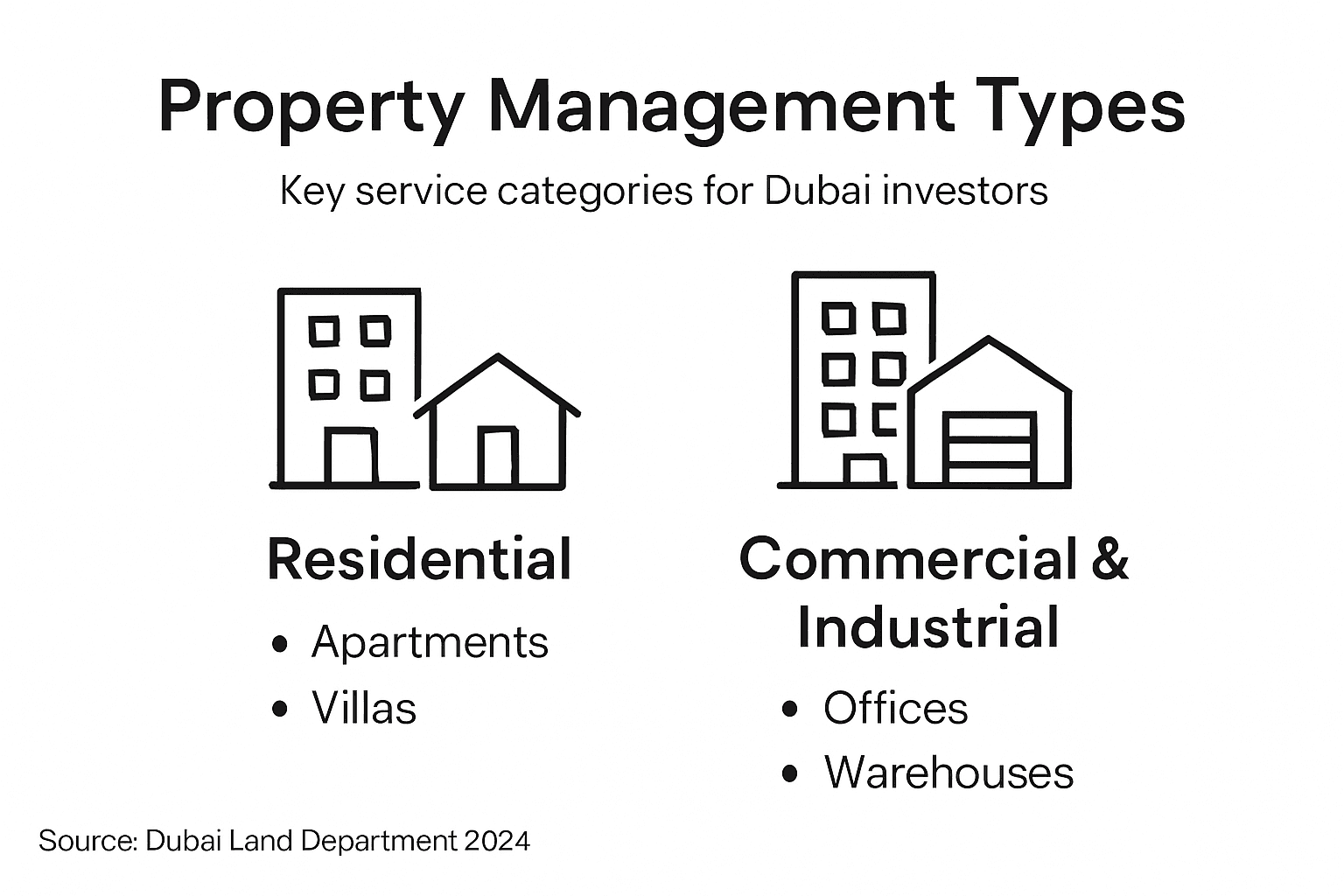
Residential Property Management serves apartment owners, villa landlords, and multi-unit residential investors. This service type focuses on tenant screening and selection, ensuring reliable occupants who pay rent consistently and respect lease terms. Your manager handles month-to-month operations including rent collection, processing tenant complaints, coordinating routine maintenance like air conditioning servicing and plumbing repairs, and managing lease renewals. For expatriate investors in Dubai, residential management also includes handling tenant disputes, security deposit accounting, and ensuring compliance with tenant rights under Dubai law. The goal centers on maximizing occupancy rates while minimizing problematic tenants and operational disruptions.
Commercial Property Management operates differently because the stakes and complexities escalate significantly. You’re managing office spaces, retail storefronts, shopping centers, or mixed-use developments where tenants range from small businesses to multinational corporations. Commercial property management services emphasize sophisticated lease agreements, facility management coordination, tenant retention strategies, and sophisticated financial reporting. Commercial managers negotiate lease terms, manage common area maintenance, oversee building security systems, coordinate utility management across multiple tenants, and often handle marketing to attract high-caliber tenants. This service category demands deep understanding of commercial real estate markets, as competitive positioning and lease terms directly affect your rental yields.
Industrial and Land Property Management addresses a specialized segment where operational efficiency matters most. Industrial facilities require management of heavy equipment, safety compliance, environmental regulations, and specialized maintenance. Land management involves different considerations entirely, focused on asset preservation, long-term value appreciation, and potential future development. Both require managers with specific expertise in these property classes.
Here is a comparison of the major property management service categories in Dubai:

Supporting Services That Enhance Management
Beyond property type specific management, sophisticated property managers offer complementary services that strengthen your overall investment position. Financial reporting and accounting provides transparent visibility into income, expenses, and net returns on your property. Legal compliance support ensures your property meets evolving Dubai regulations, protecting you from penalties and operational disruptions. Marketing and tenant acquisition helps maintain high occupancy by attracting quality tenants to vacant units. Preventive maintenance programs reduce emergency repairs by addressing issues before they become costly problems.
Facility management represents another critical dimension, especially for commercial and industrial properties. This encompasses managing physical infrastructure like HVAC systems, security systems, cleaning services, and general maintenance that keeps your property functioning safely and efficiently. Facility managers divide their work between hard FM, which covers infrastructure elements like mechanical systems, and soft FM, which involves services supporting occupants like cleaning and security.
Choosing the Right Service Mix
Your investment strategy determines which services matter most. A Dubai villa owner focused on steady rental income needs different services than a commercial real estate investor managing a business park. Some investors prefer comprehensive all-inclusive management where one firm handles everything. Others pick specialized managers for specific functions. The key is matching service offerings to your property type, investment timeline, and personal involvement preferences.
Pro tip: Request detailed service matrices from property managers showing exactly which services are included at each management tier, then compare against your specific property requirements and investment goals to avoid paying for unnecessary services or discovering gaps during operations.
How Property Management Works Day to Day
Property management operates as a continuous cycle of interconnected tasks designed to keep your investment generating income while maintaining its physical and financial health. The daily reality differs sharply from the passive ownership many investors imagine. Your property manager essentially becomes the operational brain of your real estate asset, making decisions, solving problems, and handling interactions that would otherwise consume your time and attention. Understanding this workflow helps you appreciate what professional management delivers and why it justifies the management fees you pay.
The foundation of daily operations rests on tenant communications and rent collection. Your manager maintains ongoing contact with occupants, addressing concerns about maintenance issues, noise complaints, or lease clarifications. When rent is due, professional managers ensure payment arrives on schedule through multiple collection channels and follow-up procedures that reduce delinquencies. This isn’t simply waiting for deposits to appear in your account. Effective managers track payment patterns, identify tenants showing early signs of financial trouble, and initiate appropriate actions before rent arrears accumulate into serious problems. Rent collection and lease enforcement form the backbone of cash flow consistency that makes property investment viable.
Maintenance coordination represents another critical daily function. Your property manager receives maintenance requests from tenants, assesses their urgency, schedules contractors, verifies work quality, and processes invoices. A broken air conditioning unit in Dubai heat isn’t a minor inconvenience. It demands immediate action to prevent tenant dissatisfaction and potential lease violations. Property managers maintain relationships with reliable contractors across multiple service categories, negotiate favorable pricing through volume, and prevent tenants from calling expensive emergency services when less costly standard maintenance can resolve issues. They also implement preventive maintenance schedules that catch problems before tenants even notice them. This proactive approach saves money and preserves your property condition.
The Financial and Compliance Side
Behind the scenes, property managers track expenses meticulously. Every maintenance cost, utility charge, and operational expense gets categorized and recorded. Daily management responsibilities include handling maintenance requests, managing expenses, and preparing financial reports that give you clear visibility into your property’s financial performance. This accounting matters because it reveals which operational costs can be optimized and which revenue opportunities might be overlooked. Your manager prepares monthly or quarterly financial statements showing income received, expenses incurred, and net cash flow. For investors with multiple properties, this organized financial tracking is indispensable.

Compliance runs parallel to these operational functions. Dubai’s real estate regulations evolve continuously. Your property manager stays current with tenant protection laws, tax requirements, insurance obligations, and safety standards. They ensure your property inspection records are maintained, that safety equipment functions properly, and that lease terms align with current legal requirements. This compliance work prevents costly penalties and legal disputes that could otherwise derail your investment returns.
Tenant Relations as Strategic Asset Protection
Tenant satisfaction directly impacts your property’s profitability and longevity. Happy tenants renew leases, maintain units carefully, and don’t file complaints with regulatory authorities. Your manager acts as the relationship manager, balancing owner interests with tenant needs. They enforce lease terms consistently while remaining professionally cordial. This requires judgment and people skills that separate excellent property managers from mediocre ones. When disputes arise between tenants or when lease violations occur, your manager handles these situations with documentation and professional process rather than personal confrontation.
Pro tip: Request weekly or monthly management reports from your property manager that detail tenant communications, maintenance activities, and expenses, allowing you to identify operational trends and verify that your investment is receiving the attention it deserves.
Legal Foundation and RERA Compliance Requirements
Property management in Dubai doesn’t operate in a regulatory vacuum. Every transaction, every tenant interaction, and every financial decision sits within a legal framework established by the Real Estate Regulatory Authority. RERA functions as the enforcement mechanism that ensures property managers, investors, and tenants all play by established rules. Understanding this legal foundation isn’t optional for serious investors. It’s the difference between protecting your investment and exposing yourself to penalties, disputes, and operational disruptions that can derail your financial objectives.
The Real Estate Regulatory Authority (RERA) serves as the central governing body for all real estate activities in Dubai. This agency, operating under the Dubai Land Department, establishes and enforces the regulations that property managers must follow. RERA regulates real estate activities including tenant protections, professional licensing, brokerage conduct, and escrow account management. When you hire a property manager in Dubai, that manager must hold a valid RERA license. This licensing requirement exists to ensure property managers meet professional standards, maintain ethical conduct, and operate transparently. For you as an investor, this regulatory oversight provides assurance that your manager operates under established rules with enforcement mechanisms backing them up.
The legal framework governing property management in Dubai operates through multiple interconnected regulations. Law No. (4) of 2019 Concerning the Real Estate Regulatory Agency establishes RERA’s specific authority and operational structure, defining how the agency enforces regulations and protects stakeholders. This law mandates that property managers implement transparency mechanisms, maintain proper financial accounting, and establish accountability measures for tenant funds. Beyond the RERA legislation itself, property managers must comply with Dubai’s Tenancy Laws, which establish tenant rights, eviction procedures, dispute resolution processes, and rent increase limitations. These protections exist to prevent exploitation while also protecting property owners from problematic tenants who fail to uphold lease obligations.
Critical Compliance Areas for Property Managers
Your property manager’s RERA compliance responsibilities span several critical areas that directly affect your investment security. Understanding these helps you verify that your manager operates properly and protects your interests.
Escrow Account Management requires that security deposits from tenants be held in designated RERA-regulated accounts, separate from operational funds. This prevents property managers from using tenant deposits as business capital and ensures funds are available for legitimate purposes like damage repairs or unpaid rent. Your manager must provide transparent accounting of these funds and return them promptly when lease terms end.
Lease Documentation must comply with RERA standards. Leases must include specific terms regarding rent amounts, payment due dates, maintenance responsibilities, and dispute resolution procedures. RERA provides standardized lease templates that incorporate required protections for both parties. Your property manager should ensure your leases follow these standards, protecting you from disputes based on missing or non-compliant contract language.
Tenant Relations and Dispute Resolution operate within RERA frameworks that favor mediation and documented processes over informal arrangements. When disputes arise between you and tenants, your manager must follow RERA procedures for documenting issues, providing written notice to tenants, and allowing response periods before taking enforcement actions. This procedural protection, while sometimes frustrating for investors wanting immediate action, prevents costly legal challenges based on procedural violations.
Financial Reporting and Tax Compliance require that property managers maintain detailed records of all income and expenses associated with your property. These records support your personal or corporate tax filings and help verify that management fees are reasonable and properly documented. RERA regulations mandate transparency in all financial dealings related to property management.
Why Compliance Matters for Your Investment
Non-compliance with RERA requirements exposes you to serious consequences. RERA can impose fines on property managers who violate regulations, and in serious cases, revoke their licenses entirely. If your property manager loses licensing, you lose professional management immediately and face disruption to your cash flow. More importantly, tenants can file complaints with RERA if they believe their rights have been violated. These complaints trigger investigations that can result in fines to your manager, damaged professional reputation, and potential liability for you as the property owner.
Property managers operating under RERA oversight provides you with recourse mechanisms when problems arise. If your manager mishandles funds, fails to maintain your property, or violates lease terms, you can file complaints with RERA, which has enforcement authority. This regulatory oversight creates accountability that protects your investment from manager misconduct.
Pro tip: Before hiring a property manager, verify their RERA license through the official Dubai Land Department website, request references from existing clients, and review their documented compliance procedures for escrow accounts, lease management, and financial reporting.
Costs, Fees, and Common Investor Pitfalls
Property management isn’t free, and understanding what you’ll pay separates realistic investors from those who get blindsided by expenses eroding their returns. Management fees represent just one component of the costs associated with professional property oversight. The real challenge lies in distinguishing between reasonable, market-rate fees and situations where you’re overpaying for underdelivered services. Even more critical is understanding the ancillary costs that catch many Dubai investors off guard, transforming what seemed like an attractive yield into disappointing net returns.
Management fees typically range from 4 to 8 percent of monthly rental income in Dubai, depending on property type and service scope. A residential villa generating 120,000 AED annually would incur management fees between 4,800 and 9,600 AED yearly. Commercial properties often command lower percentage fees due to higher absolute rental amounts, while smaller residential units may face higher percentages because fixed costs must be recovered across smaller income bases. Beyond the basic management fee, you’ll encounter additional charges for specific services. Lease preparation might cost 300 to 500 AED per document. Tenant eviction procedures, when necessary, can run 2,000 to 5,000 AED depending on complexity and legal requirements. Emergency maintenance call-outs often include surcharges on top of the actual repair costs. These à la carte charges add up quickly, particularly if your property experiences tenant turnover or significant maintenance issues.
The most overlooked cost category involves service charges and municipal fees that accumulate outside your manager’s direct control. Apartment buildings in Dubai impose service charges covering common area maintenance, security, utilities for shared spaces, and facility management. These charges often increase 5 to 10 percent annually as building maintenance costs rise. If you own a villa in a community with homeowners associations, similar fees apply for common facilities maintenance. Additionally, municipal fees for water, electricity, and waste management represent separate ongoing costs. Property owners sometimes discover outstanding service charges have accumulated, creating legal complications and payment enforcement actions. RERA’s Tayseer initiative exists specifically because many property owners face overwhelming service charge debt, offering installment plans to settle accumulated fees. The existence of this program underscores how common this pitfall is among investors who failed to budget adequately for these expenses.
The following table summarizes typical costs and financial considerations for Dubai property investors:

Common Investor Pitfalls That Erode Returns
Underestimating maintenance costs represents the most frequent miscalculation. Investors calculate rental yield based on gross rent, then subtract a percentage for management fees and assume everything else will be minimal. In reality, air conditioning systems fail in Dubai heat, plumbing deteriorates, and unforeseen repairs emerge. Properties built during economic downturns often have deferred maintenance that suddenly demands attention. A realistic maintenance budget should represent 8 to 12 percent of annual rental income for residential properties, and potentially higher for older buildings. Many investors allocate only 3 to 5 percent, creating cash flow crises when major repairs become necessary.
Vacancy periods catch investors off guard with surprising frequency. You might calculate yield assuming 100 percent occupancy, but reality involves tenant turnover, gaps between leases, and potential periods where properties sit vacant during market softness. A realistic assumption targets 92 to 95 percent occupancy rates, meaning you budget for 5 to 8 percent of the year without rental income while still incurring fixed costs like service charges and property taxes. New investors often don’t account for turnover costs including marketing expenses, lease preparation, and professional cleaning between tenants.
Regulatory compliance costs evolve as Dubai’s regulations change. New fire safety equipment requirements, environmental compliance upgrades, or security system modernization can require significant expenditures. Your property manager should flag these requirements early, but proactive investors budget contingency reserves rather than treating compliance costs as unexpected emergencies.
Poor manager selection amplifies all other costs. A budget-oriented manager charging below-market fees might skimp on maintenance, leading to tenant complaints, early lease terminations, and deteriorating property condition. Conversely, high-fee managers sometimes overcharge for minor repairs or inflate service delivery claims. Interviewing multiple property managers, requesting detailed fee structures, and checking references prevents selecting managers whose cost profile creates false economy.
Building a Realistic Financial Model
Successful Dubai investors model property economics transparently. Start with gross annual rental income. Subtract management fees at the upper range you’ve quoted. Subtract realistic maintenance reserves at 10 percent minimum. Subtract service charges and municipal fees in full. Subtract vacancy contingency at 5 to 8 percent. Subtract insurance and any property taxes applicable. What remains represents your actual net return. This conservative approach prevents unpleasant surprises and helps you identify properties where the fundamental economics genuinely support your investment timeline and return objectives.
Pro tip: Request detailed fee schedules from property managers showing all charges including management percentage, service call-out fees, lease preparation costs, and tenant eviction procedures, then compare total fee obligations across managers rather than focusing only on the base management percentage.
Unlock the Full Potential of Your Dubai Property Investment with Expert Management
Navigating the complexities of property management in Dubai requires more than just collecting rent. The challenges of tenant screening, maintenance coordination, and strict RERA compliance can overwhelm investors, especially those residing outside the country. You deserve a trusted partner who understands the regulatory framework, maximizes occupancy, and protects your investment from costly pitfalls like late payments and escalating service charges. Anthony Joseph offers a strategic, hands-on approach tailored to your property’s unique needs, ensuring your asset remains a consistent income generator while complying fully with Dubai’s real estate laws.

Take control of your real estate success today by connecting with a proven expert. Explore comprehensive solutions including property management, off-plan investments, and business setup at Anthony Joseph portal. Discover how professional management transforms your Dubai property into a worry-free, growth-focused asset. Visit https://anthonyjosephaj.com now to get started and ensure your investment thrives under skilled, compliant stewardship.
Frequently Asked Questions
What is property management in Dubai?
Property management in Dubai involves the comprehensive oversight of real estate assets, including tenant relations, maintenance coordination, financial administration, and ensuring compliance with local regulations.
What are the main responsibilities of a property manager in Dubai?
A property manager in Dubai is responsible for tenant screening, rent collection, maintenance requests, financial accounting, and adhering to local real estate laws, ensuring the property operates smoothly and efficiently.
How does professional property management benefit investors?
Professional property management helps investors reduce operational burdens, minimize legal risks, maintain property value, and ensure consistent rental income by effectively managing tenant relations and property upkeep.
What types of property management services are available in Dubai?
In Dubai, property management services can be categorized into residential, commercial, and industrial management, each tailored to the specific needs of the property type and client objectives.


